Shielding Door Lead Equivalent: Match mmPb to Your Room Type
A shielding door looks like any other door until you read the spec sheet. The number that matters most is not the width or the surface finish. It is the lead equivalent, written as mmPb. Get it wrong and the room fails its radiation inspection. Get it needlessly high and you pay for weight, hardware, and structural reinforcement you never required.
This guide shows how to match the lead equivalent to your actual room instead of copying a neighboring department's door. The method applies to new builds, renovations, and equipment upgrades across hospitals, dental clinics, imaging centers, and industrial radiography rooms.
What Lead Equivalent (mmPb) Actually Means
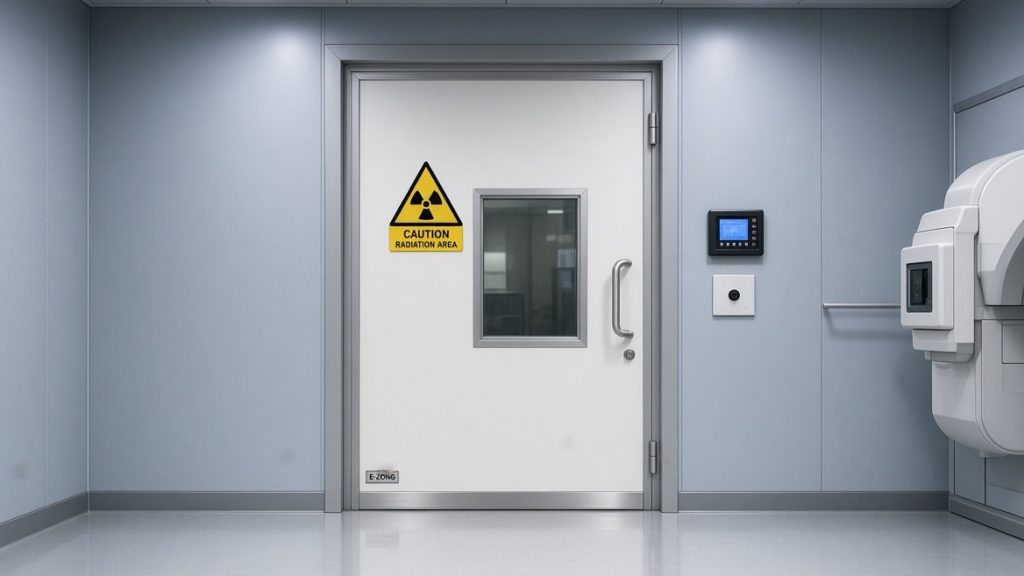
Lead equivalent is a thickness comparison, not a material claim. A door rated at 2 mmPb blocks radiation the same way a solid 2 mm sheet of pure lead would. The door leaf rarely contains solid lead. It carries a lead sheet, a lead-free high-density composite, or a hybrid core that reaches the same attenuation.
Lead works because its atomic number is 82, the highest of any stable, workable metal. That density lets it absorb X-ray and gamma photons efficiently. A thin layer does what would take a much thicker slab of steel or concrete.
The trap is assuming thicker is always safer. A 3 mmPb door over a 1.5 mmPb requirement adds mass, cost, and load on hinges or tracks with no safety gain. The goal is to meet the calculated need, then stop.
The Four Inputs That Decide Your mmPb
Your door's lead equivalent is not a catalog choice. It is the output of a shielding calculation built on four inputs.
- Maximum tube voltage (kVp). Higher energy photons penetrate more. A panoramic dental unit near 60 to 90 kVp needs far less barrier than a CT scanner at 140 kVp or an interventional suite running sustained high kVp.
- Weekly workload. This is how much radiation the equipment produces, expressed as mA per minute per week. A busy DR room imaging hundreds of patients needs more shielding than a low-volume exam room, even with the same tube voltage.
- Occupancy factor (T). A barrier next to a staffed control room (high occupancy) demands more shielding than a barrier against a storage closet (low occupancy). The factor scales the acceptable dose by how often a person sits on the other side.
- Distance (d). Radiation weakens with the square of distance from the source. A door 3 meters from the tube needs less shielding than one 1 meter away. Layout drives the number as much as the machine does.
These four values come from your equipment and your floor plan. They are the reason two rooms with the same machine can need different doors.
How the Calculation Works Without the Math Headache
In practice, a qualified medical physicist or shielding consultant runs the barrier calculation using a standard method such as NCRP Report 147. The report separates primary barriers (facing the useful beam) from secondary barriers (protecting against scatter and leakage). It sets dose limits such as 1.0 microsievert per week in public areas and 5.0 microsievert per week in occupational zones, then derives the required mmPb for each surface.
The door is one barrier in that set, sitting alongside the walls, the viewing window, and the ceiling or floor where applicable. You do not guess the door's mmPb. You read it from the shielding design report.
This is why copying another room's door is risky. Move the tube 2 meters, add a control room on the far side, or switch from 100 kVp to 140 kVp, and the correct mmPb changes.
Match mmPb to Room Type: A Working Reference
The table below gives indicative ranges seen in typical shielding reports. Treat them as a starting conversation with your physicist, not as a substitute for the calculation.
| Room type | Typical indicative lead equivalent |
|---|---|
| Dental X-ray (intraoral) | 1.0 mmPb |
| General radiography (DR) | 1.0 to 1.5 mmPb |
| CT scanner room | 2.0 to 3.0 mmPb |
| Interventional or DSA lab | 2.0 to 3.0 mmPb |
| Mammography | 0.5 to 1.0 mmPb (per shielding report) |
| Nuclear medicine or PET | Calculated individually per isotope and workload |
Two notes save projects. First, MRI suites use no ionizing radiation, so they need no lead shielding. They need RF shielding instead, which is a different system. Do not spec a lead door for an MRI room. Second, values shift with workload and layout, so the report always wins over the table.
For hospital imaging rooms specifically, the access, cleanability, and sealing requirements sit alongside shielding. Our guide on X-ray room doors for hospitals covers how shielding integrates with daily disinfection and patient flow.
Where Shielding Actually Fails: Seams, Not the Panel
Most leakage does not happen through the door panel center. It happens at the edges and penetrations, where the continuous shield breaks.
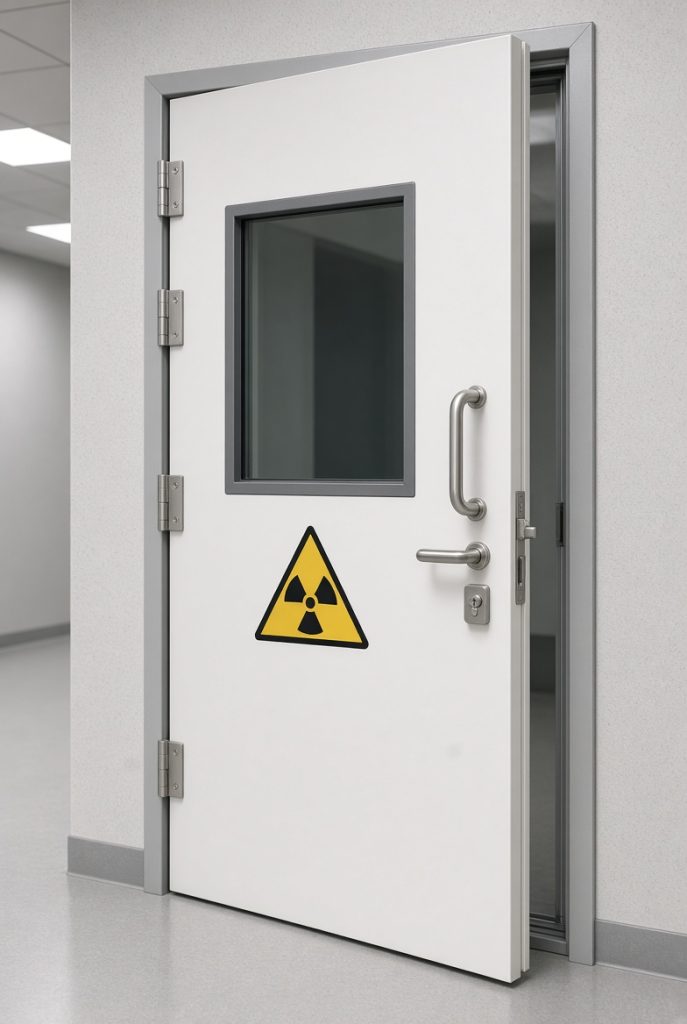
- Door-to-frame overlap should hold at least 20 mm on every side, using a labyrinth or stepped geometry rather than a flat butt joint.
- Hinge and latch points carry dynamic gaps, so hardware compensation typically runs 0.2 to 0.3 mmPb above the panel center using lead sleeves or high-density liners.
- The viewing window needs lead glass whose shield overlaps the core by at least 15 mm, framed in metal rather than set flush.
- The threshold and ceiling must connect to the room's floor and overhead shielding. A 50 mm overlap at the wall-to-frame joint prevents edge scatter.
- Cable penetrations need flexible shielding conduits or Z-shaped sleeves so they do not open a secondary leakage path.
A door can meet its mmPb on paper and still fail inspection if these details are skipped. E-ZONG builds shielding doorsets to this continuity standard, with the overlap, compensation, and lead-glass framing described above engineered into the leaf and frame as one assembly. The panel rating is only as good as the continuity around it.
Doorset Weight, Hardware, and Structure
Lead is dense, and density is mass. A 2 mmPb swing door can weigh tens of kilograms more than an unshielded steel door of the same size. That extra load lands on hinges, frames, and floor tracks.
For swing doors, specify heavy-duty or continuous hinges rated for the loaded leaf weight. For sliding lead doors, the track system must carry the mass without sag, and the embedded rail should sit in the structural slab to keep the shield continuous. Under-specifying hardware causes long-term droop, seal gaps, and reassessment costs. E-ZONG sizing reviews confirm hinge and track grades against the loaded leaf weight before production, so the structure matches the shield.
This is also where over-specifying hurts. Adding mmPb you do not need multiplies weight, hardware grade, and sometimes structural reinforcement of the wall opening. Match the number to the report and the budget follows.
Compliance and Acceptance Testing
Shielding designs reference documents such as NCRP Report 147 and product standards like IEC 61331-1, plus local regulatory codes. Compliance is proven at commissioning, not at purchase.
Acceptance testing uses a calibrated survey meter to grid-scan the door set along seams, hinges, the window, and the threshold. Common failures include incomplete lead lining around the frame, an unsealed threshold that lets scatter migrate, misaligned hardware compensation that creates a hot spot, and missing continuous gaskets around the glass. Our radiation shielding doors lead thickness code guide walks through the code references in more detail.
A 5-Step Workflow to Spec Your Shielding Door
- Pull the equipment spec sheet: maximum kVp and the manufacturer's workload estimate.
- Commission a shielding design report from a qualified physicist before you order the door.
- Read the mmPb required for each barrier, including the door, wall, and viewing window.
- Select the door construction (lead-lined sheet, lead-free composite, or hybrid) and confirm overlap, hardware compensation, and window shielding.
- Require an on-site acceptance test at commissioning and keep the report with your facility records.
E-ZONG supports this workflow as an ISO 9001-certified manufacturer with more than 26 years in cleanroom and hospital door systems, producing across facilities in Foshan, Dongguan, Zhongshan, and Taishan. For a buying decision on X-ray room doors, the lead thickness and compliance checklist helps confirm the spec before purchase.
If your room sits inside a classified environment, the door must also respect the surrounding cleanroom class limits so shielding and cleanliness do not work against each other.
Lead-Lined vs Lead-Free Composite: The Material Trade-off
Once the report gives your mmPb, you choose how to build it. Three constructions dominate hospital and lab shielding doors.
- Lead-lined sheet cores are the proven default. A rolled lead sheet sits inside a steel or HPL-faced leaf. Attenuation is predictable, and the material cost per mmPb is usually the lowest. The downside is weight: every extra mmPb adds a measurable load to hinges and tracks.
- Lead-free high-density composites use barium sulfate, tungsten, or bismuth resin. They reach the same mmPb at 20 to 35 percent less mass, which matters in renovations where the wall opening and hardware were never sized for a heavy leaf. They also meet RoHS and REACH limits, removing lead-handling concerns during fabrication and end-of-life.
- Hybrid laminated cores combine a steel frame with a lead-free core and localized lead foil at hot spots. E-ZONG uses this approach where a project needs both structural stiffness and weight control without sacrificing attenuation at penetrations.
The choice is not about which is best. It follows from weight budget, door operation (swing versus sliding), and whether the structure can carry the load. A qualified supplier sizes the construction to the report, not the other way around.
Common Specifying Mistakes That Fail Inspection
Most shielding-door failures trace back to a handful of repeat errors that are cheap to avoid at spec time.
- Copying a neighbor's mmPb instead of running a room-specific calculation.
- Forgetting the viewing window. A lead-glass panel must match the leaf mmPb and overlap the core, or it becomes the weakest point.
- Skipping hardware compensation at hinges and latches, where dynamic gaps need 0.2 to 0.3 mmPb extra.
- Treating an MRI room like an X-ray room and ordering lead where RF shielding belongs.
- Leaving the threshold or ceiling unsealed, so scatter migrates around the door rather than through it.
- Over-specifying mmPb just to be safe, which pushes weight and cost without raising compliance.
E-ZONG reviews each doorset against the shielding design report before production, so the leaf, frame, window, and hardware compensation are specified as one validated assembly rather than separate guesswork.
Reading the Shielding Design Report: What to Look For
The shielding design report is the document that decides your door. When you receive it, confirm four items before ordering.
First, the mmPb value stated per barrier, not just a single department number. Second, whether each barrier is primary (useful beam) or secondary (scatter and leakage), since that changes the margin. Third, the occupancy and distance assumptions, so you know the value holds for your actual layout. Fourth, any notes on penetrations, frames, and windows, because those are where the report's intent is easiest to lose during fabrication.
If the report lists a single mmPb for the X-ray room without breaking it down by surface, ask the physicist to separate door, wall, and window. A clean breakdown is what lets a manufacturer build the right assembly and pass acceptance on the first visit.
FAQs
Can I use one mmPb for the whole department?
No. Each barrier is calculated from its own tube voltage, workload, occupancy, and distance. A control room wall and a corridor door in the same suite often carry different values.
Does an MRI room need lead shielding?
No. MRI uses strong magnetic fields and radio frequency, not ionizing radiation. It needs RF shielding, not lead. A lead door adds weight and cost with no protection benefit there.
What if I upgrade to a higher-kVp machine later?
Re-run the shielding calculation. A higher tube voltage or workload can push the required mmPb above the original door rating, and the door may need replacement or a shielding upgrade.
How often must shielding be re-tested?
At commissioning, after any modification to the door or adjacent barrier, and on a periodic schedule set by your local code or radiation safety officer. Changes to use or equipment trigger a re-test.
Lead-lined vs lead-free composite: which should I pick?
Lead-lined is proven and often lower cost per mmPb. Lead-free composites (barium sulfate, tungsten, or bismuth resins) cut weight by 20 to 35 percent and meet RoHS and REACH limits, which helps in renovation projects where hardware and structure are constrained. The choice follows weight, budget, and compliance, not a fixed rule.
-
 Cleanroom Glass Windows Are The Key to Maintaining a Clean Environment
-
 Top Aluminium Profile Manufacturers in China: Leading the Global Market
-
 The Evolution of Air Tight Sliding Doors
-
 AHU Aluminium Profile: A Comprehensive Guide
-
 The Importance of Choosing the Right Cleanroom Door in Vietnam
-
 The Benefits of Hospital Automatic Doors: Enhancing Efficiency and Safety
-
 The Best Bathroom Door Manufacturers - Unlocking Endless Possibilities!
-
 Unlock the Possibilities with AJ Manufacturing Doors
-
 Make a Statement with Manufactured Home Interior Doors!
-
 what is aluminum profile? Aluminum Profiles for Your Home is the best option
-
 Laboratory Door Pressure: Positive vs Negative and Drop Seal
-
 Shielding Door Lead Equivalent: Match mmPb to Your Room Type
-
 Cleanroom Automatic Sliding Doors: Belt vs Magnetic Drive
-
 What Leak Rate Must a Hermetic Door Pass to Comply
-
 Hospital Door Costs 2026: What Drives the Price Tag
-
 Why Hospitals Pick Sliding Over Swing Doors in 2026
-
 Why Hospital Room Doors Need STC 35 for Wards 2026
-
 Cleanroom Doors: Replace or Retrofit? Save 40% on Cost
-
 Why Pharmaceutical Doors Fail VHP: Seal and Material Fixes
-
 Hospital Entrance Doors 2026: Touchless, ADA, Security Specs


-

Home
-

Tel
-

Email
-

Contact


Guangzhou Yizhong Aluminum Industry Co., Ltd.
We are always providing our customers with reliable products and considerate services.
We are always providing our customers with reliable products and considerate services.
Speak Your Mind