
Radiation Shielding Doors: Lead Thickness & Code Guide
Specifying a radiation shielding door leaves little room for error. Get it wrong and you're looking at failed inspections, delayed projects, and real safety risks for patients and staff.
Hospital imaging departments increasingly combine CT, X-Ray, and PET in shared suites, which makes radiation protection more complex. MRI adds another wrinkle: it doesn't use ionizing radiation at all, so the "shielding" requirements are fundamentally different.
This guide covers how to determine the correct lead equivalence ($1/32"$ to $3/8"$ Pb) for different imaging modalities. We'll walk through equipment-specific requirements, door configurations, interlocking systems, and NCRP 147 compliance so your project passes inspection the first time.
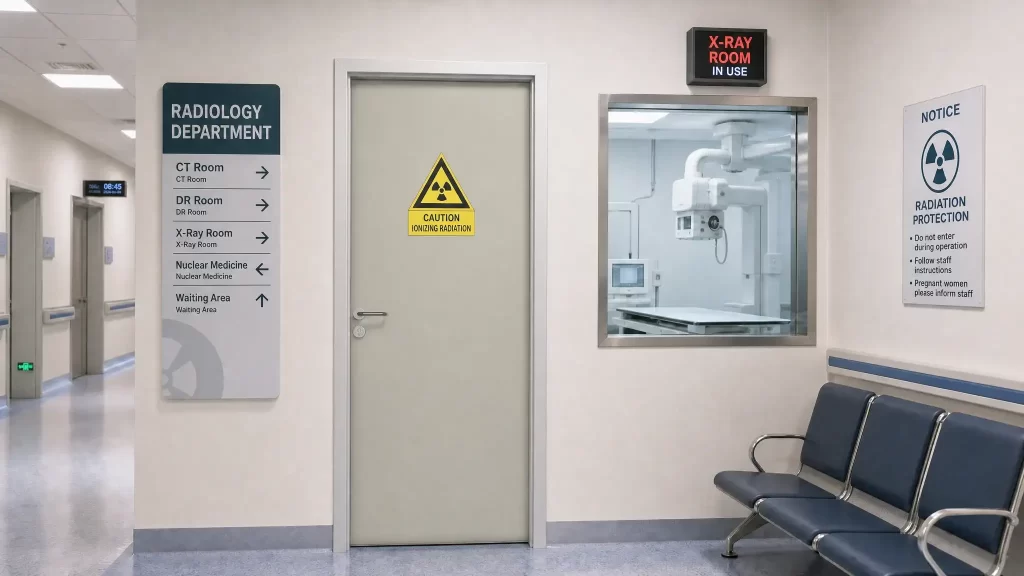
Understanding Lead Equivalence and Radiation Attenuation
Before selecting a medical radiation protection door, you need to know how its shielding effectiveness is measured.
What Is Lead Equivalence and How Is It Measured?
Lead equivalence (Pb eq) is the standard metric for radiation attenuation. A door rated at "$1/8\"$ Pb eq" means its composite materials (usually steel sheets with a lead core) attenuate radiation the same way 1/8th of an inch of pure lead would at a given X-ray energy level, typically 75 kVp or 100 kVp.
Radiation attenuation depends on material density and photon energy. Consequently, you must match a door's Pb eq to the kilovoltage peak (kVp) and workload of the equipment behind it.
NCRP 147 Shielding Methodology for Doors vs. Walls
NCRP 147 (Structural Shielding Design for Medical X-Ray Imaging Facilities) is the reference document for medical imaging shielding in the US. A common mistake is assuming the door needs the same shielding as the primary barrier walls. In fact, experts almost always classify doors as secondary barriers.
Core Calculation Variables
The required Pb eq depends on four crucial variables:
- Workload (W): Total radiation output per week (mA-min/week).
- Use Factor (U): Fraction of time the beam points toward the door.
- Occupancy Factor (T): How occupied the adjacent room is. A public hallway needs more shielding than an empty storage closet.
- Distance (d): Distance from the X-ray source to the door.
Contextual Shielding Design
Furthermore, you should always calculate door shielding based on the adjacent room's occupancy, not the imaging room itself. If a CT scanner room shares a wall with a busy nurse's station, the door to that station needs a higher Pb eq than one leading to an unoccupied storage room.
Standard Lead Thickness Ranges for Medical Imaging
A Qualified Medical Physicist (QMP) must do the final calculations, but these are the typical starting ranges for lead lined radiation door specs:
- $1/32"$ to $1/16"$ Pb: Low-energy X-ray, dental, and veterinary suites.
- $1/16"$ to $1/8"$ Pb: General diagnostic X-ray, mammography, and CT control rooms.
- $1/8"$ to $1/4"$ Pb: CT scan rooms, fluoroscopy, and high-energy general X-ray.
- $1/4"$ to $3/8"$ Pb: PET/CT suites, interventional radiology, and nuclear medicine hot labs.
Equipment-Specific Shielding Requirements: MRI, CT, X-Ray, and PET
Different imaging modalities produce different types of energy, which means different door specs.
MRI Rooms: RF Shielding vs. Radiation Shielding
This is the specification error we see most often. MRI rooms do not require lead-lined doors. Instead, MRI scanners use magnetic fields and radio frequency (RF) pulses, not ionizing radiation. An MRI suite needs an RF shielded enclosure (a Faraday cage) to keep external radio waves from degrading image quality.
An RF shielding door for MRI rooms is built from non-magnetic materials, usually stainless steel or aluminum, with continuous copper or phosphor bronze mesh.
Therefore, never install a standard lead-lined door in an MRI suite. The lead serves no purpose there. Worse yet, ferromagnetic components in the door hardware can break the RF shield's continuity and become a projectile hazard. Specify non-magnetic, RF-rated hardware for MRI environments.
CT Scan Rooms: Calculating Lead Equivalence
CT scanners run at higher energies and workloads than standard radiography. As a result, a CT scan room lead lined door typically needs $1/8"$ to $1/4"$ Pb eq for the patient entrance.
Control room doors usually need less ($1/16"$ to $1/8"$ Pb) because the control booth itself acts as a secondary shield. For modern 128-slice or 256-slice CT scanners, go with $1/4"$ Pb eq. The higher tube currents and faster scan speeds push the weekly workload up.
Diagnostic X-Ray Rooms: Standard Shielding
For general radiography, diagnostic x-ray room doors typically need $1/16"$ to $1/8"$ Pb eq.
One thing that gets overlooked is the impact of mobile X-ray units. If a room frequently hosts portable units (common in emergency or overflow situations), the door shielding has to account for the unpredictable use factor of a mobile source. Ultimately, this often pushes the requirement toward the higher end of the $1/8"$ Pb range.
PET and PET/CT Suites: High-Energy Gamma Shielding
PET introduces a different problem. PET radiopharmaceuticals like F-18 FDG emit 511 keV annihilation photons, which are high-energy gamma rays and much harder to attenuate than standard X-rays.
To handle this threat, custom lead lined doors often need $1/4"$ to $3/8"$ Pb eq for PET facilities. Specifically, hot labs where staff prepare radiopharmaceuticals commonly demand $3/8"$ Pb eq. Meanwhile, uptake room doors typically require $1/4"$ to $3/8"$ Pb eq, depending on patient throughput.
In PET suites, specify lead glass vision panels with matching Pb eq. Patients injected with radiotracers have to stay isolated during the uptake period. Consequently, a lead glass window lets staff monitor them without opening the heavy shielding door, which keeps the shield intact and reduces staff exposure.
Door Configuration and Structural Considerations
Getting the Pb eq right is half the job. The physical configuration of the door determines how well that shielding actually works.
Single-Leaf vs. Double-Leaf Doors
Single-leaf doors (typically $36"$ to $42"$ wide) are standard for most CT and X-ray rooms. They're lighter and easier to seal.
In contrast, double-leaf doors become necessary when you need to move large equipment, stretchers, or bariatric patients through the opening. The weak point is where the two doors meet. To prevent radiation leakage, double-leaf doors need an astragal, which is a lead-lined overlap strip that keeps the shielding continuous when the doors are closed.
Sliding (Automatic) vs. Swing Doors
The choice between sliding and swing radiation shielding doors affects both workflow and shielding integrity.
Swing doors are cheaper and easier to install, and they provide good shielding continuity because there are fewer moving parts. The downside is that they need clearance space and rely on staff to close them—a door left ajar is a shielding failure.
On the other hand, sliding (automatic) doors are better for high-traffic CT and PET departments. They save floor space, allow hands-free operation (important for infection control), and close automatically. The trade-off is a 30 to 50% cost premium and the need for a maintenance contract.
When installing an automatic sliding radiation shielding door, use an overlap shielding jamb on all four sides (top, bottom, and both vertical edges) to stop radiation from streaming through the track gaps.
Jambs, Frames, and Seals
A $1/4"$ Pb door won't help if the frame is unshielded. The frame has to match the door leaf's Pb eq.
The most common cause of failed radiation inspections is threshold leakage. Hospital floors settle over time, creating a gap under the door. To prevent this, specify radiation protective door sweeps and seals that are mechanically adjustable. That way facility managers can lower the lead-impregnated sweep to keep the seal tight without replacing the whole door.
Safety Systems and Interlocking Requirements
Shielding handles stray radiation. Interlocks handle human error.
When Are Interlocking Systems Required?
NCRP 147 doesn't require interlocks for all diagnostic rooms. They're typically needed for:
- PET hot labs and nuclear medicine preparation areas.
- High-workload fluoroscopy rooms.
- Radiation therapy bunkers (these fall under NCRP 151, not 147).
For standard CT and X-ray rooms, interlocks are usually optional unless state regulations require them.
Types of Interlocking Mechanisms
If you need an interlock, there are two main options:
- Electromagnetic interlocks tie directly into the imaging equipment's control console. The X-ray generator won't fire unless the door's magnetic sensor confirms it's closed.
- Mechanical key interlocks use a physical key that can only be removed when the door is closed and locked. This is simpler and cheaper, making it good for retrofits.
Either way, "Radiation On" warning lights above the door frame are almost always required to alert staff in corridors.
Integration with Fire Safety Systems
Radiation safety can't override life safety. Therefore, all electromagnetic interlocks and automatic door operators must tie into the building's fire alarm system. If a fire alarm goes off, the interlocks have to fail-safe (release) so doors can be opened manually for emergency egress.
Lead vs. Lead-Free Shielding: Material Selection
The industry is shifting toward alternative materials, partly due to environmental concerns and weight limits.
Traditional Lead-Lined Doors
Traditional doors use a solid lead sheet sandwiched between steel or wood facings.
- Pros: Lowest upfront cost, proven attenuation data, accepted by all state regulators, easy to modify on-site.
- Cons: Very heavy. A $1/4"$ Pb eq door can weigh over 200 lbs, which means you need heavy-duty continuous hinges to prevent sagging. Disposal is also an environmental headache.
Lead-Free Alternatives
Lead-free radiation shielding doors use materials like antimony, barium sulfate, or tungsten composites.
- Antimony composites are 30 to 40% lighter than lead and non-toxic. They work well for diagnostic X-ray energies, but are 20 to 40% more expensive.
- Tungsten composites are denser than lead, so the door can be thinner. This is useful for tight retrofits, but expensive (2 to 3x the cost of lead).
When to Specify Lead-Free vs. Traditional Lead
Go lead-free if your project targets LEED certification, if you're putting doors on upper floors of older buildings with weight constraints, or in pediatric facilities where the perception of toxicity matters.
Conversely, stick with traditional lead for high-energy PET applications (where lead-free performance data is thinner), for tight budgets, or when timelines are short. Lead-free materials tend to have longer manufacturing lead times.
Compliance, Documentation, and Inspection Preparation
The door itself is only part of the story. You also need the paperwork.
Required Documentation
Before the state inspector arrives, have these ready:
- Manufacturer certifications: Third-party lab test results verifying the Pb eq of the door and frame.
- QMP calculations: Shielding design calculations signed and sealed by a Qualified Medical Physicist.
- As-built drawings: Architectural plans showing door locations, dimensions, and specified Pb eq.
- Post-installation survey: A radiation leakage report done by the QMP after installation.
State-Specific Code Variations
NCRP 147 is the national baseline, but state health departments have the final say. California Title 17, for instance, has strict signage and interlock testing rules. Similarly, Texas DSHS requires specific registration for shielding plans. Talk to a local radiation safety consultant to confirm what your state requires for door labeling and permits.
Post-Installation Validation
After installation, the QMP tests the door with a calibrated survey meter. The acceptable leakage limit for controlled areas is typically less than 0.02 mSv/week (2 mrem/week). The physicist will check the seams, the vision panel, and the threshold.
Facility staff should visually inspect the radiation protective door sweep and seals quarterly. If the door gets damaged or modified, or if the floor settles, do a re-survey right away.
Conclusion
Picking the right radiation shielding door comes down to understanding the imaging modality, equipment workload, adjacent room occupancy, and door configuration. Whether it's a non-magnetic RF door for an MRI suite, a $1/4"$ Pb eq sliding door for a busy CT department, or a $3/8"$ Pb eq interlocked door for a PET hot lab, the specs have to be exact.
Talk to E-ZONG's radiation shielding specialists to pin down the lead equivalence ($1/32"$ to $3/8"$ Pb) for your MRI, CT, X-Ray, or PET room. Our engineering team will make sure your doors meet NCRP 147 requirements, work with your interlocking safety systems, and pass inspection the first time.
Frequently Asked Questions (FAQ)
1. Can existing door frames be retrofitted with lead lining, or must the entire assembly be replaced?
In most cases, the entire assembly (door, frame, and hardware) needs to be replaced. Retrofitting a hollow metal frame with lead sheeting rarely meets code because seam gaps, structural weakness, and the frame's inability to support the weight of a lead-lined door all create compliance problems. A prefabricated, factory-tested door and frame assembly is the reliable path to passing NCRP 147 inspection.
2. How can radiation leakage at the threshold of an existing shielding door be fixed without full replacement?
Threshold leakage is the most common reason inspections fail, usually because the floor has settled. If the door leaf and frame are otherwise fine, installing or adjusting a heavy-duty lead-impregnated mechanical door sweep usually fixes it. For larger gaps, a contractor may need to add lead flashing beneath the threshold, followed by a mandatory re-survey to confirm leakage is below 0.02 mSv/week.
3. Can radiation shielding doors meet ISO cleanroom standards for pharmaceutical or medical device facilities?
Yes. Radiation shielding doors can be built for cleanroom compatibility (ISO Class 5 to 8). Specifically, this means flush-mounted door leaves to avoid particle-trapping ledges, seamless stainless steel or antimicrobial finishes, cleanroom-rated compression seals that don't shed fibers, and integration with the facility's HVAC pressure differential systems. E-ZONG builds these hybrid doors for facilities that need both contamination control and radiation protection.
4. How do I verify that a lead-free composite door meets the same NCRP 147 attenuation standards as traditional lead?
Ask the manufacturer for certified third-party lab attenuation test reports. These reports should state the material's lead equivalence at specific diagnostic energy levels (75 kVp, 100 kVp, 150 kVp). Your project's Qualified Medical Physicist (QMP) also needs to review and approve the alternative material, and it has to meet your state radiation control program's documentation requirements before installation.
5. What is the typical lead time for custom lead-lined radiation shielding doors?
Standard single-leaf lead-lined doors ($1/16"$ to $1/8"$ Pb eq) usually take 4 to 6 weeks to manufacture. In contrast, custom configurations like double-leaf doors, high-equivalence doors ($1/4"$ to $3/8"$ Pb) for PET suites, automatic sliding operators, or cleanroom finishes can push that to 8 to 12 weeks. Specifying early in the architectural design phase helps avoid construction delays.
-
 Cleanroom Glass Windows Are The Key to Maintaining a Clean Environment
 -
 Top Aluminium Profile Manufacturers in China: Leading the Global Market
 -
 The Evolution of Air Tight Sliding Doors
 -
 AHU Aluminium Profile: A Comprehensive Guide
 -
 The Importance of Choosing the Right Cleanroom Door in Vietnam
 -
 The Benefits of Hospital Automatic Doors: Enhancing Efficiency and Safety
 -
.jpg) The Best Bathroom Door Manufacturers - Unlocking Endless Possibilities!
The Best Bathroom Door Manufacturers - Unlocking Endless Possibilities! -
 Unlock the Possibilities with AJ Manufacturing Doors
 -
 Make a Statement with Manufactured Home Interior Doors!
 -
 what is aluminum profile? Aluminum Profiles for Your Home is the best option
-
 Hospital Emergency Exit Doors: 90 Minute Fire Rating Meets Infection Control
 -
 ICU and Isolation Door Requirements Hospitals Often Overlook
 -
 Laboratory Door Requirements for BSL-2 and BSL-3 Containment
 -
 Retrofitting Hospital Sliding Doors: Upgrade Wards Without a Rebuild
 -
 Why Airtight Hospital Sliding Doors Are Critical for Infection Control
 -
 Automatic cleanroom door systems: sensor, actuator and access control integration
 -
 Cleanroom Door Materials: Stainless Steel vs HPL vs FRP vs Aluminum Comparison
 -
 X-Ray Room Door Buying Guide: Lead Thickness & Compliance
 -
 Operating Room Doors: Hermetic & Infection-Control Guide
 -
 Hospital ICU Door Selection: Sealing, Sterility & Workflow



-

Home
-

Tel
-

Email
-

Contact


Guangzhou Yizhong Aluminum Industry Co., Ltd.
We are always providing our customers with reliable products and considerate services.
We are always providing our customers with reliable products and considerate services.
Speak Your Mind