
X-Ray Room Door Buying Guide: Lead Thickness & Compliance
Buying an X-ray room door is not the same as buying a standard interior door. The leaf has to stop stray radiation, keep the room sealed for infection control, swing or slide through constant hospital traffic, and still satisfy building and life-safety codes. Most specification mistakes happen because procurement teams treat it as a commodity purchase instead of a shielded, code-driven assembly.
If you are planning a new radiology suite, upgrading an existing room, or coordinating a hospital fit-out, this guide walks through the decisions that actually affect compliance and budget. For the engineering side of the same problem, our article on the design challenges of X-ray room doors covers shielding calculations and material trade-offs in more depth.
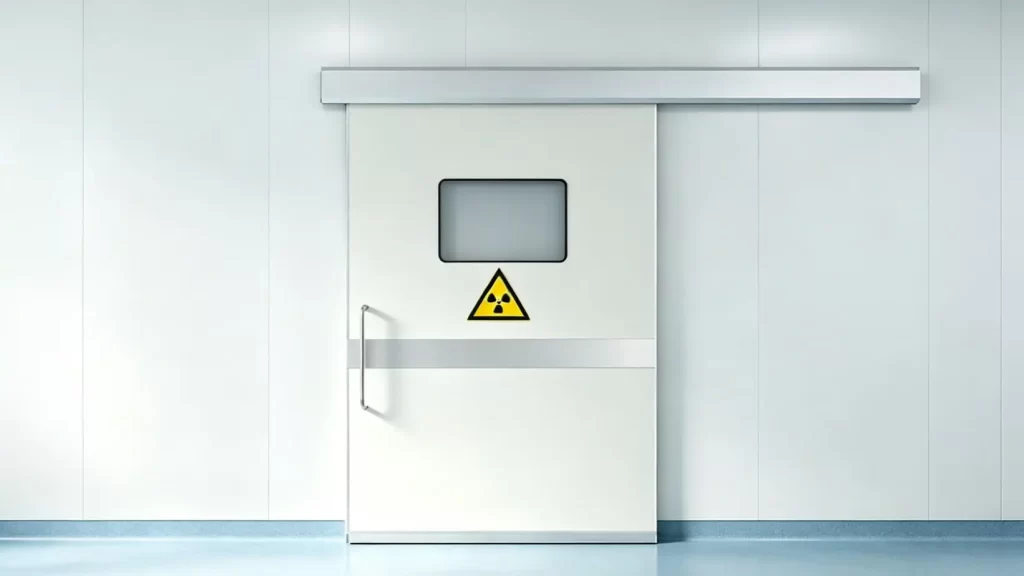
Why the X-Ray Room Door Is a Specified Purchase, Not a Standard Door
A diagnostic X-ray tube emits a directed beam, but scatter radiation leaves the patient and the room in every direction. The door, frame, walls, and vision panel together form the barrier. Leave any one element under-shielded and the room fails its leakage survey.
Three requirements pull in different directions at the same time:
- Radiation shielding demands mass — typically lead lining inside the leaf and frame.
- Infection control demands a smooth, sealed, easy-to-clean surface with no ledges where contaminants collect.
- Traffic and code demand reliable operation, clear egress, and accessibility for stretchers and wheelchairs.
A door that does one well but fails the others creates rework, delayed commissioning, and failed inspections. The buying process therefore has to specify the door as a system — leaf, frame, glass, hardware, and sealing — rather than as loose components.
Understanding Lead Thickness (mmPb) and How It Is Determined
What "mmPb" Actually Means
Lead thickness on an X-ray door is always expressed as mmPb, or "millimeter lead equivalence." A 2 mmPb door does not necessarily contain 2 mm of solid lead; it contains a shielding material (often a lead plate laminated inside the panel) that blocks as much radiation as 2 mm of solid lead would. This standardized unit lets architects, medical physicists, and manufacturers compare barriers regardless of construction. For the calculation method, wall shielding, and the code references behind these numbers, our radiation shielding door lead thickness guide walks through NCRP 147 and equipment-specific requirements.
The Factors That Drive Required Lead Thickness
The exact value is not a guess and should never be copied from another project. A qualified medical physicist calculates it from:
- Tube voltage (kVp) of the X-ray unit — higher energy penetrates more, so it needs more shielding.
- Workload (mA·min/week) — how heavily the room is used.
- Occupancy factor of the space on the other side of the door (corridor vs. staff office vs. public area).
- Distance from the tube to the door.
- Use factor — how often the beam points toward that barrier.
Higher kVp and heavier workload push the requirement up. That is why a dental periapical room and a CT suite, even if they sit side by side, often need different door shielding.
Typical Ranges You Will Encounter
For many diagnostic radiology rooms, shielding in the 2–4 mmPb range covers common installations. E-ZONG's lead-lined medical door series, for example, is built with a lead plate lining of 2–4 mmPb inside both the leaf and the frame, designed specifically for hospital radiation protection. The panel pairs PPGI or HPL facing with the lead core and uses a smooth transition design so the surface stays easy to clean.
Treat any published range as a planning reference, not a substitute for the room's shielding report. Your physicist's calculation is the number that goes on the purchase order.
Code Compliance: What Your Door Must Satisfy
Radiation Protection Standards
Radiation shielding follows a layered set of requirements. In the United States, shielding design generally references NCRP guidance (the National Council on Radiation Protection and Measurements) and must meet the limits in applicable state and local regulations. The International Building Code (IBC) addresses radiation in its occupancy and special-hazard provisions, and many jurisdictions adopt it with local amendments.
The practical rule: the door's mmPb rating must match the shielding design for that barrier. A door rated lower than the wall defeats the room; a door rated far higher than necessary adds weight, cost, and operational strain without compliance benefit.
Fire, Egress, and Accessibility
An X-ray room is still a occupied, fire-rated space. Depending on the assembly, the door may need to contribute to the corridor or room fire rating and must comply with NFPA 101 (Life Safety Code) for egress, plus IBC and ADA provisions for accessible door force, clear width, and maneuvering clearance.
Watch these specifics during specification:
- Clear opening width for stretcher and wheelchair passage (commonly 900–1100 mm for singles, wider for doubles).
- Maximum opening force at the latch and over the full sweep.
- Self-closing or controlled-close behavior where required.
- Vision panel sizing that still preserves the shielded field.
Infection Control and Hygiene
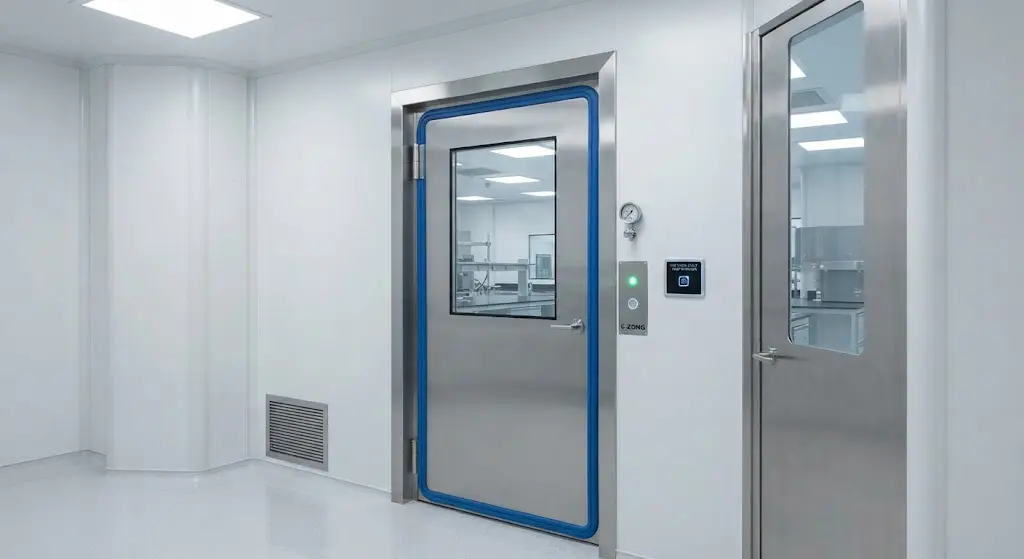
Hospital infection-control programs care about what the door surface does between cleanings. Specifiers should look for seamless or flush transitions, non-porous facings, and sealed edges. E-ZONG's broader hospital door application solutions show how air-tight, easy-clean door assemblies are applied across wards, isolation rooms, and procedure areas — the same hygiene principles carry directly into the X-ray room.
For rooms adjacent to patient areas, an air-tight hospital swing door illustrates the sealing and surface approach that keeps contamination control consistent across the facility.
Choosing the Right Door Type and Configuration
Swing vs Sliding (Automatic)
Swing doors are the more common choice for X-ray rooms because the lead-lined leaf hangs in a conventional frame and the shielding is straightforward to extend into the jamb. They suit rooms with adequate clearance and lower traffic.
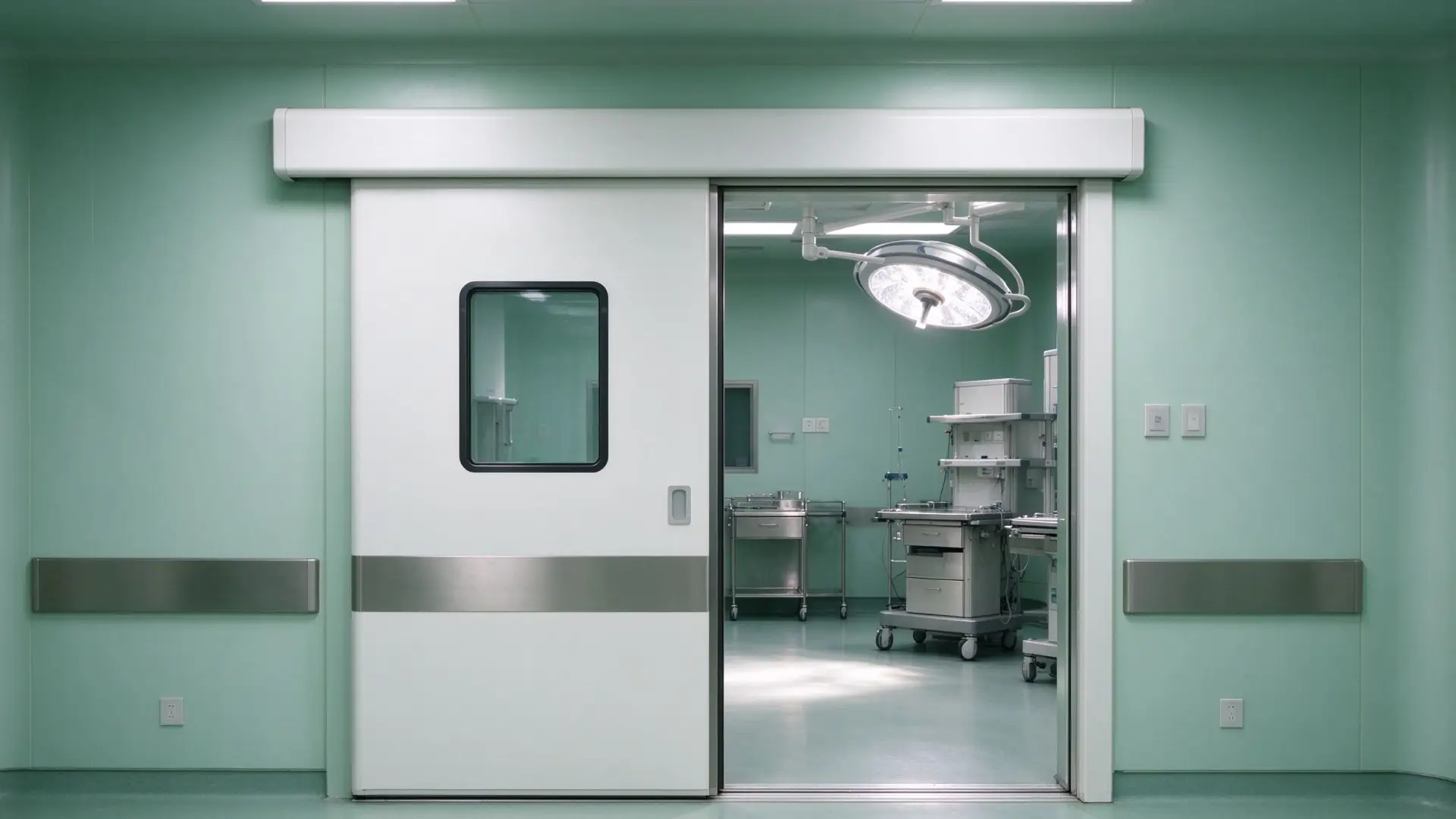
Sliding (automatic) doors help high-traffic or sterile-corridor contexts where hands-free operation matters. They do introduce a shielding complication: the pocket and track region must also be shielded, usually with a lead-lined header and wall build-out. Our overview of automatic sliding cleanroom doors explains the airtight automatic-entrance logic that also applies when specifying a motorized X-ray door. For a broader look at automatic operation, access control, and hermetic sealing in healthcare settings, see the hospital entrance door design guide.
Single vs Double Leaf and Sizing
E-ZONG's lead protection series lists common openings as a single door at 950 or 1000 mm wide by 2100 mm high, and a double door at 1500 mm wide. Leaf thickness is 40 mm, with wall thickness of 50 mm or more. These are standard planning dimensions; the final size should follow your opening and the equipment the room serves.
For bariatric, trauma, or combined CT/radiography rooms, a double-leaf configuration gives the clear width stretchers need without an oversized single leaf that is hard to shield and operate.
Frame, Wall Thickness, and Integration
The frame is part of the shield, not just a trim piece. Specify a lead-lined frame (jamb and header) at the same mmPb as the leaf, with a wall thickness that matches the surrounding shielded wall — 50 mm minimum in this product series. Poor frame-to-wall integration is the most common leak path found during acceptance surveys.
Hardware, Sealing, and Observation Windows
Lead-Lined Frames and Jambs
Extend the lead lining continuously from the leaf into the frame and through the frame into the wall. Any gap in the shield is a leak. Confirm the supplier provides a coordinated leaf-and-frame package rather than a generic frame retrofitted after the fact.
Door Hardware and Access Control
Hospital X-ray doors carry hardware chosen for durability and hygiene:
- Exposed door closers for controlled single-direction closing.
- Floor springs where the leaf must swing both ways in high-traffic areas.
- Split locks and stainless handles for corrosion resistance.
- Interlocks to coordinate with adjacent doors or control room access.
- Swing automatic door motors with anti-pinch reversal for hands-free operation.
- Foot reaction switches or face-recognition switches to avoid hand contact and reduce contamination transfer.
Each option changes the lead layout slightly — a floor spring pocket, for instance, must stay within the shielded envelope.
Observation Windows
The vision panel is a radiation path unless it uses leaded glass at the same mmPb as the leaf. Standard sizes in the product series are 300 × 400 mm or 400 × 300 mm. Place the window where clinical staff actually need sightlines, but keep it clear of the frame's lead overlap so the shield stays continuous.
Installation: What Procurement Needs to Plan
Coordination With Wall and Shielding Build-Out
The door arrives as part of a shielded envelope. The wall, frame, and leaf must be detailed together on the same drawings. Procurement should confirm the wall build-up (stud type, board layers, lead sheet if used) before the door is fabricated so the frame depth matches on site.
Site Survey and Shop Drawings
Require shop drawings that show leaf, frame, glass, hardware, and lead thicknesses, plus a clear mounting detail against your specific wall. A correct site survey up front prevents the most expensive failure mode: a delivered door that does not fit the rough opening or the wall thickness.
Acceptance Testing and Handover
What Acceptance Looks Like
Before the room goes live, a qualified surveyor performs a radiation leakage survey around the closed door, frame, and window at operating kVp. The result must fall within the design limits. Keep the documentation — the shielding report, the leakage survey, and the equipment ratings — as part of the room's compliance file for accreditation and future audits.
If the survey shows a leak at the frame or under the leaf, it usually traces back to a discontinuity in the lead lining rather than the leaf itself. That is why the coordinated frame matters more than the leaf rating alone.
A Practical Procurement Checklist
Use this list when issuing or reviewing a quote:
- Shielding report from a medical physicist with the required mmPb for the door barrier.
- Leaf and frame both rated to that mmPb, with continuous lining into the wall.
- Leaded glass window at the same mmPb, correctly placed.
- Fire, egress, and accessibility compliance documented (NFPA 101, IBC, ADA as applicable).
- Sizing matched to equipment and stretcher/ wheelchair clearance.
- Hardware specified for hygiene and traffic (closers, interlocks, automatic operators as needed).
- Shop drawings coordinated with the wall build-up.
- Acceptance leakage survey included in the handover scope.
FAQs
How thick should the lead be in an X-ray room door?
It depends on the X-ray unit's kVp, workload, room layout, and what is on the other side of the door. Common diagnostic rooms fall in the 2–4 mmPb range, but the value must come from a medical physicist's shielding calculation for that specific room — not a generic guess.
Can I use a normal hospital door and add a lead sheet later?
Not reliably. The leaf, frame, window, and wall must form one continuous shield. Retrofitting lead onto a standard door usually leaves gaps at the frame and undercuts the rating. Specify a purpose-built lead-lined assembly instead.
Swing or sliding — which is better for an X-ray room?
Swing doors are simpler to shield and more common. Sliding automatic doors help high-traffic or sterile corridors but need shielded pockets and headers. Choose based on traffic, clearance, and infection-control workflow.
Does the observation window need lead too?
Yes. Any glazing in the shielded barrier must use leaded glass rated to the same mmPb as the leaf, or it becomes the weakest point in the room's protection.
Who confirms the door is compliant after installation?
A qualified radiation surveyor performs a leakage survey at operating parameters. The documented results, together with the shielding design, form the room's compliance record.
Get a Compliant X-Ray Door Specification
Specifying the right X-ray room door comes down to one coordinated package: the correct mmPb from a shielding report, a frame and window that extend the shield without gaps, hardware suited to hospital traffic, and an installation detailed against your wall build-up.
Share your room's X-ray equipment parameters, opening dimensions, and required lead thickness, and E-ZONG's team will return a matched door and frame specification with shop drawings for review. Reach out through the contact page to start a technical consultation.
-
 Cleanroom Glass Windows Are The Key to Maintaining a Clean Environment
 -
 Top Aluminium Profile Manufacturers in China: Leading the Global Market
 -
 The Evolution of Air Tight Sliding Doors
 -
 AHU Aluminium Profile: A Comprehensive Guide
 -
 The Importance of Choosing the Right Cleanroom Door in Vietnam
 -
 The Benefits of Hospital Automatic Doors: Enhancing Efficiency and Safety
 -
.jpg) The Best Bathroom Door Manufacturers - Unlocking Endless Possibilities!
The Best Bathroom Door Manufacturers - Unlocking Endless Possibilities! -
 Unlock the Possibilities with AJ Manufacturing Doors
 -
 Make a Statement with Manufactured Home Interior Doors!
 -
 what is aluminum profile? Aluminum Profiles for Your Home is the best option
-
 Laboratory Door Pressure: Positive vs Negative and Drop Seal
 -
 Shielding Door Lead Equivalent: Match mmPb to Your Room Type
 -
 Cleanroom Automatic Sliding Doors: Belt vs Magnetic Drive
 -
 What Leak Rate Must a Hermetic Door Pass to Comply
 -
 Hospital Door Costs 2026: What Drives the Price Tag
 -
 Why Hospitals Pick Sliding Over Swing Doors in 2026
 -
 Why Hospital Room Doors Need STC 35 for Wards 2026
 -
 Cleanroom Doors: Replace or Retrofit? Save 40% on Cost
 -
 Why Pharmaceutical Doors Fail VHP: Seal and Material Fixes
 -
 Hospital Entrance Doors 2026: Touchless, ADA, Security Specs




-

Home
-

Tel
-

Email
-

Contact


Guangzhou Yizhong Aluminum Industry Co., Ltd.
We are always providing our customers with reliable products and considerate services.
We are always providing our customers with reliable products and considerate services.
Speak Your Mind