Cleanroom Automatic Sliding Doors: Belt vs Magnetic Drive
A belt driven automatic door in an ISO 5 corridor does something most specifications never mention: it sheds. Every cycle, the toothed belt rubs against its pulleys, the pulleys wear against their bearings, and a fine stream of rubber and metal particles enters the airstream just above the floor. Nobody sees it happen. The particle counter sees it, the validation report sees it, and eventually the batch record sees it. Below, the two drive technologies behind cleanroom automatic sliding doors are compared on the things that decide a specification: particles, noise, leakage drift, lifespan, and cost.
What each drive does
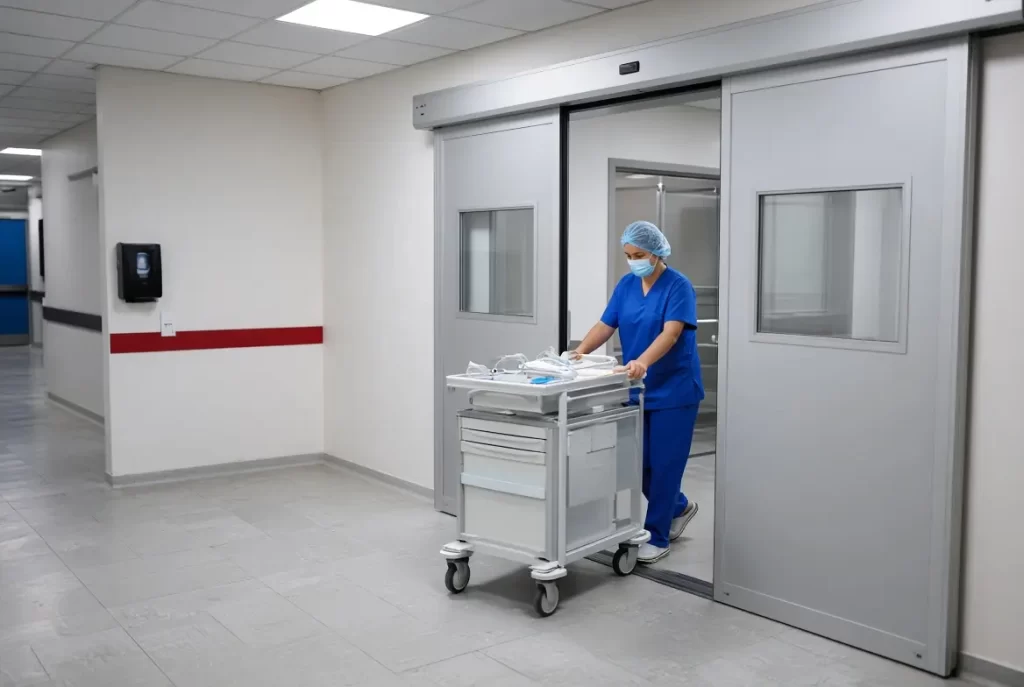
A belt drive automatic door works like a garage door opener. A motor turns a pulley, the pulley pulls a toothed belt, and the belt drags the door leaf along a track. The motor can sit at the top of the frame or in a side operator box, and the belt does the mechanical work of converting rotation into linear motion. The design is mature, cheap to build, and easy to service because every part is a commodity.
A magnetic drive, also called a maglev or linear direct drive, removes the transmission entirely. The motor itself is a linear assembly mounted along the door path: a stator rail fixed to the header and a moving coil or magnet plate attached to the carrier. When the controller energizes the stator, it pulls the carrier along the track with no belt, no pulley, and no contact between moving parts. The leaf is propelled by magnetic force, a maglev train scaled down to a 900 mm opening.
That single design difference, contact versus no contact, explains most of the gap between them.
Particle generation: the gap that matters most
In a controlled environment, the door is not just a barrier. It is a piece of machinery operating inside the cleanest room in the building, and any wear it generates becomes part of the room's particle count.
A belt drive has two wear sources. The belt itself loses material as its teeth engage the pulley, and that rubber dust does not stay in the operator box; air movement around the opening carries a share of it into the room. The pulleys and bearings add a second, smaller stream of metal wear. Published maintenance guidance for belt driven cleanroom doors schedules belt replacement every two to three years, which is a realistic measure of how fast the wear part degrades. Each replacement is an intervention inside a classified area, with its own cleaning and re-qualification overhead.
A magnetic drive has no wear interface to generate particles. The carrier floats along the stator without touching it, so there is no belt dust and no bearing dust. What the drive can still release comes from the seal and the guide rails, which both drive types share, not from the transmission. E-ZONG specifies enclosed tracks and low particle guide hardware on its sliding assemblies so those shared surfaces stay off the wear list as well. For rooms where particle counts are the acceptance criterion, that difference is the whole argument.
Noise and airflow disturbance during a pass
Every automatic door pass disturbs the room twice: once acoustically and once aerodynamically.
On noise, belt drives land in the 50 to 65 dB(A) range at normal operating speed, with the belt engagement and pulley rotation contributing most of the sound. Magnetic drives measure 40 to 50 dB(A) because there is no friction surface, and high end maglev assemblies for clinical and cleanroom use are commonly accepted at 35 dB or below measured one meter from the leaf. In a ward or a quiet laboratory, that difference is the gap between a door nobody notices and a door every conversation pauses for.
On airflow, the disturbance comes from how fast the leaf accelerates and how long the opening stays open. Belt drives tend to start and stop abruptly because the belt stretches under load, which produces a piston effect that pushes air through the opening. Magnetic drives follow a programmed S-curve, accelerating and decelerating smoothly, and they hold position precisely because the controller knows exactly where the carrier is at every millisecond. A shorter, gentler pass means less conditioned air escapes and the pressure differential recovers sooner.
How the seal ages: leakage over the life of the door
The airtightness figures a supplier quotes are day-one numbers measured on a new assembly. What matters at year three is how far those numbers drift, and the drive technology turns out to affect the seal indirectly.
The connection is alignment. A belt drive transmits force through a flexible element, so the leaf position repeats with a small tolerance band. Over tens of thousands of cycles, pulley wear and belt stretch widen that band. When the leaf stops a few millimeters short of its designed closed position, the drop-down seal and the perimeter gaskets compress unevenly, and the leakage rate climbs.
Field data from cleanroom automatic door service work shows the pattern clearly. A belt driven airtight door that measures 0.6 cubic meters per hour at commissioning can exceed 5.0 after about three years, mostly from belt aging and the alignment drift that follows it. A magnetic drive holds its alignment because there is no elastic element in the force path, and equivalent assemblies stay near their commissioning figure for years.
This is why the drive choice belongs in the leakage specification, not only in the mechanical scope. A door specified to hold a documented pressure differential is being specified with a drive whether the drawing says so or not.
Lifespan, maintenance, and what gets replaced
Compare the two drives on what physically wears out.
A belt drive assembly has a predictable consumable list: the belt every two to three years, the pulleys when their bearings go, and the motor brushes on cheaper units. Total mechanical life lands in the five to eight year range, and the door spends part of that life in a maintenance cycle that keeps pulling technicians into the cleanroom.
A magnetic drive has no wear parts in the transmission. The stator rail and carrier do not touch, so there is nothing to schedule. What remains on the maintenance list is the same for both technologies: the perimeter gaskets, the drop seal, the guide rails, the sensors, and the controller. Mechanical life for the drive itself lands in the fifteen to twenty year range, with the electronics, not the mechanics, setting the limit. E-ZONG's maintenance documentation for magnetic drive assemblies schedules seal and gasket inspection on a fixed interval instead of a belt calendar, and that is the difference a facility planner feels.
The maintenance angle matters more in a classified area than in a corridor. Every service visit inside a cleanroom is a contamination event that has to be managed: gowning, cleaning, documentation, and in validated facilities a re-qualification step. A drive that removes the two most frequent interventions, belt and pulley service, removes most of those events.
Energy and efficiency
Belt drives convert motor rotation into linear motion through an elastic transmission, and each stage loses energy to friction and belt slip. End to end efficiency for a belt driven operator lands around 60 to 75 percent. A linear direct drive runs at roughly 93 to 96 percent because power goes straight from the stator to the carrier.
The saving is real but modest in absolute terms: one automatic door operator draws little power compared with the HVAC system it protects. The efficiency argument matters at scale, on a corridor with forty doors cycling all day, and it matters as a sustainability line in a specification. It is not usually the reason to choose magnetic. The particle and maintenance arguments carry the decision.
The cost picture: paying more to spend less
A magnetic drive operator costs roughly 1.5 to 2 times what a belt drive operator costs at purchase. That gap is the first number a buyer sees, and it is the reason many projects default to belt.
The lifecycle math runs the other way once traffic is accounted for. Belt drives add belt replacement, pulley service, and more frequent cleaning after service visits, and they consume more power per cycle. On a high traffic opening, cycling several hundred times a day, those recurring costs overtake the purchase premium within a few years. On a low traffic opening, cycling a few dozen times a day, the belt drive stays cheaper for the whole life of the asset.
So the cost question is a traffic question. Doors on the critical path, material airlocks, main corridors, operating room suites, justify the magnetic premium. Doors on a quiet administrative route do not.
When a belt drive is still the right answer
A fair comparison has to name the cases where the older technology wins.
Traffic is the first filter. A belt drive on a low cycle opening will out-cost the magnetic option over any horizon, and nothing about a storeroom door justifies a premium drive.
Payload is the second. Belt driven operators handle heavy leaves comfortably, with standard units rated to 180 kg and premium units to 250 kg. Magnetic assemblies are strongest in the 150 to 300 kg band depending on configuration, and very wide or very heavy leaves need the drive specified explicitly rather than assumed.
Power failure behavior is the third. A magnetic drive needs power to hold its levitation, so an uninterruptible supply or a mechanical release is mandatory, and the manual override force has to be verified at acceptance. Belt drives also fail without power, but a stalled belt door is easier to free by hand in some hardware configurations. Both need the emergency case designed, and the magnetic option needs it designed more carefully.
None of these exceptions applies to the rooms where magnetic drives are usually specified. In a grade A corridor or an ISO 5 core, the particle argument alone settles the choice, and the cost and payload questions never reach the table.
Matching the drive to the room class
The room's classification sets the floor for the drive decision, the same way it sets the floor for the seal, the leaf material, and the surface finish.
For ISO 8 and grade C/D support spaces, traffic is usually low and particle budgets are loose. A belt drive with standard gaskets is a defensible specification, provided the maintenance schedule for belt replacement is written into the facility plan.
For ISO 6 to 7 and grade B areas, the answer depends on traffic. A busy buffer corridor pushing hundreds of cycles a day should run magnetic or, at minimum, a brushless motor with low-particle guides. A quiet room can stay on belt with a realistic maintenance schedule.
For ISO 5 and cleaner cores and grade A areas, the belt option is off the table. Particle generation, alignment stability, and quiet operation are all mandatory, and the magnetic drive is the only operator class that delivers all three. The ISO cleanroom door standards by class lay out how each class constrains the door assembly, and the drive sits inside that envelope.
In semiconductor fabs the same logic sharpens further. Wafer fabrication runs ISO 3 to 5 in the processing bays, where a single wear particle can kill a die, and the industry has standardized on contactless drives for exactly that reason. The semiconductor cleanroom requirements that make fabs sensitive to particles are the same requirements that make belt drives unacceptable in the main ballroom.
What to require in the specification
Drive selection is a specification decision, and specifications are enforced at acceptance. These five requirements are what tell a magnetic drive in a quotation apart from one in the wall.
- Ask for the leakage figure with the drive running, not just at rest. A door that seals only when parked is not an airtight door.
- Ask for the noise measurement, taken one meter from the leaf at operating speed, and set the acceptance number at 35 to 40 dB(A) for clinical and high class rooms.
- Ask for a cycle test at commissioning, fifty consecutive open and close cycles minimum, with position repeatability checked at the end. A drive that drifts out of alignment within the first hundred cycles will drift for the rest of its life.
- Ask for the power failure case in writing: the release method, the manual force required, and whether a battery backup is included.
- And ask for the maintenance schedule that reflects the actual drive. If a supplier quotes a magnetic drive but schedules belt replacement, the quote and the hardware do not match.
Where the drive meets the rest of the assembly
The drive is one layer of the opening. It has to work with the seal system, the leaf, and the controls, and the weakest layer sets the performance of the whole.
A magnetic drive paired with an economy gasket still leaks. The seal system is what turns a moving leaf into a barrier, and E-ZONG's airtight automatic cleanroom door assemblies specify drop-down and perimeter compression seals rated to the same class as the wall system they sit in, so the drive advantage is not lost at the perimeter. Where two doors sit back to back in an airlock, the interlock logic has to sequence them so the pressure step holds, and that sequencing lives in the controller, not the motor.
The drive also decides how well the door integrates with the rest of the building. A linear drive with a precise position report can tell the access system exactly when the leaf is closed, which is what lets an interlock release the second door and what lets a monitoring system log the opening. The cost and compliance tradeoffs of automatic versus manual cleanroom doors start from the same premise: an automatic opening is a control point in the room, and its value comes from how precisely it reports its own state.
FAQs
Is a magnetic drive automatic door quieter than a belt drive door?
Yes. Belt drives measure 50 to 65 dB(A) in normal operation; magnetic drives measure 40 to 50 dB(A), and high end cleanroom assemblies are accepted at 35 dB or below at one meter.
Do magnetic drives really produce zero particles?
The transmission produces none, because there is no contact between moving parts. The seals and guide rails still shed trace material over time, as they do on any sliding door. What disappears is the belt and pulley dust, which is the dominant wear source on a belt drive.
How long does each drive last?
Belt drive assemblies run five to eight years mechanically, with belts replaced every two to three years. Magnetic drive assemblies run fifteen to twenty years, limited by electronics rather than mechanics.
Does a magnetic door still work during a power failure?
It needs a designed release. A battery backup or mechanical override is mandatory, and the manual force should be tested at acceptance. Never assume a maglev door can be pushed open without power until the release has been demonstrated.
Which rooms should not use a belt drive?
ISO 5 and cleaner cores and grade A areas should not. Those rooms require contactless operation for particle control, and no maintenance schedule makes a belt drive acceptable there.
-
 Cleanroom Glass Windows Are The Key to Maintaining a Clean Environment
-
 Top Aluminium Profile Manufacturers in China: Leading the Global Market
-
 The Evolution of Air Tight Sliding Doors
-
 AHU Aluminium Profile: A Comprehensive Guide
-
 The Importance of Choosing the Right Cleanroom Door in Vietnam
-
 The Benefits of Hospital Automatic Doors: Enhancing Efficiency and Safety
-
 The Best Bathroom Door Manufacturers - Unlocking Endless Possibilities!
-
 Unlock the Possibilities with AJ Manufacturing Doors
-
 Make a Statement with Manufactured Home Interior Doors!
-
 what is aluminum profile? Aluminum Profiles for Your Home is the best option
-
 Cleanroom Automatic Sliding Doors: Belt vs Magnetic Drive
-
 What Leak Rate Must a Hermetic Door Pass to Comply
-
 Hospital Door Costs 2026: What Drives the Price Tag
-
 Why Hospitals Pick Sliding Over Swing Doors in 2026
-
 Why Hospital Room Doors Need STC 35 for Wards 2026
-
 Cleanroom Doors: Replace or Retrofit? Save 40% on Cost
-
 Why Pharmaceutical Doors Fail VHP: Seal and Material Fixes
-
 Hospital Entrance Doors 2026: Touchless, ADA, Security Specs
-
 Hospital Doors: Types, Codes, and Selection by Department
-
 Clean Room Airlock Design: Pressure Cascade, Size, Doors



-

Home
-

Tel
-

Email
-

Contact


Guangzhou Yizhong Aluminum Industry Co., Ltd.
We are always providing our customers with reliable products and considerate services.
We are always providing our customers with reliable products and considerate services.
Speak Your Mind