
Laboratory Door Pressure: Positive vs Negative and Drop Seal
A laboratory door looks like a simple panel set in a wall. In a controlled lab it is part of the pressure boundary, and the direction of that pressure decides what the door seal has to do. Get the pressure sign wrong and the seal that looked fine on the spec sheet fails the room the first time someone walks through. This article explains how to read positive versus negative pressure at a lab door, and why the drop seal, the automatic bottom seal at the floor, is the component you cannot afford to get wrong.
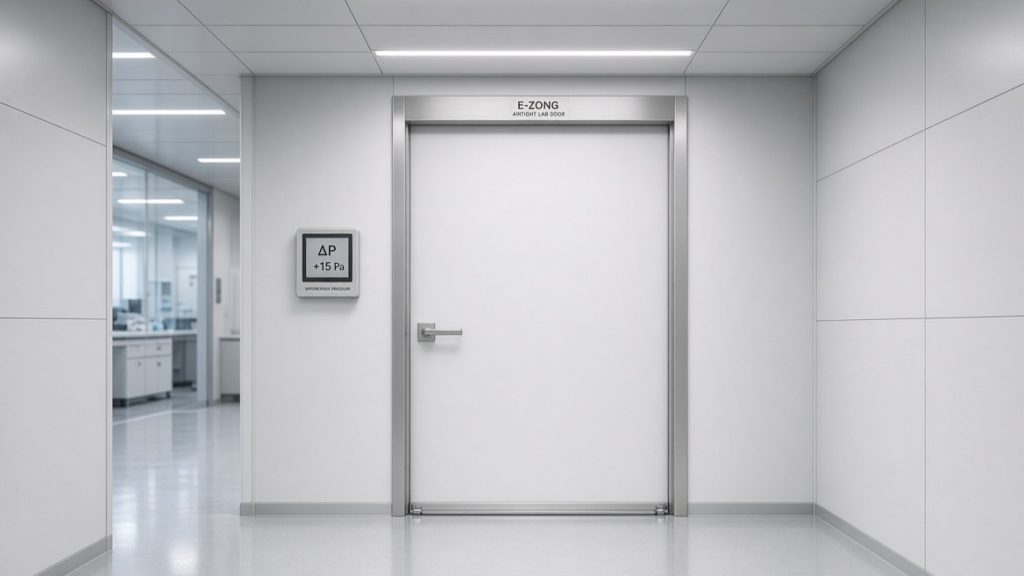
Why pressure direction matters at the door
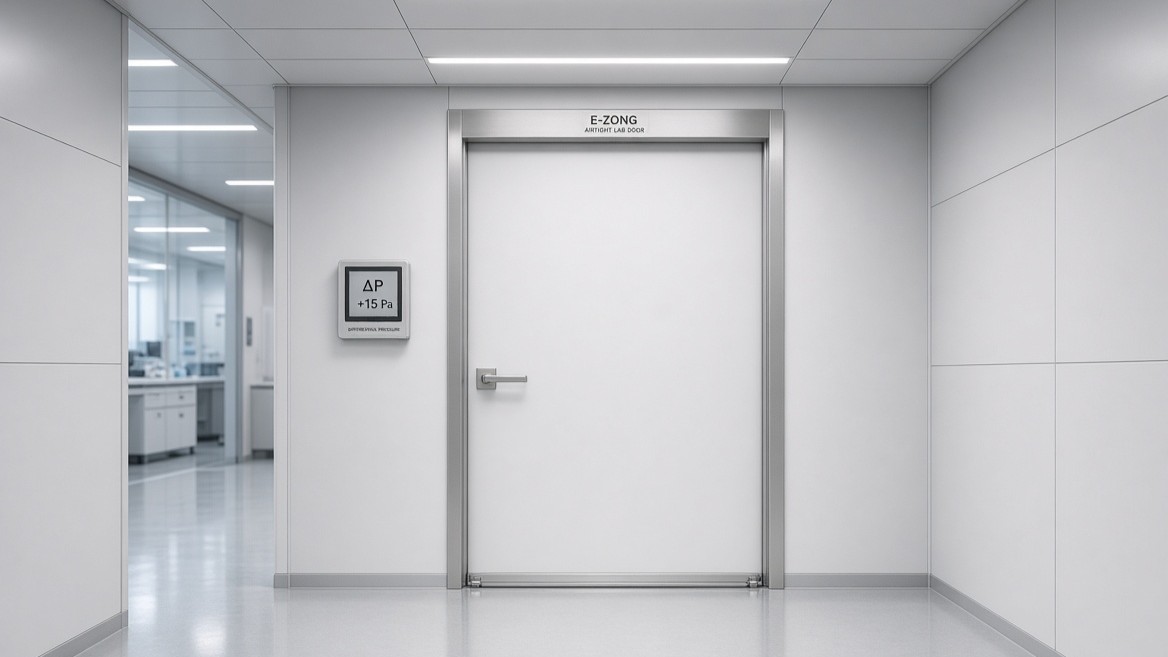
Every lab that controls its air is held at a pressure relative to the space next to it. The differential is small, often measured in pascals, but it sets the direction air wants to move. Air flows from the higher pressure side to the lower pressure side. The door assembly, not just the wall around it, is the line that pressure pushes against every second the room runs.
E-ZONG, which builds cleanroom and laboratory doors as parts of the controlled envelope rather than as standalone panels, treats the door, frame, wall connection, and floor seal as one continuous pressure line. That view matters here, because the seal load reverses with the pressure sign.
In a clean lab the goal is to keep room air from leaking in. In a containment lab the goal is to keep lab air from leaking out. Same door, opposite job. The seal that does the first job is not always the seal that does the second, because the force on the gasket flips direction.
A standard commercial door with a sweep seal was never built for this. It assumes the floor gap just needs to be covered while the door is closed. Under a controlled differential, that floor gap is the largest and weakest path, and the drop seal is the component that closes it on command.
Positive pressure labs: keep contamination out
A positive pressure lab is held higher than its surroundings. Air leaves the room through any leak, and outside air cannot push in. This protects the work inside from the corridor, the storeroom, and the people walking past the opening.
Typical positive pressure labs include:
- Aseptic processing and weighing rooms where the product must stay free of particles
- Clean benches and ISO class controlled spaces for microelectronics or optics
- IVF and cell culture labs where the culture must stay protected
- Sterile compounding and animal nursery spaces
What the drop seal must do here is hold against an outward push. When the room is positive, air tries to escape under the door. The drop seal has to seat firmly at the floor the moment the door closes, with no gap for particles to ride out on. Perimeter gaskets on the jambs and head also stay compressed, and the door should not be specified to swing outward into a corridor unless the layout forces it, because an outward swing can fight the seal line on every cycle.
The risk in a positive lab is usually blow-by at the floor. If the drop seal is slow, mis set, or worn, clean room air escapes and the pressure recovery slows after every opening. That drift is invisible until someone reads the differential trend during qualification.
Negative pressure labs: keep hazards in
A negative pressure lab is held lower than its surroundings. Outside air moves in through leaks, and room air cannot push out. This contains what is inside: infectious agents, toxic vapors, or powders that should not reach the corridor or the people beyond it.
Typical negative pressure labs include:
- BSL-2 and BSL-3 containment rooms for microbiology and virology
- Labs handling toxic or volatile chemicals that need local exhaust dominance
- Airborne infection isolation style spaces used in teaching hospitals
- Decontamination and soiled areas placed next to clean zones
The drop seal here has the harder job. Under negative pressure, room air is pulled toward every leak, and the floor gap is the easiest path out. If the drop seal does not seat, contaminated air leaves the room at ankle height, exactly where people stand and where the exhaust may not reach. The perimeter gasket still matters, but the floor seal is the one that fails first and fails worst.
For containment, the door is only as good as the anteroom and interlock around it. A single negative room with a direct corridor door is hard to keep stable. Most containment labs use a buffer space and a sequence that allows one door open at a time, which the BSL laboratory door requirements guide covers in depth for biosafety level requirements.
How the drop seal behaves under each sign
The drop seal, also called an automatic door bottom, stays retracted while the door is open and drops a seal to the floor as the door closes. It removes the permanent threshold or the loose sweep brush that drags on every cycle. Under pressure, its behaviour changes with the sign.
Under positive pressure
Air pushes the door bottom outward. A well set drop seal keeps the line closed, and the small outward flow helps confirm the room is positive. The failure mode is a gap from a slow or short drop, which lets clean air escape and slows pressure recovery after each cycle.
Under negative pressure
Room air is pulled toward the floor line. If the drop seal is not fully seated, that pull finds the gap and carries room air out. The seal must engage before the room goes to negative, which means the drop timing and the closer speed have to be matched, not guessed from a generic schedule.
In both cases the drop seal works with the perimeter gasket, not instead of it. The jamb and head gaskets handle the vertical and top lines. The drop seal handles the floor. Miss one and the pressure boundary has a hole that no wall sealing can fix.
The floor gap is the real test
Walls and ceilings get sealed during construction. The floor at the door is left to the door hardware, and that is where labs lose the battle. Epoxy, vinyl, and raised access floors all finish at different heights, and the threshold has to meet the finished floor, not the drawing dimension.
A drop seal solves the moving gap. It drops to whatever the floor is when the door closes, so a few millimeters of floor variation do not open a leak path. A fixed sweep or a glued brush does not adjust, and over a year of cycles it wears a channel that air finds every time the door moves.
E-ZONG specifies drop seal inserts by the chemicals in the room, because a seal that swells or cracks under the lab disinfectant stops sealing exactly when the room needs it most. Silicone based inserts survive more daily cleaning agents than many rubber compounds, which matters in labs wiped down on a fixed schedule. The airtight door guide for cleanrooms and laboratories explains how this leakage control supports the wider pressure plan.
Gasket material and the pressure load
The perimeter gasket carries the pressure load on the vertical and top lines, and the material choice is not cosmetic. Under a sustained differential the gasket stays compressed, so it has to resist both the compression set and the cleaning chemistry.
Silicone gaskets hold their shape through more cycles and tolerate vaporized hydrogen peroxide and peracetic acid better than standard EPDM in many labs. EPDM still works where the cleaning agent is mild and the budget is tight. The point is to match the gasket to the disinfectant, not to pick the cheapest line on the schedule, because the gasket is what the pressure pushes against all day.
A gasket that hardens loses contact. Once contact is lost on one jamb, the pressure boundary leaks on that side regardless of how good the drop seal is at the floor. The two seals are a system, and the system is only as tight as its weakest member.
Pressure stability needs the door sequence
A lab door does not hold pressure by itself. The room holds pressure because the HVAC supplies more air to the positive side or pulls more from the negative side, and the openings are controlled. The door is the moving part of that control.
Interlock and airlock
Where the lab opens to a corridor or to a cleaner or dirtier space, an airlock with an interlock keeps one door closed before the other opens. This protects the pressure cascade during entry and exit, when the room is most exposed. The interlock logic, the closer speed, and the drop seal timing all have to agree, or the room drifts every time someone passes through. The cleanroom airlock door guide covers how the sequence controls entry and contamination.
Anteroom as buffer
A small buffer space between the containment lab and the corridor absorbs the pressure shock of an opening. It is cheaper to build than a failed audit, and it lets the HVAC recover before the clean or dirty side sees the gap. For a positive lab the same buffer keeps particles from the corridor out of the clean side during transfer.
Reading the room pressure spec
The pressure sign is not a door decision. It is a lab function decision, and the door follows it.
A clean or protective lab defaults to positive so the work stays protected. A containment lab defaults to negative so the hazard stays inside. Some labs run neutral, held equal to the corridor, when the risk is low and the main need is just particle control at the bench rather than directional isolation.
When you read the room spec, look for the differential in pascals, the adjacent space it is measured against, and the recovery time after a door cycle. Those three numbers tell the door supplier what the seal must survive. The cleanroom door pressure cascade guide explains how room to room differentials build across a facility, and the BSL containment guide covers negative pressure requirements for biosafety levels in detail.
E-ZONG asks every lab project for the pressure sign and the differential in pascals before quoting a door, because a door ordered only as "laboratory door" with no pressure sign will be built to a commercial standard that assumes no controlled differential. The commercial standard fails the recovery test the first week.
Common mistakes when specifying lab door pressure
These show up in lab projects again and again:
- Treating the door as a panel, not part of the pressure boundary. The frame, the wall connection, and the floor seal all belong to the same line.
- Specifying a sweep seal where a drop seal is needed. A sweep drags and wears; a drop seal engages only when closed.
- Ignoring the finished floor height. The threshold is ordered to the drawing and arrives wrong for the real floor.
- Matching closer speed to the drawing, not to the drop seal timing, so the gap opens before the seal seats.
- Mixing pressure zones without an airlock, so every opening dumps the differential.
- Forgetting chemical exposure on the seal insert, so the gasket fails under the very disinfectant meant to protect the room.
E-ZONG field reviews often find the floor height mismatch as the first cause of a drifting differential, because the threshold was set to the architectural drawing and the epoxy finished ten millimeters higher. None of these mistakes are visible on a brochure. They show up as a drifting differential, a failed recovery test, or an audit finding about uncontrolled leakage.
What to tell the door supplier
A short specification prevents most of the above. Share these with the manufacturer before the door is built:
- The pressure sign, positive negative or neutral, and the differential in pascals
- The adjacent space the differential is measured against
- The finished floor type and height at the opening
- The traffic type, pedestrian, cart, or both, and the cycle count per day
- The cleaning agents and concentrations the seal will see
- The interlock or airlock the door connects to, if any
With those, the supplier can set the drop seal, the gasket, the closer, and the frame as one assembly instead of four parts that happen to meet at your wall. The door then holds the differential from the first cycle instead of after a season of fixes.
FAQs
Does a lab door need to be airtight?
Not absolutely airtight, but the leakage has to be small enough to hold the designed differential. Critical labs need enhanced compression or a purpose built seal. An airtight door guide covers how leakage control supports the pressure plan.
Can one door serve both positive and negative needs?
Only if the room is designed neutral or the function does not change. A door built for one sign can still seal the other, but the room pressure plan has to be fixed before the door is specified, because the HVAC, not the door, sets the sign.
Why not just use a threshold instead of a drop seal?
A fixed threshold seals one floor height and blocks carts, wheelchairs, and cleaning equipment. A drop seal clears the floor when open and seals it when closed, which suits lab traffic better.
How do I know the seal is failing?
Watch the pressure differential trend after door cycles. If recovery slows or the room drifts, the floor seal is the first suspect. A smoke test at the floor line shows the path directly.
What differential should a lab hold?
It depends on the standard and the room function, often a modest value such as 10 to 15 Pa for a clean positive lab and a smaller negative such as 2.5 to 10 Pa for a containment lab, but the applicable standard and the room design set the number. State it to the supplier rather than assuming a generic figure.
Conclusion
Share your room pressure sign, the differential in pascals, the floor finish, and your traffic and cleaning plan. E-ZONG can return a door specification matched to the pressure, including the drop seal type, the gasket material, and the closer timing, so the assembly holds the differential from the first cycle. Contact the technical team with your layout and classification to review the door schedule before fabrication.
-
 Cleanroom Glass Windows Are The Key to Maintaining a Clean Environment
-
 Top Aluminium Profile Manufacturers in China: Leading the Global Market
-
 The Evolution of Air Tight Sliding Doors
-
 AHU Aluminium Profile: A Comprehensive Guide
-
 The Importance of Choosing the Right Cleanroom Door in Vietnam
-
 The Benefits of Hospital Automatic Doors: Enhancing Efficiency and Safety
-
 The Best Bathroom Door Manufacturers - Unlocking Endless Possibilities!
-
 Unlock the Possibilities with AJ Manufacturing Doors
-
 Make a Statement with Manufactured Home Interior Doors!
-
 what is aluminum profile? Aluminum Profiles for Your Home is the best option
-
 Laboratory Door Pressure: Positive vs Negative and Drop Seal
-
 Shielding Door Lead Equivalent: Match mmPb to Your Room Type
-
 Cleanroom Automatic Sliding Doors: Belt vs Magnetic Drive
-
 What Leak Rate Must a Hermetic Door Pass to Comply
-
 Hospital Door Costs 2026: What Drives the Price Tag
-
 Why Hospitals Pick Sliding Over Swing Doors in 2026
-
 Why Hospital Room Doors Need STC 35 for Wards 2026
-
 Cleanroom Doors: Replace or Retrofit? Save 40% on Cost
-
 Why Pharmaceutical Doors Fail VHP: Seal and Material Fixes
-
 Hospital Entrance Doors 2026: Touchless, ADA, Security Specs




-

Home
-

Tel
-

Email
-

Contact


Guangzhou Yizhong Aluminum Industry Co., Ltd.
We are always providing our customers with reliable products and considerate services.
We are always providing our customers with reliable products and considerate services.
Speak Your Mind