
BSL Laboratory Door Requirements: Biosafety Level 2 and 3 Containment Guide
A biosafety laboratory door is far more than a passage. In a BSL-2 or BSL-3 facility it is an engineered containment boundary that must hold pressure, resist repeated decontamination, seal against leakage, and integrate with airlock and monitoring systems. Selecting the wrong door—or specifying the right door poorly—undermines the entire envelope and puts audit outcomes, operator safety, and project schedules at risk.
This guide is written for biosafety laboratory managers, facility planners, engineering managers, and procurement teams who are specifying doors for new BSL-2/BSL-3 construction, expansion, or renovation. It covers what actually differs between the two levels, the door requirements that follow, material and configuration choices, validation documentation, and a practical selection checklist. For a view of how integrated door and envelope design performs in a real controlled-environment build, see our biotechnology clean room case reference.
Understanding BSL-2 and BSL-3 Containment Requirements
What separates BSL-2 from BSL-3
Both BSL-2 and BSL-3 protect personnel, the environment, and the community from biological agents, but they address different risk classes.
- BSL-2 applies to moderate-risk agents that can cause human disease but are unlikely to be spread through airborne routes and for which effective treatment or prophylaxis generally exists. Typical controls include restricted access, biohazard signage, hand-washing facilities, and the use of biological safety cabinets (BSCs) for aerosol-generating procedures. Many BSL-2 spaces are converted from conventional rooms, so the envelope is often adapted rather than built from scratch.
- BSL-3 applies to indigenous or exotic agents that may cause serious or lethal disease through inhalation. The design response is fundamentally different: the laboratory is kept under negative pressure relative to surrounding areas, airflow is directional (inward), exhaust air passes through HEPA filtration, and access is controlled through sealed airlocks with interlocked doors. Surfaces must be impervious, sealed, and cleanable, and the space must support gaseous or vapor decontamination.
A BSL-2 door is primarily about hygiene, access control, and liquid-tight surfaces, while a BSL-3 door is a pressure-rated, gasketed, monitored containment component.
Why the door is a containment boundary, not just an opening
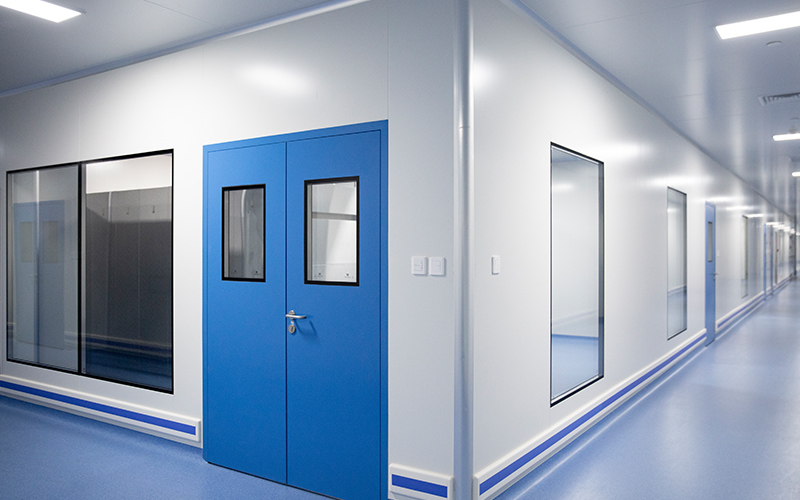
A cleanroom or laboratory envelope can be near-perfect on the walls and ceiling, but the door is the one element that moves thousands of times per year. Every cycle is a potential leak path for particulates, aerosols, and pressure loss. In BSL-3 especially, the door and its frame-to-wall interface are scrutinized during commissioning because they directly affect the room's ability to maintain negative pressure and directional airflow. Door selection therefore belongs in the early design conversation—alongside HVAC, exhaust HEPA, and room-pressure strategy—not as a late procurement afterthought.
Core Door Requirements for BSL-2 Laboratories
Sealing and surface integrity
BSL-2 doors should fit tightly within a sealed frame and present surfaces that are impervious to liquids and resistant to routine disinfection. Gaps, open joints, and porous edges become reservoirs for contamination and complicate cleaning validation. A self-foamed or gasketed perimeter seal, flush-mounted frames, and coved or radiused transitions at the frame-to-wall joint reduce crevices where organisms can shelter.
Self-closing and access control
Doors must be self-closing so the room is never left open unintentionally. Depending on the agent and workflow, access may be restricted by keycard, intercom, or visual management, but the door hardware itself should support reliable automatic closure without slamming or bounce-back that could compromise the seal.
Disinfection compatibility
BSL-2 surfaces are cleaned frequently with agents such as sodium hypochlorite, quaternary ammonium compounds, alcohol, or hydrogen peroxide wipes. Door panels, frames, seals, and hardware must tolerate this exposure without surface degradation, swelling, or loss of finish. Stainless steel, powder-coated steel, and HPL (high-pressure laminate) panels are common choices when selected with disinfectant-compatible seals and coatings.
Core Door Requirements for BSL-3 Containment
Airtight sealing and pressure boundaries
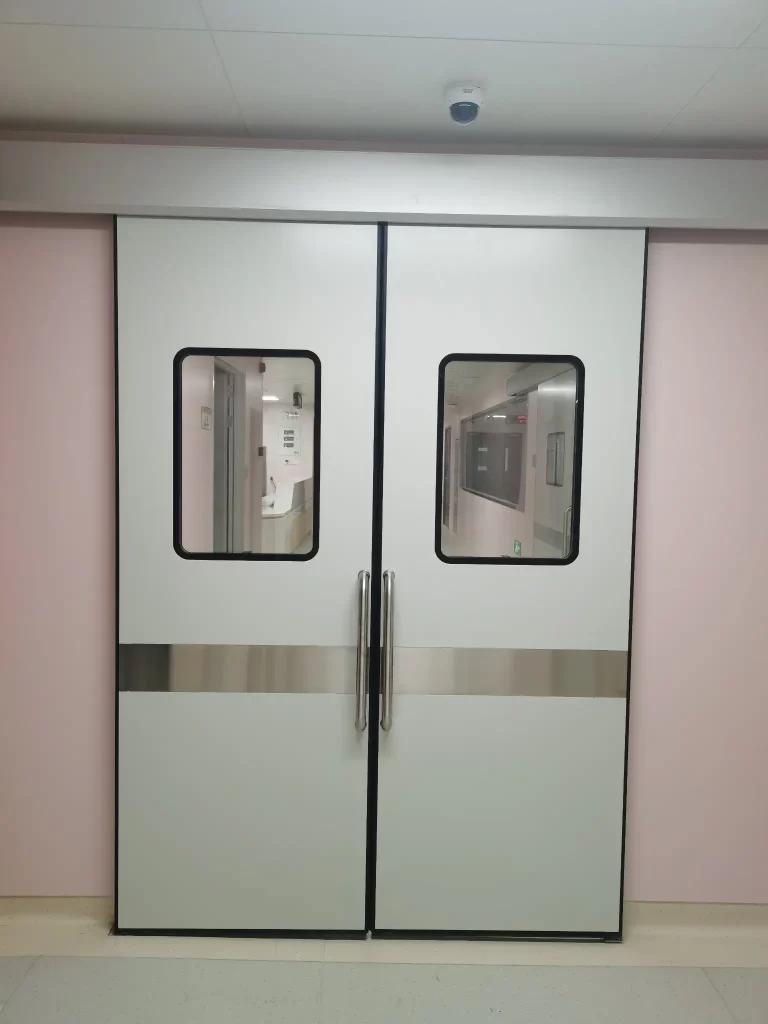
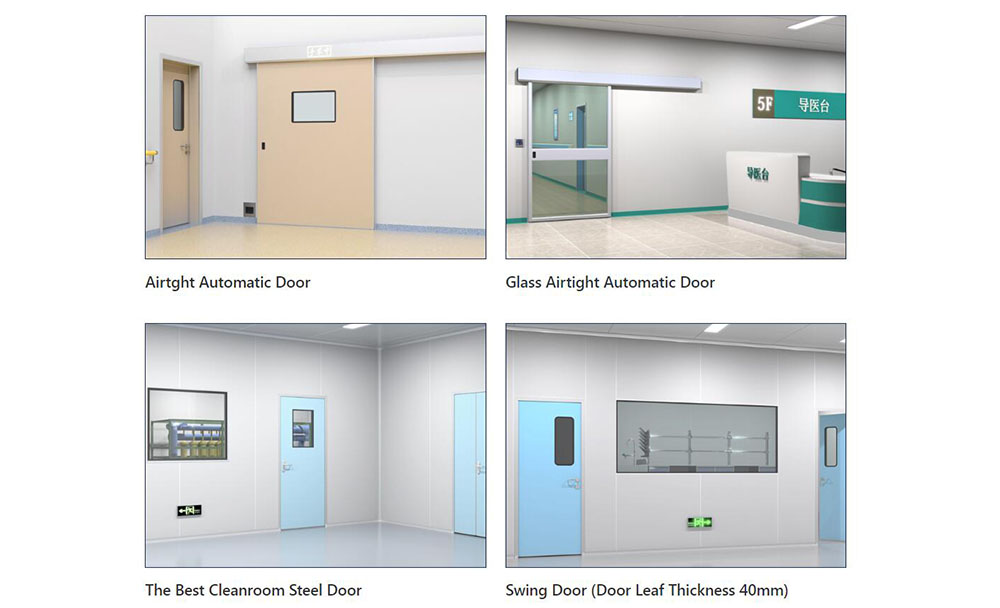
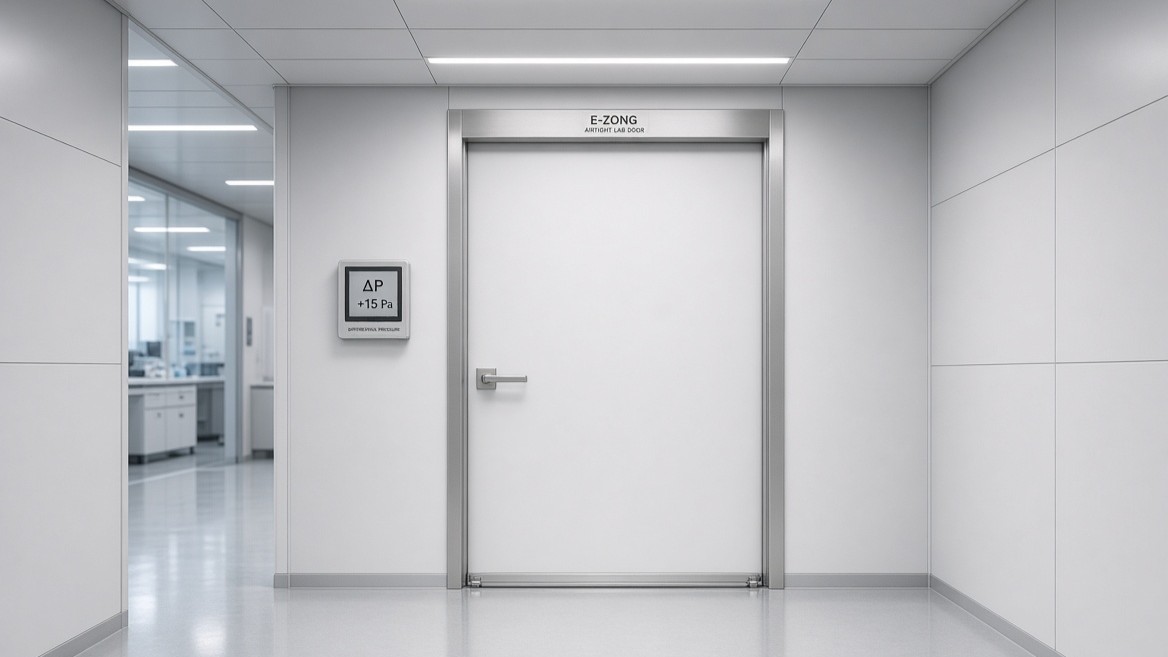
In BSL-3, the door must hold the room's negative pressure boundary. This requires a tight-fitting, gasketed leaf with a reliable automatic bottom seal (drop seal) and perimeter compression gaskets that maintain contact across the full frame. The objective is to minimize leakage so the HVAC system can sustain the required pressure differential and directional airflow. For high-traffic or critical boundaries, airtight automatic doors for hospitals and cleanrooms illustrate the sealing and actuation approach used at pressure-rated interfaces.
Airlock integration and interlocked doors
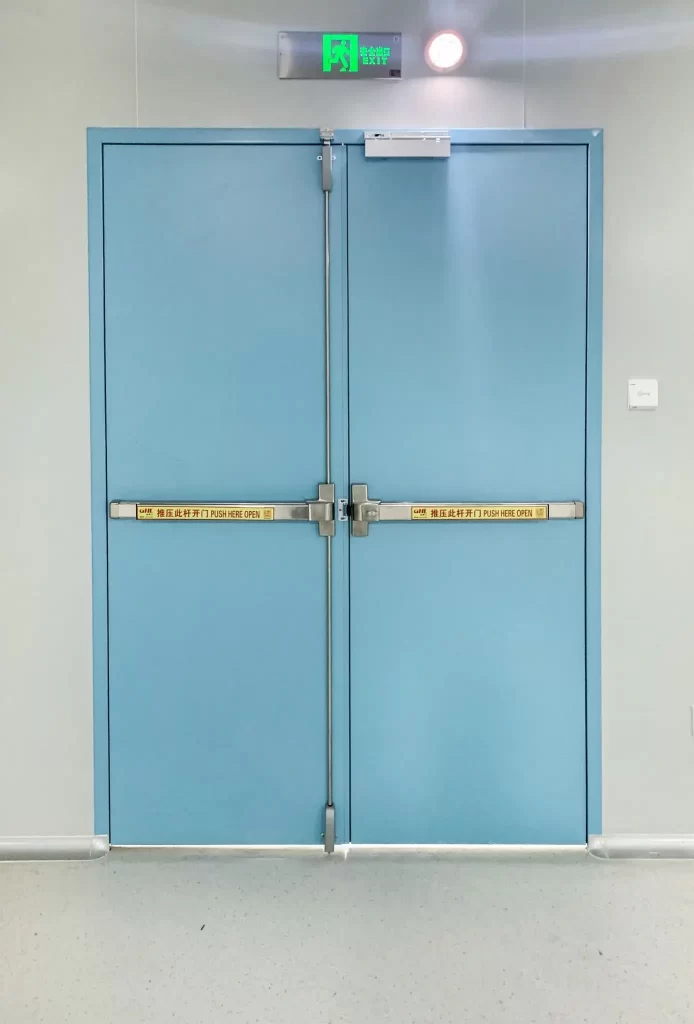
BSL-3 access is normally provided through an airlock with two or more doors that are electrically or mechanically interlocked so they cannot be opened at the same time. This preserves the pressure cascade and prevents direct pathways between the containment space and the outside. Door hardware and controls must support this interlock logic and fail safe (typically remaining closed) on power loss.
Decontamination-ready materials
BSL-3 spaces may require whole-room decontamination using vaporized hydrogen peroxide (VHP), formaldehyde, or chlorine dioxide. Door assemblies—panels, frames, gaskets, glazing, and hardware—must survive these cycles without material breakdown, embrittlement, or seal failure. Smooth, non-shedding, chemical-resistant surfaces with no exposed fasteners on the contaminated face are preferred. Where a BSL-3 laboratory also handles radioactive materials, the door envelope may need to combine containment sealing with shielding; our radiation shielding doors guide covers lead thickness and code considerations for those combined requirements.
Pressure differential monitoring integration
A BSL-3 door is not isolated from the building's monitoring system. The pressure boundary it forms is continuously verified by room-pressure sensors referenced to adjacent spaces, with alarms on deviation. From a door-specification standpoint this means: the assembly must not introduce uncontrolled leakage that the monitoring system cannot reconcile, and penetrations (for interlock wiring, sensors, or vision panels) must be sealed to the same standard as the leaf. Door position can also be tied into the building management or environmental monitoring system so that an open containment door is logged and alarmed.
Material Selection: Biocompatibility and Disinfection Resistance
The right material protects both containment and service life. The main options and their behavior:
| Material | Disinfection resistance | Typical BSL use | Cautions |
|---|---|---|---|
| Stainless steel (e.g., 304/316) | Excellent against most agents; 316 better for chloride exposure | BSL-3 panels, frames, visible faces | Higher cost; needs careful finish selection |
| Powder-coated galvanized steel | Good with most wipes; dependent on coating quality | BSL-2 and many BSL-3 faces | Coating damage exposes substrate |
| HPL (high-pressure laminate) panel | Good chemical resistance; smooth, cleanable | BSL-2/BSL-3 faces where weight matters | Edge sealing must be specified |
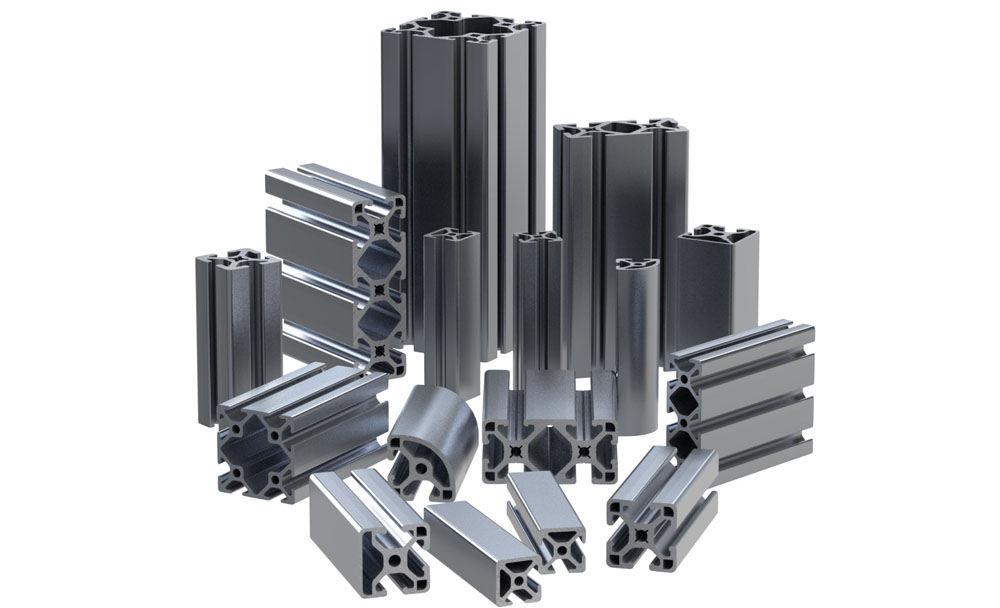
| Anodized aluminum profile (frame) | Good; pairs with sealed glazing | Frames, vision panels | Not a primary barrier alone |
Gaskets deserve equal attention: EPDM and silicone are common, but the chosen elastomer must be rated for the specific decontamination chemistry (e.g., VHP) and temperature range. A door that survives the agent on the panel but fails at the gasket is still a failed containment boundary.
Sliding vs Swing: Door Configuration for BSL Labs
Configuration affects both containment and workflow. Our cleanroom sliding doors overview details the actuation and sealing variants; for BSL applications the decision usually comes down to the following:
| Factor | Sliding door | Swing door |
|---|---|---|
| Space at threshold | Lower footprint; good for tight airlocks | Needs swing clearance |
| Seal consistency | Good with proper track and gasket design | Good with quality frame and drop seal |
| High-traffic / hands-free | Strong fit with automatic operation | Feasible with automatic operators |
| Airlock interlock | Well suited (paired leaves) | Well suited (paired leaves) |
| Maintenance access | Track and roller service required | Hinge and closer service |
For most BSL-3 airlocks, paired interlocked leaves—sliding or swing—are specified by the design, with automatic operation preferred in high-traffic or high-containment routes to remove manual handling at the boundary.
Validation and Documentation Requirements
A BSL door is only "compliant" if its performance can be demonstrated on paper as well as in place. Expect to compile:
- Material certifications for panels, frames, glazing, and gaskets, including disinfection/chemical compatibility data.
- Factory Acceptance Test (FAT) / Site Acceptance Test (SAT) records for automatic and interlocked doors.
- Installation and sealing records at the frame-to-wall interface (critical for BSL-3 leakage control).
- IQ/OQ/PQ (Installation / Operational / Performance Qualification) support where the door feeds into a qualified cleanroom or GMP-adjacent process.
- Interlock and monitoring verification confirming doors cannot be opened simultaneously and that door position/pressure alarms function.
- Traceability to the governing biosafety standard and the project's basis of design.
Procurement teams should request this documentation up front rather than after installation; missing validation files are a common cause of delayed commissioning and failed audits.
Common Specification Mistakes
- Treating BSL-3 like BSL-2. A standard room door cannot provide the gasketed, pressure-rated boundary BSL-3 demands.
- Ignoring the frame-to-wall seal. The leaf may be perfect while the wall joint leaks.
- Specifying gaskets incompatible with VHP/formaldehyde, leading to premature seal failure.
- Leaving interlock and monitoring out of the door scope, forcing costly site integration later.
- Procuring doors separately from the envelope system, creating compatibility gaps with wall panels and profiles.
BSL Door Selection Checklist
- Confirm target biosafety level (BSL-2 vs BSL-3) and the governing standard.
- Define pressure strategy: negative pressure and required differential for BSL-3.
- Specify gasketed, self-closing, airtight leaf with automatic bottom seal.
- Select panel/frame materials rated for the planned disinfectants.
- Require interlocked airlock configuration and fail-safe closure.
- Integrate door position and pressure monitoring with the BMS/EMS.
- Confirm decontamination compatibility (VHP/formaldehyde/chlorine dioxide).
- Collect FAT/SAT, IQ/OQ/PQ, and material certification packages.
- Verify compatibility with the wall/ceiling profile system.
How E-ZONG Supports BSL-2 and BSL-3 Projects
E-ZONG is an ISO 9001-certified manufacturer specializing in cleanroom doors, hospital doors, cleanroom windows, aluminum profiles, and related architectural components for controlled environments, with manufacturing operations established since 1996. For biosafety and pharmaceutical-adjacent projects, the relevant door families include hermetic and airtight configurations, sliding and swing cleanroom doors, and the aluminum profile systems that integrate the door into the wall envelope. Where the project spans pharmaceutical and biotechnology requirements, our pharmaceutical cleanroom doors reference outlines GMP-relevant door considerations that often overlap with BSL specifications.
The practical role E-ZONG plays is technical partner rather than product vendor alone: reviewing cleanroom classification, door dimensions, material preferences, and facility layouts so the door assembly matches the containment and validation strategy instead of being sourced in isolation.
FAQs
What are the basic BSL-2 lab door specifications?
A BSL-2 door should be self-closing, tightly fitted, and built with surfaces impervious to liquids and resistant to routine disinfectants. Access control and biohazard signage support the room-level controls; the door itself focuses on hygiene, sealing, and cleanability rather than pressure rating.
What are the BSL-3 containment door requirements?
A BSL-3 door must form a gasketed, airtight pressure boundary with an automatic bottom seal, self-close reliably, support interlock with the airlock, tolerate gaseous decontamination, and integrate with room-pressure monitoring. It is specified and validated as a containment component, not a standard door.
How do I select the right biosafety level door?
Start from the assigned biosafety level and governing standard, then define the pressure strategy, disinfection chemistry, airlock/interlock logic, and documentation set. Match materials and gaskets to those requirements, and keep the door within the same envelope system as the walls and profiles.
Can a BSL-2 door be upgraded to BSL-3?
Not by modification alone. BSL-3 demands a pressure-rated, gasketed, monitored assembly with validated frame-to-wall sealing and interlock. A BSL-2 door typically lacks these characteristics, so the boundary is usually re-specified rather than retrofitted.
Get a Compliant BSL Door Solution
Door selection sets the tone for the entire containment strategy. Share your BSL level, laboratory floor plan, required door dimensions, and preferred materials, and our technical team will review the specification against your biosafety and validation requirements—providing a compliant door proposal and quotation sized to your project.
-
 Cleanroom Glass Windows Are The Key to Maintaining a Clean Environment
 -
 Top Aluminium Profile Manufacturers in China: Leading the Global Market
 -
 The Evolution of Air Tight Sliding Doors
 -
 AHU Aluminium Profile: A Comprehensive Guide
 -
 The Importance of Choosing the Right Cleanroom Door in Vietnam
 -
 The Benefits of Hospital Automatic Doors: Enhancing Efficiency and Safety
 -
.jpg) The Best Bathroom Door Manufacturers - Unlocking Endless Possibilities!
The Best Bathroom Door Manufacturers - Unlocking Endless Possibilities! -
 Unlock the Possibilities with AJ Manufacturing Doors
 -
 Make a Statement with Manufactured Home Interior Doors!
 -
 what is aluminum profile? Aluminum Profiles for Your Home is the best option
-
 Laboratory Door Pressure: Positive vs Negative and Drop Seal
 -
 Shielding Door Lead Equivalent: Match mmPb to Your Room Type
 -
 Cleanroom Automatic Sliding Doors: Belt vs Magnetic Drive
 -
 What Leak Rate Must a Hermetic Door Pass to Comply
 -
 Hospital Door Costs 2026: What Drives the Price Tag
 -
 Why Hospitals Pick Sliding Over Swing Doors in 2026
 -
 Why Hospital Room Doors Need STC 35 for Wards 2026
 -
 Cleanroom Doors: Replace or Retrofit? Save 40% on Cost
 -
 Why Pharmaceutical Doors Fail VHP: Seal and Material Fixes
 -
 Hospital Entrance Doors 2026: Touchless, ADA, Security Specs



-

Home
-

Tel
-

Email
-

Contact


Guangzhou Yizhong Aluminum Industry Co., Ltd.
We are always providing our customers with reliable products and considerate services.
We are always providing our customers with reliable products and considerate services.
Speak Your Mind