Cleanroom Vision Panel Doors: Visibility Without Compromising Hygiene
The Balance Between Visibility and Containment in Controlled Environments
Facility managers face a daily dilemma. They must verify core zone status. Yet, they cannot open doors constantly. Doing so disrupts pressure differentials. Furthermore, relying only on external cameras creates blind spots. Consequently, teams often delay responses to equipment alarms or personnel anomalies. Fortunately, visibility and containment are not mutually exclusive. Specifically, cleanroom vision panel doors solve this operational challenge. These units are not simple glass inserts. Instead, they function as integrated systems. They align sightline coverage, dynamic sealing, and surface cleanliness into one deployable solution. Drawing on field data and procurement experience, this article breaks down best practices. Therefore, you can maintain strict cleanliness baselines. Meanwhile, daily operations become truly visible and manageable. We will cover three dimensions. These include routine inspection, cross-zone collaboration, and particulate control.
Real-Time Monitoring & Safety: Building a Visual Defense Line
Eliminating Blind Spots in High-Risk Zones
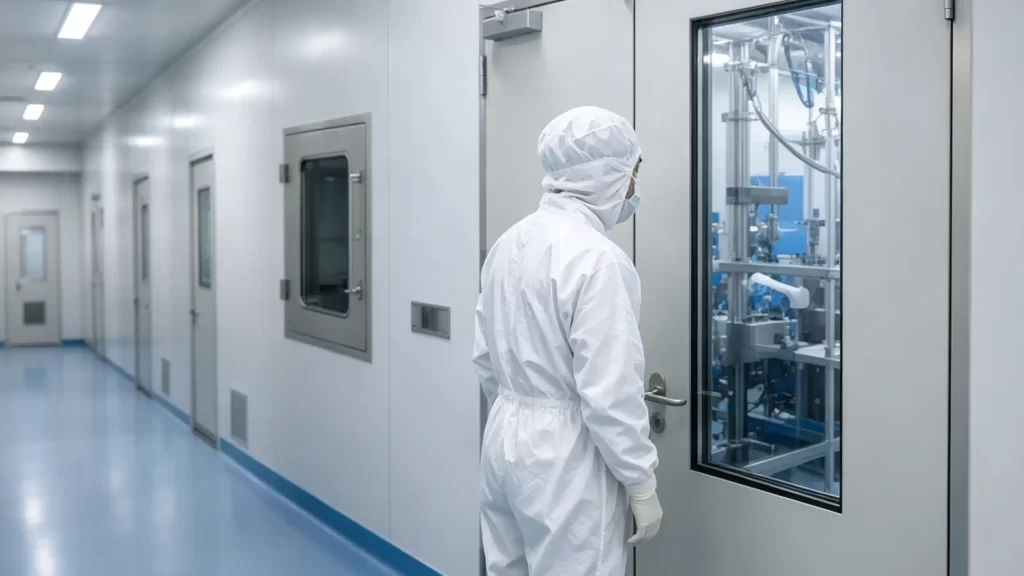
Unplanned intrusions risk batch rejection in ISO 5 zones. They also threaten BSL-3/4 labs and photolithography areas. However, properly engineered vision panels prevent this issue. Specifically, maintenance staff can verify equipment status without contact. Moreover, they can check process parameters without triggering airlock interlocks.
- Precision Sightline Coverage: Manufacturers typically center the panel on equipment HMIs. They also align it with filling needles or biosafety cabinet zones. As a result, one panel covers critical workflows. Consequently, facilities minimize personnel traffic. Therefore, this design represents a critical step in deploying a cleanroom visibility solution.
- Accelerated Early Warning: Field data proves that standardized vision panels boost detection rates. Specifically, teams spot micro-leaks and flashing alarms 40% more often. They also catch improper PPE removal faster. Consequently, average response latency drops from 3.5 minutes to under 1.2 minutes.
- Digital Layer Integration: Vision panels also act as physical anchors for BMS/EMS integration. Furthermore, they cross-reference thermal imaging and particle counter data. This process significantly reduces false alarms. When you configure a vision panel for ISO 7 cleanroom spaces, you must match the sightline angle with camera focal lengths. Otherwise, distortion could compromise situational awareness.
Enhancing Personnel Safety Without Compromising Containment
Facilities typically maintain pressure differentials at 15–25 Pa. However, indiscriminate door opening causes instant pressure loss. It can also reverse airflow. Consequently, aerosols escape high-risk zones. Therefore, the core value of a vision panel lies in a simple rule. Teams must verify conditions first. Then, they intervene second.
- Proactive Safety Assessment: EHS personnel quickly assess chemical spill extents through the panel. They also evaluate personnel distress or fire suppression activation. As a result, teams plan scientifically sound entry paths. Furthermore, they prevent secondary incidents.
- Structural Protection Upgrade: We specifically recommend explosion-proof cleanroom safety glass. A 6mm + 1.52mm PVB + 6mm laminated structure works best. This build withstands ≥500J of impact energy. Moreover, it meets Class 2B impact standards. Therefore, facilities completely eliminate the shatter risk of conventional glass.
- Environmental Resilience: Manufacturers integrate anti-fog coatings and anti-static treatments. They control surface resistivity between 10^6 and 10^9 Ω. Consequently, light transmission stays stable above 89%. This stability holds even under low temperatures or high humidity. Furthermore, high-frequency disinfection does not degrade performance. Thus, facilities guarantee uninterrupted safety monitoring.
Optimizing Operations: Streamlining Cross-Zone Workflows
Visual Collaboration for Multi-Disciplinary Teams
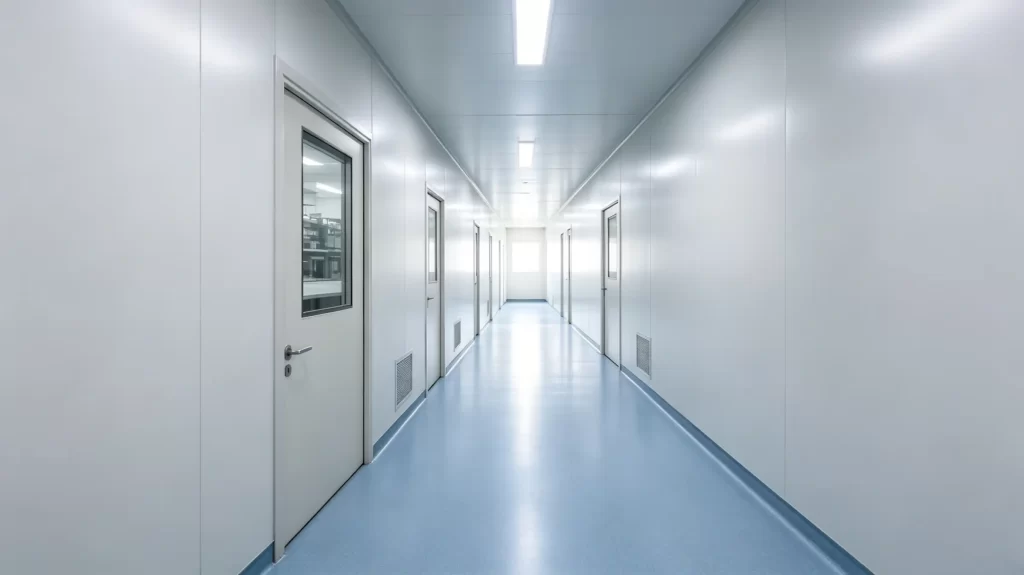
Efficient operations rely on tight coordination. Process engineers, quality teams, and maintenance staff must collaborate closely. Fortunately, cleanroom vision panel doors provide a stable physical interface. Therefore, cross-zone collaboration improves immediately. Moreover, teams break down persistent information silos.
- Contactless Communication: Staff inside and outside the cleanroom verify parameters easily. They also coordinate material transfers or report anomalies. Teams simply use hand signals, status boards, or AR overlays. Consequently, they avoid frequent gowning cycles. Furthermore, they reduce airlock traffic.
- Audit & Training Efficiency: GMP auditors track real-time SOP compliance through the panel. Internal trainers use the same advantage. They never need to enter the core zone. Since a single person movement generates 500–2,000 particles, reducing entries directly lowers the environmental burden. Therefore, this design delivers a core compliance advantage for the pharmaceutical cleanroom visibility door.
- Energy & Pressure Optimization: Facilities implementing standardized vision panels see immediate results. They reduce daily airlock cycles by 25–30%. Consequently, HVAC energy consumption drops by roughly 15%. Furthermore, equipment standby wait times shorten significantly.
Integrating Vision Panels with Cleanroom SOPs
Teams only realize the full engineering value when they embed panels into facility SOPs. Therefore, we recommend establishing a visual decision matrix. Apply the following logic.
- Define Verification Boundaries: First, clarify release conditions. Green self-check lights, secured hatches, and stable particle counts need only visual confirmation. Conversely, persistent alarms, material jams, or pressure excursions mandate dual verification. Consequently, staff must intervene physically.
- Workflow Logic Integration: Second, link panel placement with electronic interlocks. Connect them to air showers and high-speed doors as well. For example, an engineer checks the tool chamber through the panel. He confirms zero residual wafers or solvents. Then, he initiates the purge cycle. Consequently, teams eliminate idle downtime.
- Dynamic Airflow Management: Third, prioritize visual verification. It drastically cuts unnecessary door openings. Therefore, teams gain a quantifiable lever for dynamic airflow balance. This practice directly satisfies ISO 14644-16 requirements. Furthermore, facilities reduce dynamic particulate excursions by approximately 35%.
Contamination Control: Engineering the Visual Barrier
Sealed Integration: Eliminating Particulate Traps at the Glass-Frame Interface
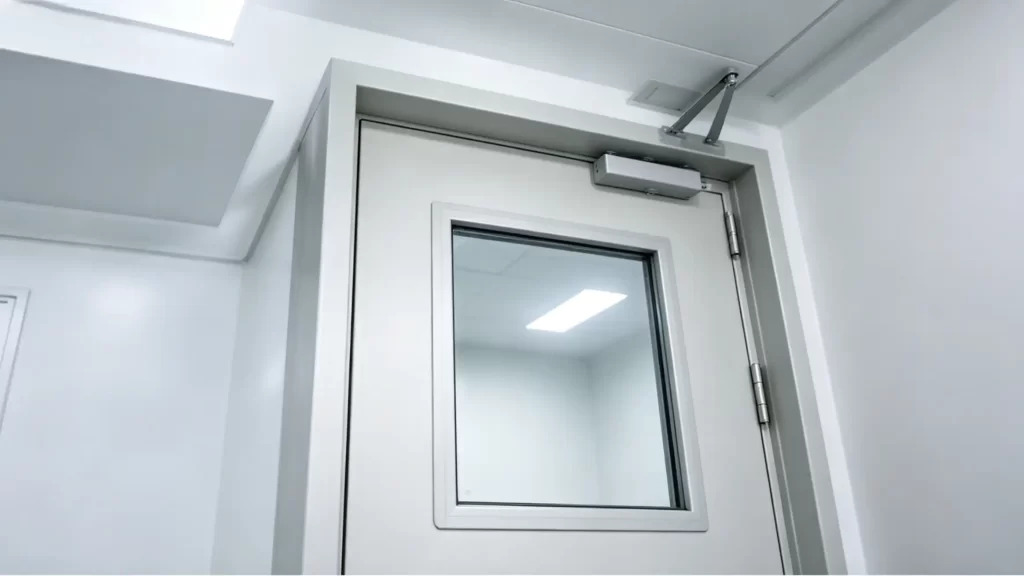
Contamination risks concentrate heavily at door interfaces. Traditional compression-strip mounting often leaves ≥0.5mm gaps. Consequently, these gaps become reservoirs for particulates and microbes. However, an engineered sealed glass cleanroom door breaks this chain. It achieves this through specific design features.
- Seamless Fabrication: Embedded potting or laser full-welding creates a smooth transition. The process joins glass and metal framing seamlessly. Therefore, facilities reduce cleanable dead zones by over 60%.
- Surface Parameter Control: Manufacturers strictly maintain interior surface roughness at Ra≤0.4μm. They also pair this with R≥3mm radius coving. As a result, wipe paths remain uninterrupted and residue-free.
- Anti-Condensation Structure: Double-cavity insulated units range from 12 to 19mm thick. Manufacturers fill them with molecular sieve desiccants. Consequently, the system maintains a dew point ≤-40°C. This design completely eliminates internal fogging. Furthermore, it removes secondary contamination risks from temperature shifts.
- Airtight Validation: Independent labs verify the assembly via DOP/PAO aerosol leak testing. The unit achieves a leakage rate below 0.01% at 500 Pa. Therefore, it meets dynamic sealing standards. This performance qualifies it as a high-grade cleanroom pressure differential door.
Material Compatibility & Cleanability Validation
Vision panel components must withstand harsh chemical disinfection. Facilities apply disinfectants at high frequencies and high intensities. Therefore, material selection requires strict validation. Follow these protocols.
- Glass Substrate: Engineers prefer low-iron ultra-clear tempered glass. It contains less than 0.015% iron and transmits over 91% light. Furthermore, manufacturers treat it with fluorosilane or nano-titanium dioxide. These coatings provide anti-static and easy-clean properties.
- Frame Matching: Facilities operating in high-humidity or chlorine environments should choose 316L stainless steel. This grade features a passivation layer ≥2.0nm. Conversely, general support areas can use fluorocarbon-coated aluminum profiles. These profiles pass ASTM B117 salt spray tests for ≥1,000 hours. Consequently, teams balance strength and cost effectively.
- Chemical Resistance: Components must survive ≥2,000 cyclic wipes. They face 70% IPA, 3% hydrogen peroxide, and 0.5% quaternary ammonium compounds. The materials must show zero hazing, crazing, or ion leaching. Additionally, a hydrophobic design maintains a contact angle above 100°. This feature reduces liquid residue to under 5%. Therefore, when you finalize a cleanroom door glass specification, always request a Certificate of Compatibility. Verify it against your specific disinfectant regimen.
Maintaining Pressure Stability & Airflow Integrity
Engineers must introduce vision panels carefully. They cannot disrupt local airflow patterns. Therefore, implementation requires strict attention to core parameters.
- Flow Field Avoidance: CFD simulations guide panel placement. This process ensures teams avoid HEPA or ULPA diffusers. It also keeps panels away from return air vortex zones. Typically, installers mount units in the upper-middle door section. They place them 1.4 to 1.6 meters from the floor. Consequently, the design preserves both laminar and turbulent flow regimes.
- Locking & Sealing: Installers use a ≥4-point linked locking mechanism. They pair it with EPDM or food-grade silicone gaskets. The system compresses the seals by 20–30%. Therefore, the door maintains long-term airtightness.
- Long-Term Stability: Testing proves the system holds up. After 100,000 cycles, airtightness degrades by less than 5%. Furthermore, ISO 7 environments show minimal fluctuation. Air exchange rates stay within ±2% at a 15 Pa baseline. Consequently, facilities meet continuous dynamic pressure monitoring requirements.
Selection Guide: Configuring Vision Panels to Match Cleanroom Requirements
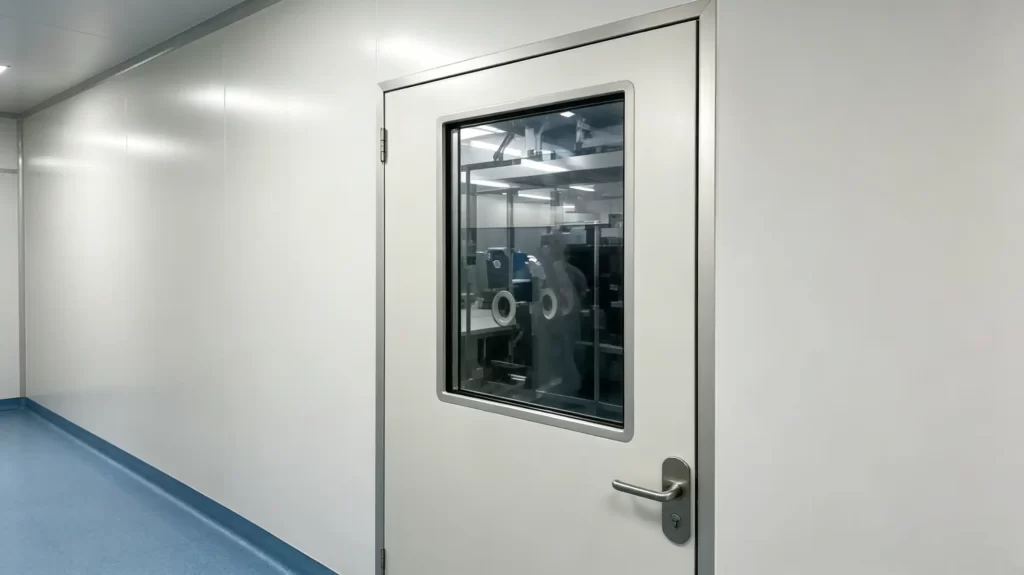
Dimension & Placement Planning
Engineers must balance structural integrity and functional needs. They approach panel sizing and layout scientifically.
- Standard Dimensions: Industry standards range from 300×400mm to 600×900mm. However, larger spans need extra support. Designers add concealed reinforcement ribs or double-laminated construction. Consequently, the units resist wind-load deformation.
- Height Calibration: Installers typically center panels at the 95th percentile standing eye level. This height averages around 1.55 meters. Therefore, teams maintain unobstructed sightlines. The design supports both seated monitoring and standing inspections.
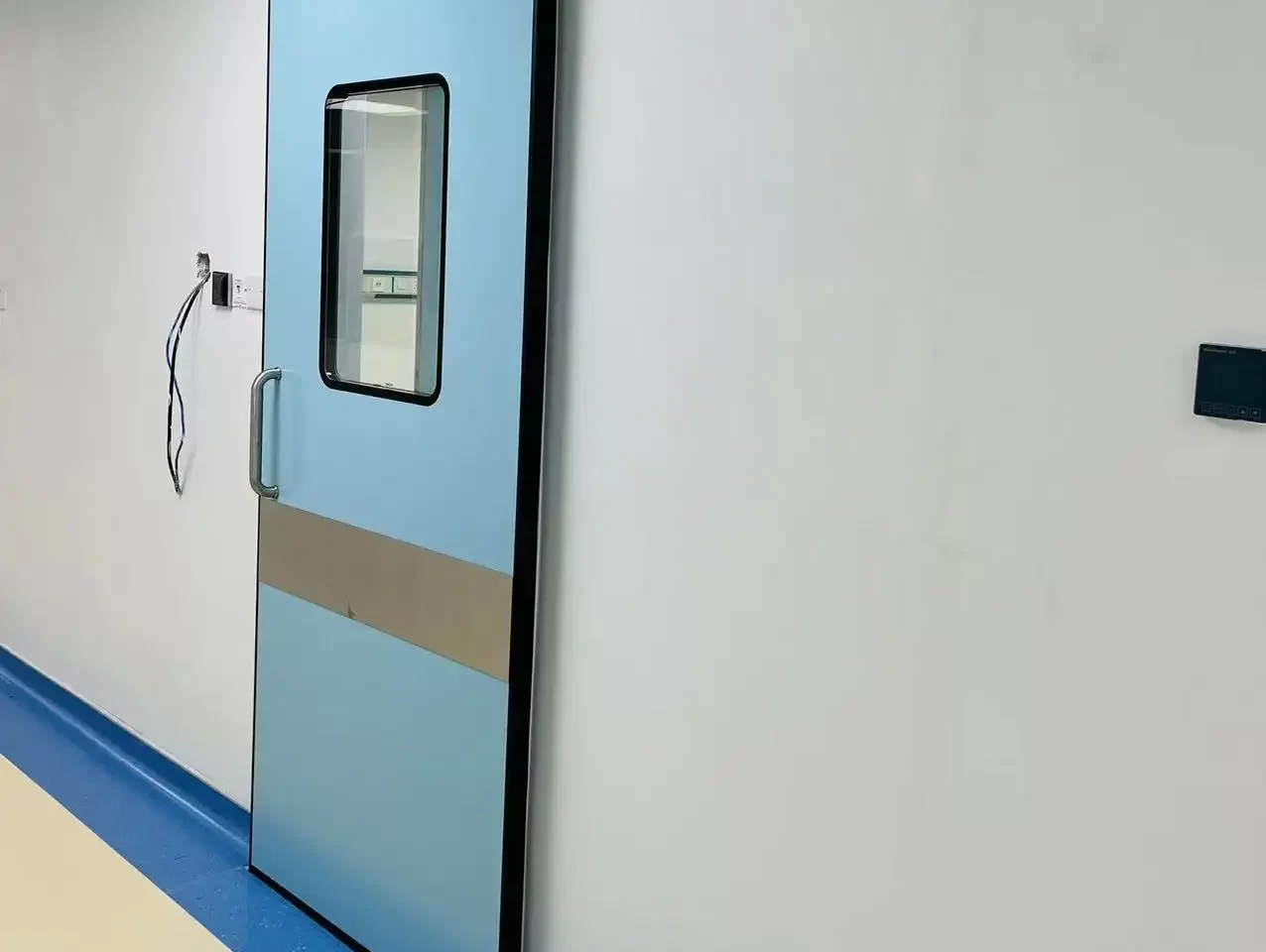
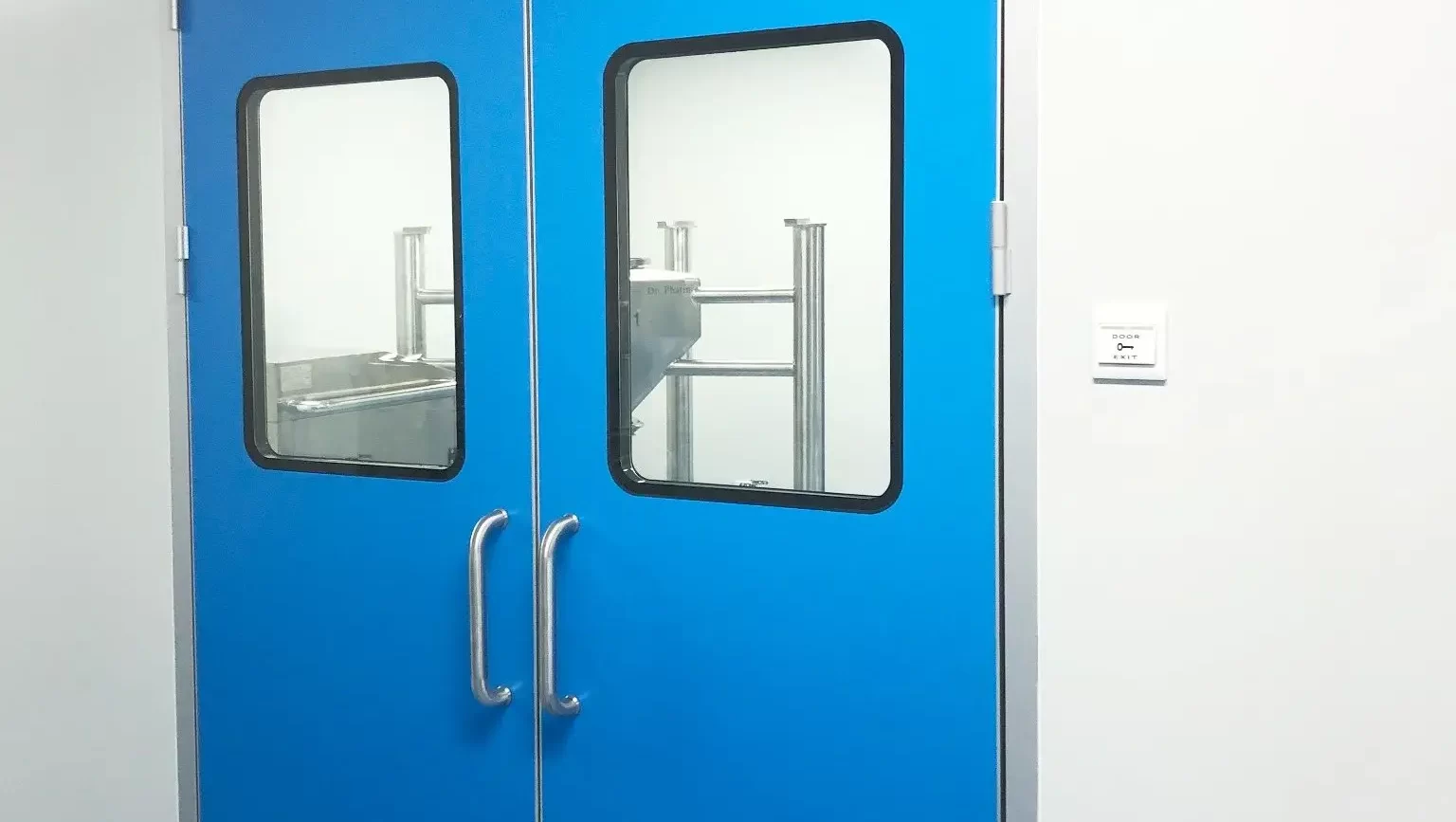
- Layout Strategy: Choose a single panel for standard inspection corridors. It fits conventional swing or sliding doors perfectly. Conversely, select a dual panel for complex process areas. This layout supports simultaneous equipment monitoring and personnel tracking. Finally, consider a strip panel for narrow corridors. Teams often use 200×800mm units near high-speed doors. They also suit space-constrained explosion-proof scenarios.
Glass & Frame Material Selection Matrix
Procurement teams must follow a structured assessment model. Evaluate three dimensions carefully. These include cleanliness class, operating environment, and maintenance cycle.
- ISO 5–6 Core Zones: For ISO 5–6 core zones, select 12–19mm blast-resistant laminated glass. Pair it with a 316L full-welded frame. Apply an electropolished finish. Consequently, you prioritize absolute sealing and maximum impact resistance.
- ISO 7–8 Support Areas: ISO 7–8 support areas demand different specs. An 8–12mm single tempered glass panel works well. Combine it with a powder-coated aluminum frame. Therefore, you balance high light transmission with lower initial CAPEX.
- Special Condition Adaptation: Strong laser or UV environments need anti-glare coatings. Adjust transmission to 75–80%. Conversely, food and beverage facilities prioritize uncoated food-grade glass. This choice mitigates chemical migration risks. Furthermore, clarify thickness standards early. Define frame termination details for every cleanroom door with observation window custom order. Doing so controls long-term maintenance costs effectively.
Compatibility with Cleanroom Class & Door Systems
Engineers must validate vision panel components carefully. Test them alongside the overall door system. Otherwise, facilities risk a "door passes, panel fails" scenario.
- Certification Alignment: First, verify the panel's particle emission rate. Check airtightness and corrosion resistance next. Validate all metrics against ISO 14644 and GMP dynamic standards. Furthermore, request full test documentation.
- Automation Interfaces: Second, reserve standard signal interfaces. Connect automatic door controllers, interlock logic, and access readers. This setup supports direct Modbus or BACnet integration. Consequently, teams achieve seamless facility platform connectivity.
- Retrofit Applications: Finally, assess structural stress before any laboratory cleanroom door upgrade. We highly recommend modular inset installation. Technicians typically finish the work within 4–6 hours. Consequently, teams avoid production disruptions. They also maintain pressure stability. Additionally, choose a modular vision panel cleanroom door for future flexibility. Quick-release designs reduce routine cleanroom door sealing maintenance to under 30 minutes.
Conclusion: Integrating Visibility into Your Contamination Control Strategy
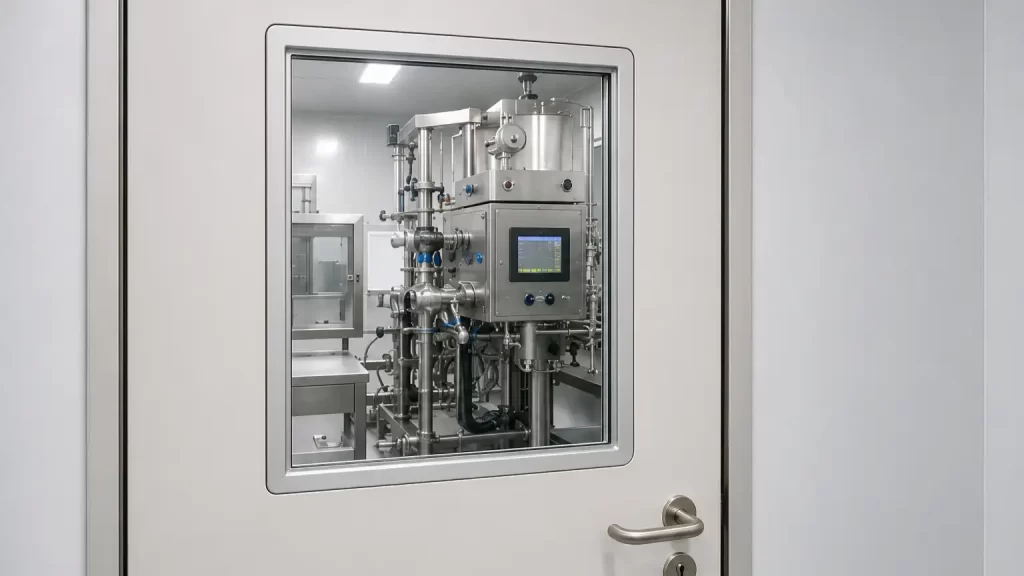
The value of cleanroom vision panel doors extends far beyond a simple view. They represent a strategic systems-engineering decision. Specifically, they unify safety inspections, workflow coordination, and contamination control. Therefore, correct selection delivers immediate results. Facilities reduce operational blind spots significantly. They also lower personnel exposure risks and system energy consumption. Crucially, teams achieve all this without compromising cleanliness class or pressure stability.
Are you planning a new cleanroom build-out? Or perhaps you are evaluating an existing door upgrade? We recommend starting with clear project alignment. Follow these steps.
- Consult on custom panel sizing. Run a sightline simulation to guarantee precise coverage. This ensures accurate monitoring of critical workstations.
- Request a glass selection guide. We tailor frame material recommendations to your disinfection frequency, cleanliness class, and budget.
- Schedule an engineering feasibility assessment. Our experts will clarify retrofit timelines, structural stress impacts, and pressure differential effects.
Contact our cleanroom engineering team today. Request detailed technical datasheets for cleanroom vision panel doors. Explore our proven industry application case studies. We deliver integrated visibility and containment solutions. We tailor every system to your exact operational requirements.
-
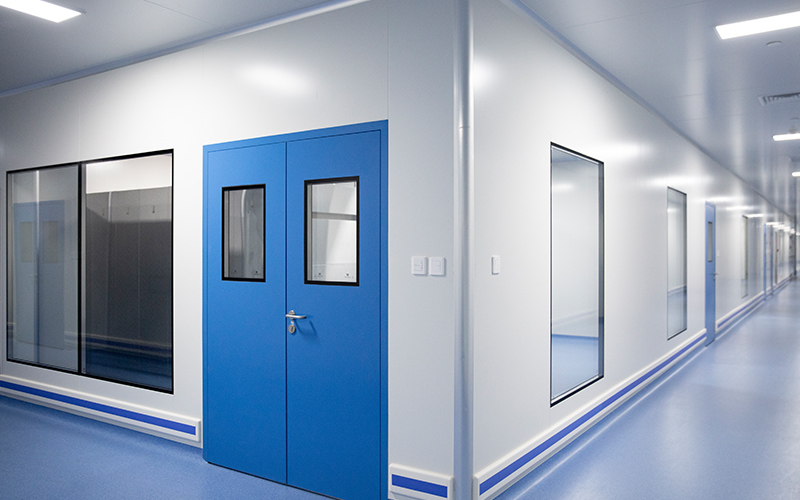
 Cleanroom Glass Windows Are The Key to Maintaining a Clean Environment
 -
 Top Aluminium Profile Manufacturers in China: Leading the Global Market
 -
 The Evolution of Air Tight Sliding Doors
 -
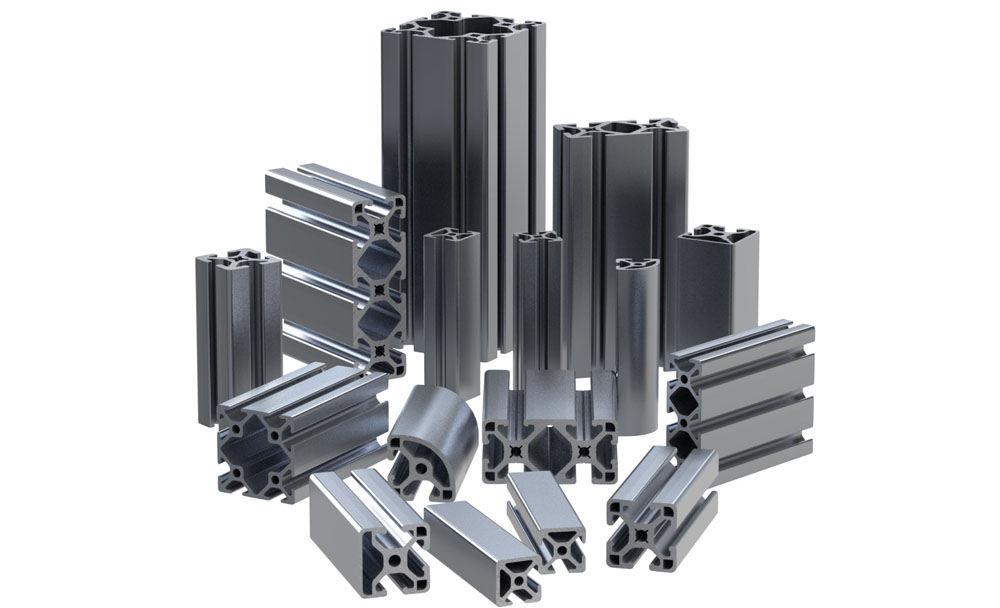 AHU Aluminium Profile: A Comprehensive Guide
 -
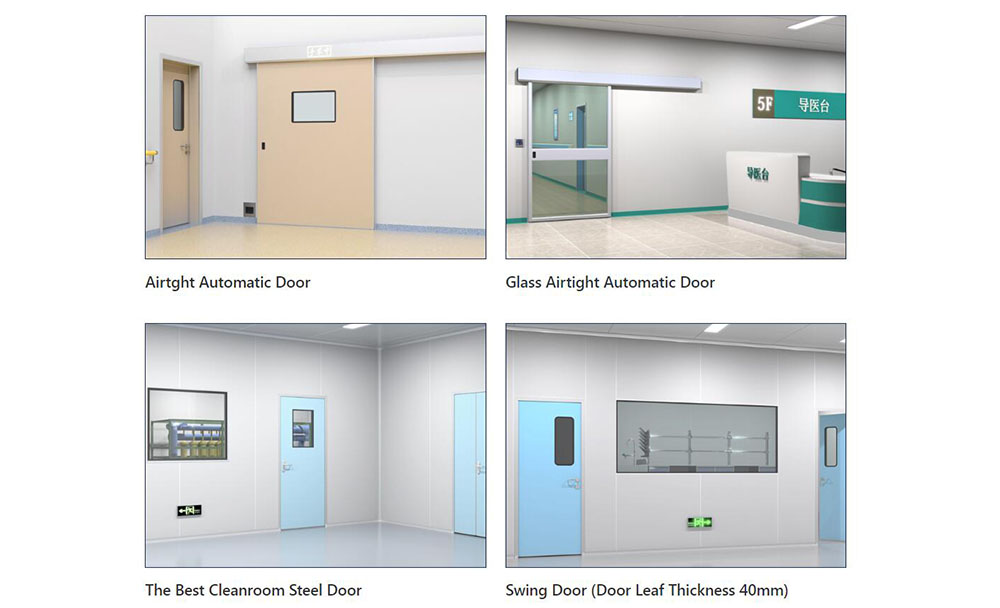 The Importance of Choosing the Right Cleanroom Door in Vietnam
 -
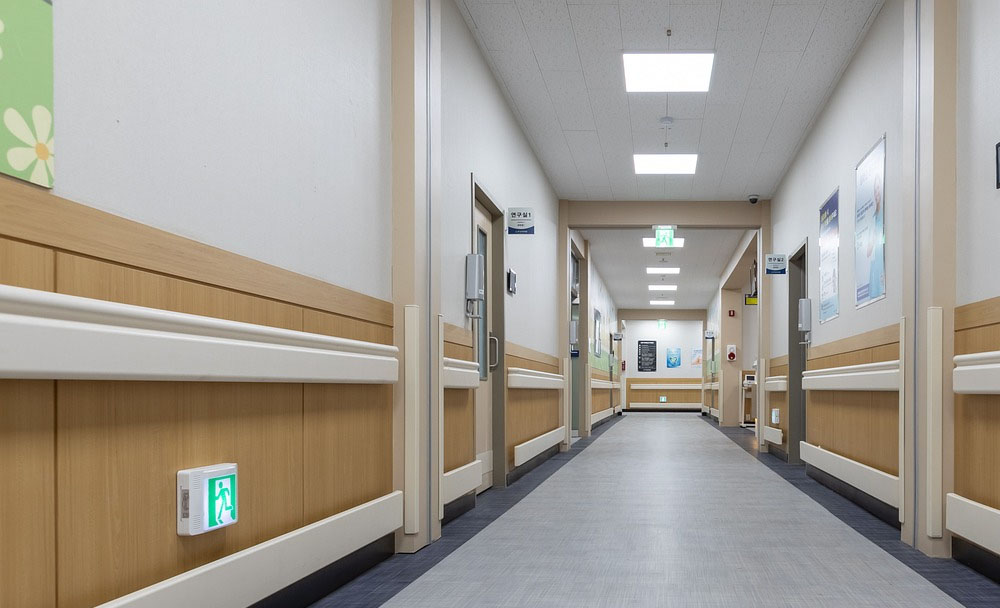 The Benefits of Hospital Automatic Doors: Enhancing Efficiency and Safety
 -
.jpg) The Best Bathroom Door Manufacturers - Unlocking Endless Possibilities!
The Best Bathroom Door Manufacturers - Unlocking Endless Possibilities! -
 Unlock the Possibilities with AJ Manufacturing Doors
 -
 Make a Statement with Manufactured Home Interior Doors!
 -
 what is aluminum profile? Aluminum Profiles for Your Home is the best option
-
 Hospital Emergency Exit Doors: 90 Minute Fire Rating Meets Infection Control
 -
 ICU and Isolation Door Requirements Hospitals Often Overlook
 -
 Laboratory Door Requirements for BSL-2 and BSL-3 Containment
 -
 Retrofitting Hospital Sliding Doors: Upgrade Wards Without a Rebuild
 -
 Why Airtight Hospital Sliding Doors Are Critical for Infection Control
 -
 Automatic cleanroom door systems: sensor, actuator and access control integration
 -
 Cleanroom Door Materials: Stainless Steel vs HPL vs FRP vs Aluminum Comparison
 -
 X-Ray Room Door Buying Guide: Lead Thickness & Compliance
 -
 Operating Room Doors: Hermetic & Infection-Control Guide
 -
 Hospital ICU Door Selection: Sealing, Sterility & Workflow




-

Home
-

Tel
-

Email
-

Contact


Guangzhou Yizhong Aluminum Industry Co., Ltd.
We are always providing our customers with reliable products and considerate services.
We are always providing our customers with reliable products and considerate services.
Speak Your Mind