
Cleanroom Roll-Up Doors for Fast Access in Controlled Areas
Balancing Throughput and Environmental Control
In cleanroom facilities, operational efficiency and environmental control are constantly at odds. Slow doors bottleneck logistics, while prolonged openings disrupt pressure differentials and invite contamination. Traditional swing or sliding doors struggle in high-traffic zones like pharmaceutical filling lines or semiconductor AGV corridors. Cleanroom roll-up doors solve this by combining vertical rolling mechanisms with rapid actuation. They complete open-close cycles in under two seconds, maintaining workflow continuity while keeping airflow disruption within strict compliance limits. This article outlines the engineering logic behind these systems, from material selection and sealing architecture to validation requirements and lifecycle maintenance.
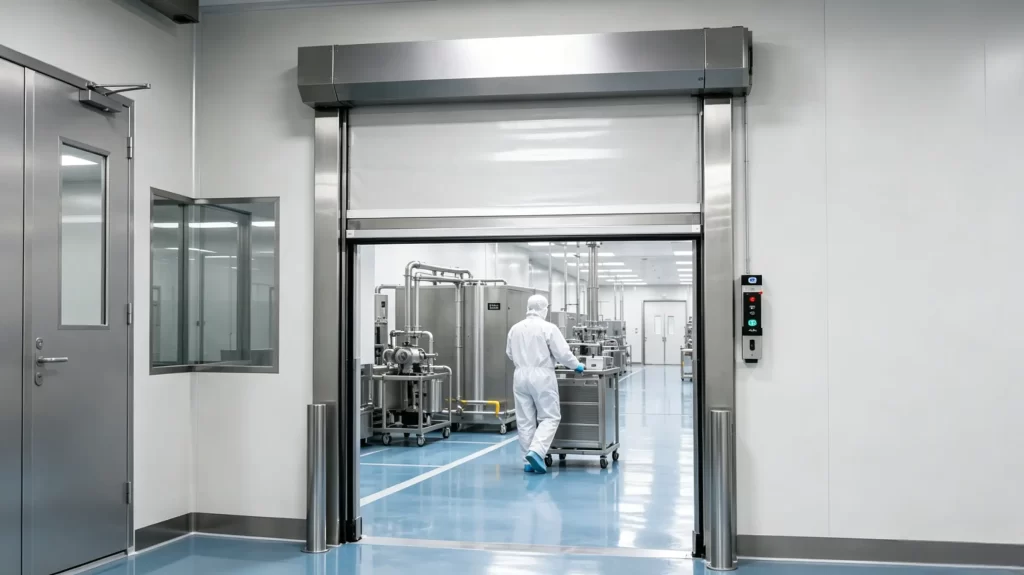
Rapid Access and Space Efficiency Engineering Logic
The throughput efficiency of cleanroom corridors and airlocks depends directly on door actuation dynamics. As a leading solution among high speed cleanroom doors, cleanroom roll-up doors leverage Variable Frequency Drive (VFD) systems and S-curve velocity profiling to minimize turbulence and pressure loss. Key operational parameters include:
- Adjustable speed: 0.8 to 2.0 m/s, customizable for mixed AGV, forklift, and pedestrian traffic.
- Smooth acceleration: Torque-transition algorithms limit pressure differential fluctuations to ±3 Pa.
- Rapid recovery: In standard 10–15 Pa positive-pressure zones, differential restoration averages ≤2.5 seconds.
- Energy savings: Reduced AHU damper cycling cuts long-term HVAC energy consumption by 12%–18%.
Spatial efficiency is equally critical. Unlike horizontal sliding doors that demand 1.2–1.5 times their width for clearance, these systems require minimal footprint. Side rails measure just 80–120 mm, and headroom housing stays within 150–250 mm. This design reclaims 40%–60% of overhead space in low-ceiling facilities, accommodating process piping, lighting, and fire suppression systems. Rated for ≥100 cycles per hour or 500,000 fault-free cycles, rapid roll doors for cleanrooms align seamlessly with high-throughput logistics schedules.
Contamination Control and Cleanroom-Grade Design
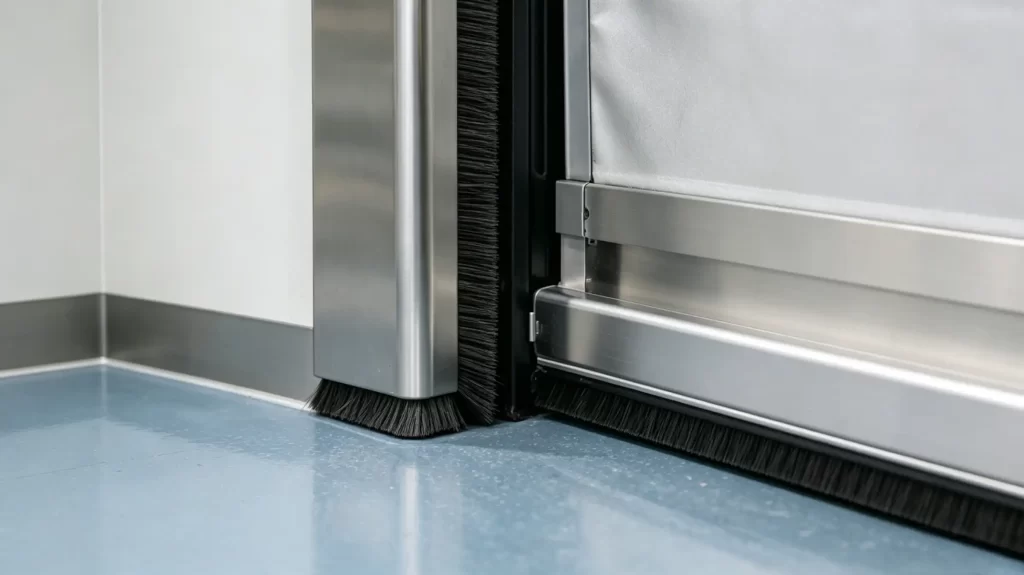
Containment relies on more than speed. It requires precise cleanroom roll-up door sealing specifications, low-shedding materials, and chemical-resistant surfaces. Core design elements include:
Curtain Materials & Surface Treatment:
- FDA/USP Class VI certified PVC or polyurethane composites with antimicrobial coatings.
- Surface resistivity maintained at 10^6 to 10^9 Ω to prevent static-driven particle attraction.
- High-frequency heat-welded seams eliminate stitched harborage points and cleaning residue traps.
- Surfaces withstand repeated VHP, 75% IPA, peracetic acid, and quaternary ammonium decontamination without degradation.
Three-Tier Sealing Architecture:
- Lateral seal: Dual high-density silicone brushes (≤0.15 mm filaments) with EPDM guide channels compensate for ±5 mm frame tolerances.
- Bottom interception: Magnetic-weighted aluminum bars with polyurethane gaskets create a closed-loop seal against conductive flooring, blocking particles ≥0.5 μm.
- Top housing: Enclosed dust covers with micro-positive-pressure routing prevent particulate ingress during retraction.
Independent testing confirms that EU GMP Annex 1 compliant configurations maintain leakage below 0.5 m³/(h·m²) at 50 Pa. Physical barrier integrity remains the priority over air curtains or dynamic airlocks. In controlled environments, cleanroom fast acting doors serve as the primary isolation valve.
Vertical Industry Applications and Compliance Alignment
Sector-specific regulations dictate door specifications. Compliance alignment ensures pharmaceutical cleanroom doors, food grade cleanroom doors, and semiconductor variants meet audit standards.
Pharmaceutical & Biomanufacturing: Requires full DQ/IQ/OQ/PQ validation and FDA 21 CFR Part 11 compliant audit trails. Materials must include third-party COAs and biocompatibility reports. Ideal for aseptic filling lines, cell therapy zones, and CIP/SIP isolation, meeting GMP compliant rapid roll door standards.
Food Processing & Cold Chain: Focuses on HACCP zoning and temperature resilience (-25°C to +40°C). Low-temperature models integrate PTC self-regulating heating elements (≤15 W/m²) and condensate drains. IP65/IP66 ratings withstand CIP washdowns (≤80 bar, ≤85°C, ≥12 L/min).
Electronics & Semiconductors: Requires ANSI/ESD S20.20 certification with equipotential grounding (<4 Ω resistance). Paired with Milli-Q water protocols, these systems maintain Class 100 (ISO 5) particle control and ESD safety in photolithography and wafer transfer corridors.
Core Performance Parameters and System Integration
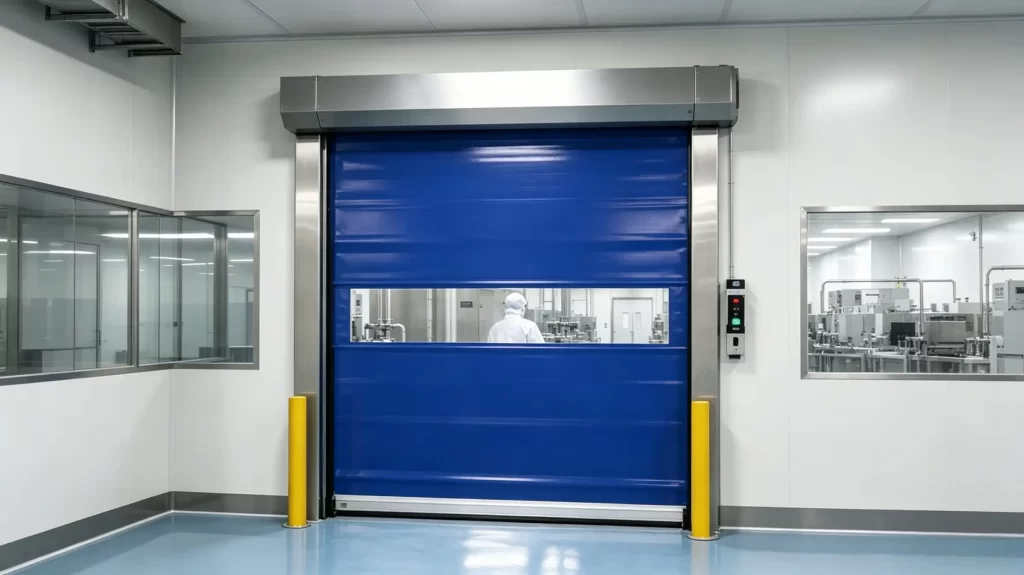
Deployment requires strict adherence to architectural interfaces and control logic. Single-leaf clear openings reach 6.0 m wide by 5.5 m high, but structural loads (12–18 kg/m²) must be calculated against cleanroom panels or steel framing. BIM clash detection is essential during design to avoid compromising wall airtightness or fire ratings.
Control integration maximizes performance through three core modules:
- Industrial bus connectivity: Profinet, Modbus TCP, or BACnet integration enables seamless BMS/MES synchronization and digital twin monitoring.
- Multi-sensor triggering: Millimeter-wave radar (0.3–8 m range) predicts approach trajectories. Type 4/PL e light curtains (<10 ms response) provide anti-crush protection, while sterile foot pedals enable touchless operation.
- Safety redundancy: Adjustable obstacle reversal (50–150 Nm), 0.2-second light curtain interruption response, controlled emergency descent (≤0.3 m/s), and UPS backup (≥50 cycles).
Certifications include CE Machinery Directive (2006/42/EC), UL 325, and alignment with ASHRAE 170 and EN 16240 pressure management guidelines. Note that these doors execute physical isolation; they do not replace HVAC airflow or pressure gradient design.
Maintenance, Validation, and Lifecycle Management
Long-term reliability depends on standardized maintenance and preventive servicing. Facility teams should follow this cleanroom roll door maintenance checklist:
Routine Protocols:
- Tension calibration: Laser-level checks every 6 months (tolerance ≤±2 mm/m).
- Lubrication: ISO 21469 H1-grade particulate-free lubricants only. Avoid silicon or mineral oils to prevent VOC emissions.
- Gasket monitoring: Replace EPDM/silicone seals if ASTM D395 compression set exceeds 15% or micro-cracking appears.
- Drive inspection: Monitor synchronous belt tension, bearing clearance, and encoder signal integrity.
Validation & Documentation: Manufacturers must provide FAT/SAT reports, velocity curves, pressure recovery data, and particle settlement tests (ISO 14644-2 compliant, dual-channel 0.5/5.0 μm logging). Airborne microorganism and bioburden reports support IQ/OQ validation cleanroom doors requirements. All systems should enable 21 CFR Part 11 electronic record export and change control logging.
Predictive maintenance modules track motor current, cycle counts, and vibration spectra, feeding data to CMMS platforms for early wear detection. Modular curtain segments allow replacements in under 30 minutes without ceiling disruption. Combined with localized spare parts, Mean Time To Repair (MTTR) stays under 2 hours. Structured preventive maintenance reduces unplanned failures by over 70%, preventing batch losses and audit findings.
Conclusion: Engineering the Balance Between Efficiency and Compliance
Cleanroom roll-up doors are precision-engineered isolation systems designed for pressure stability, particle control, and high-cycle throughput. To accurately match cleanroom roll-up doors sizing and speed requirements for your facility, provide your workflow cadence, ISO/GMP classification, and decontamination protocols. Our engineering team will deliver a customized specification package and 3D layout proposal.
-
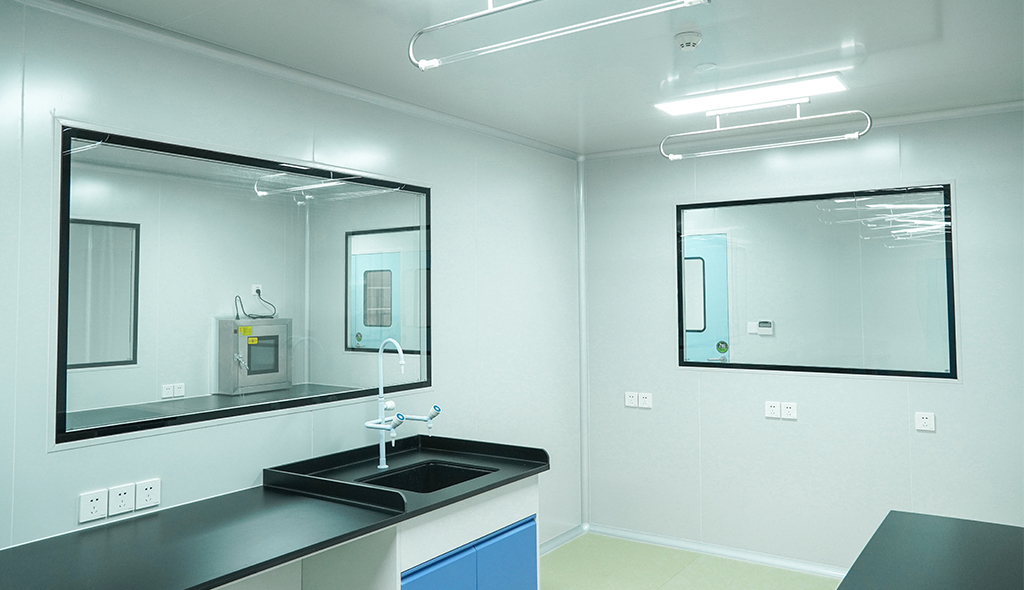 Cleanroom Glass Windows Are The Key to Maintaining a Clean Environment
 -
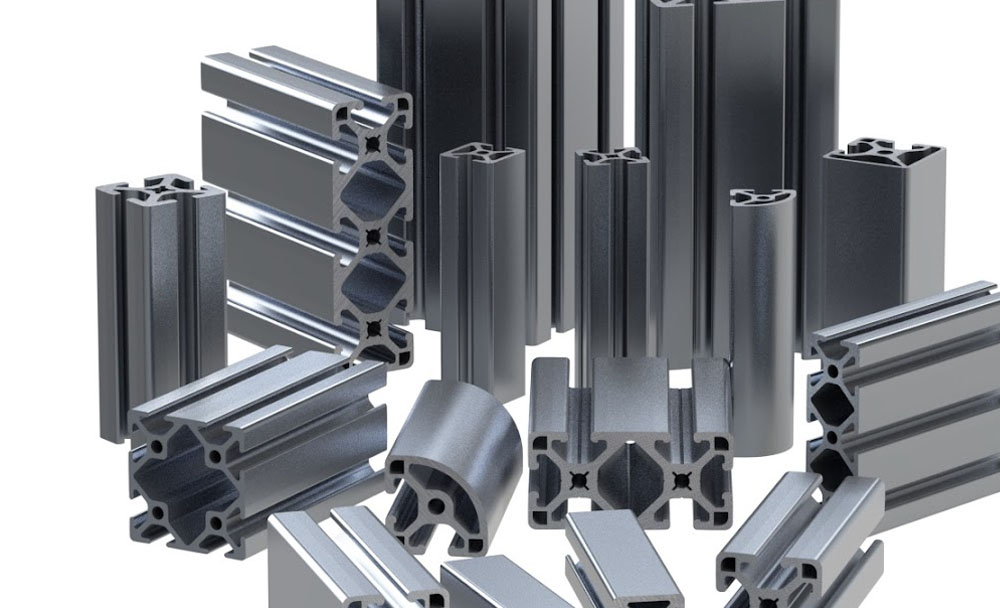 Top Aluminium Profile Manufacturers in China: Leading the Global Market
 -
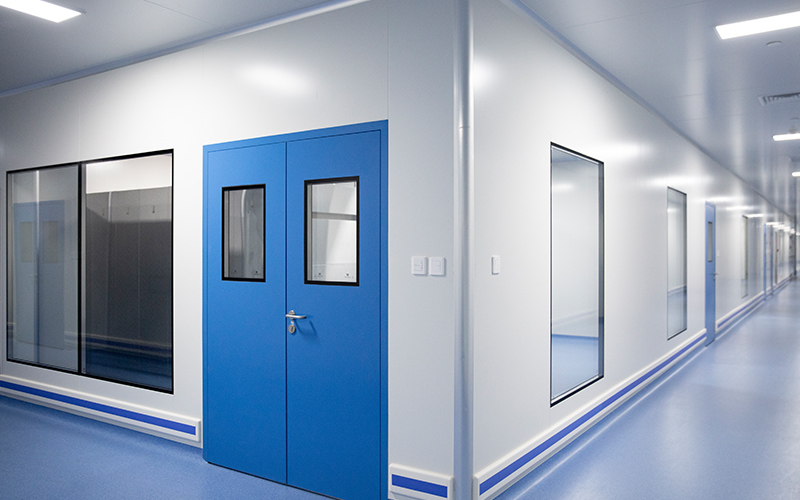 The Evolution of Air Tight Sliding Doors
 -
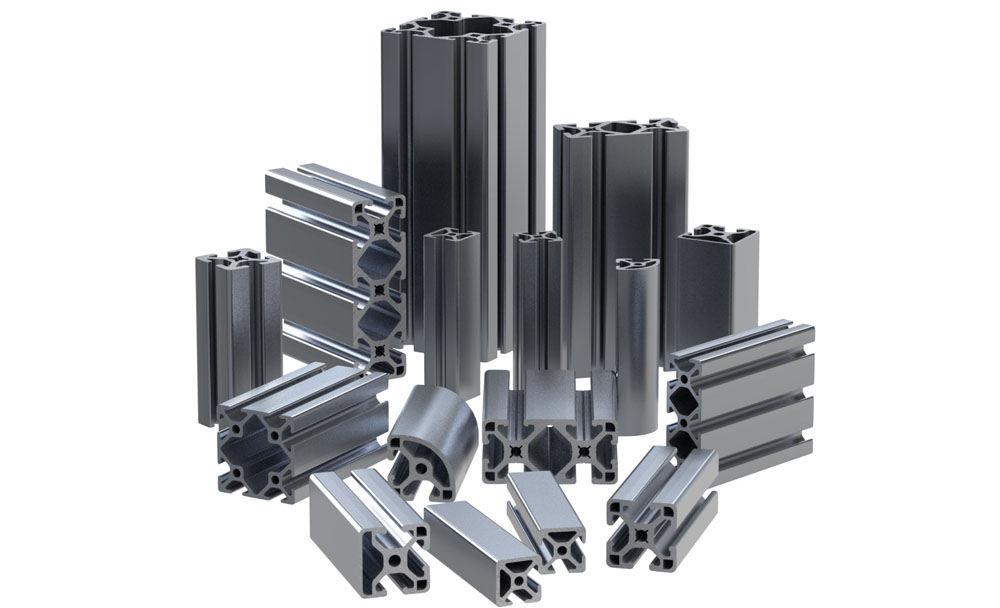 AHU Aluminium Profile: A Comprehensive Guide
 -
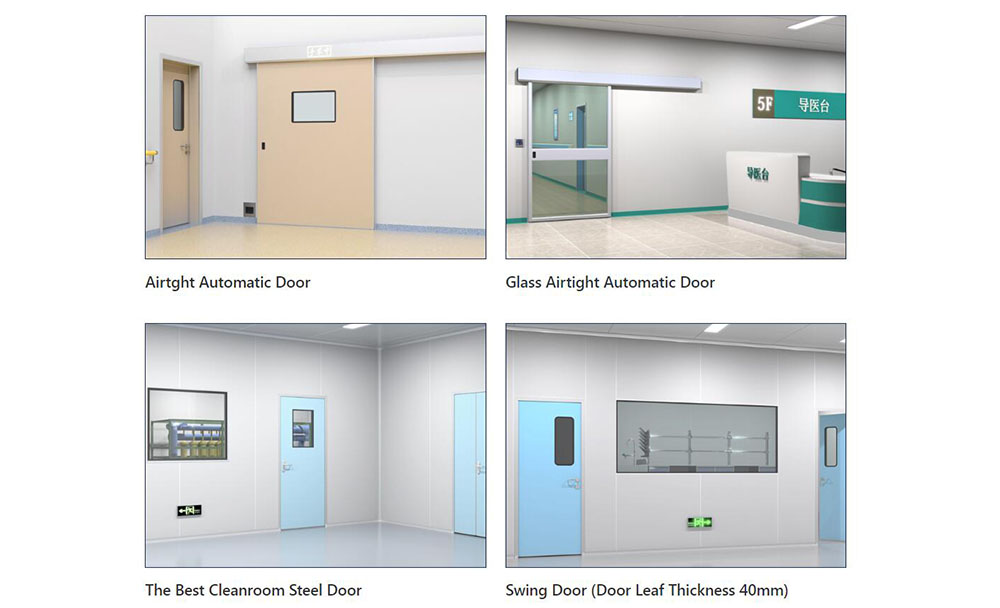 The Importance of Choosing the Right Cleanroom Door in Vietnam
 -
 The Benefits of Hospital Automatic Doors: Enhancing Efficiency and Safety
 -
.jpg) The Best Bathroom Door Manufacturers - Unlocking Endless Possibilities!
The Best Bathroom Door Manufacturers - Unlocking Endless Possibilities! -
 Unlock the Possibilities with AJ Manufacturing Doors
 -
 Make a Statement with Manufactured Home Interior Doors!
 -
 what is aluminum profile? Aluminum Profiles for Your Home is the best option
-
 Hospital Emergency Exit Doors: 90 Minute Fire Rating Meets Infection Control
 -
 ICU and Isolation Door Requirements Hospitals Often Overlook
 -
 Laboratory Door Requirements for BSL-2 and BSL-3 Containment
 -
 Retrofitting Hospital Sliding Doors: Upgrade Wards Without a Rebuild
 -
 Why Airtight Hospital Sliding Doors Are Critical for Infection Control
 -
 Automatic cleanroom door systems: sensor, actuator and access control integration
 -
 Cleanroom Door Materials: Stainless Steel vs HPL vs FRP vs Aluminum Comparison
 -
 X-Ray Room Door Buying Guide: Lead Thickness & Compliance
 -
 Operating Room Doors: Hermetic & Infection-Control Guide
 -
 Hospital ICU Door Selection: Sealing, Sterility & Workflow




-

Home
-

Tel
-

Email
-

Contact


Guangzhou Yizhong Aluminum Industry Co., Ltd.
We are always providing our customers with reliable products and considerate services.
We are always providing our customers with reliable products and considerate services.
Speak Your Mind