
Cleanroom Steel Door vs HPL Door: Which One Fits Your Project
When project budgets are tight, project teams often choose HPL doors first on the procurement list. However, once GMP validation kicks in or frequent VHP decontamination becomes necessary, QA and site supervisors will relentlessly push for steel doors. Consequently, this tug-of-war between initial cost and long-term compliance plays out in almost every project during the detailed design phase.
When evaluating cleanroom steel door vs hpl door, simply comparing unit prices can lead to massive losses in later operations. Therefore, today we will skip the basic material science. Instead, we will dive into the real differences between these two mainstream cleanroom door materials from the perspectives of engineering implementation and Total Cost of Ownership (TCO). Furthermore, we will break it all down to help you clarify the selection logic and ensure every penny of your budget goes to good use.
I. Core Concept Definition
Before diving into the comparison, we must clearly define the cleanroom door specifications discussed in this article. Understanding the underlying manufacturing processes helps avoid conceptual confusion.
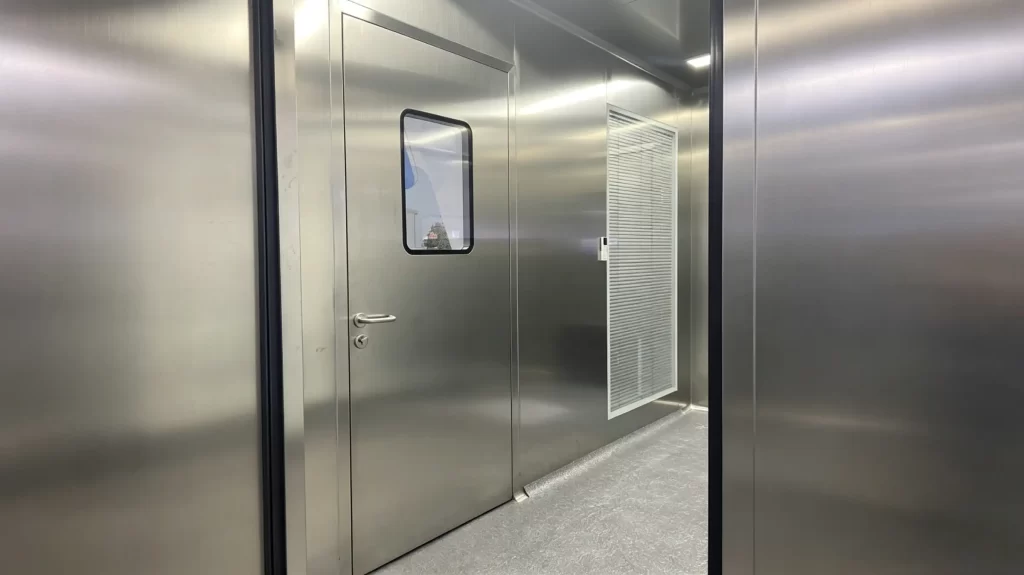
What Is a Cleanroom Steel Door?
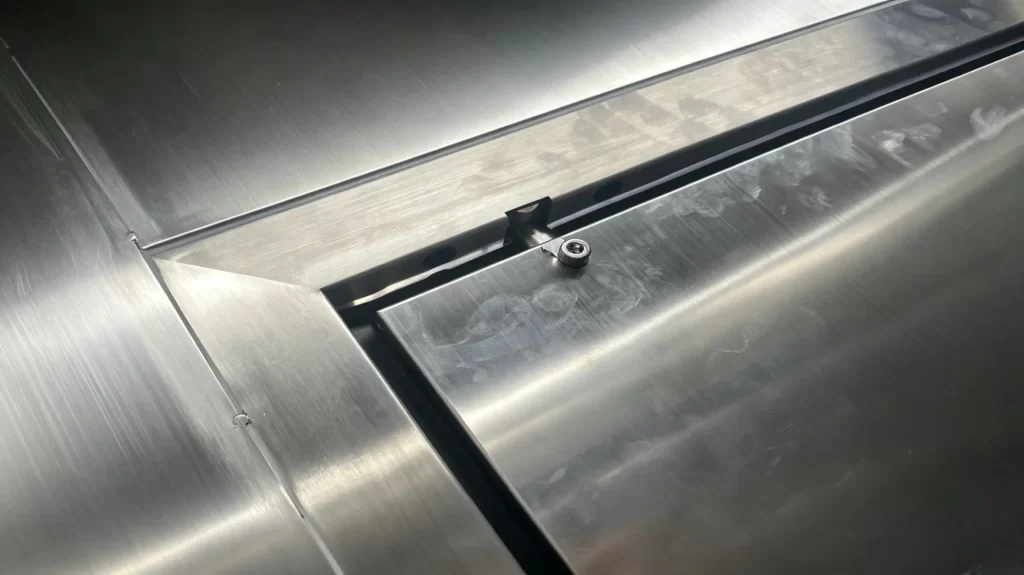
This does not refer to a solid block of iron. Rather, manufacturers construct it from high-quality galvanized steel sheets (e.g., SGCC material, typically 1.0mm-1.5mm thick) or stainless steel sheets (SUS304/316L) as face panels. Additionally, manufacturers fill the core with high-density rock wool, aluminum honeycomb, or PU foam. They then treat the surface with electrostatic powder coating or fluorocarbon spraying. Ultimately, its core lies in the fully rigid structure of a metal frame combined with a metal panel.
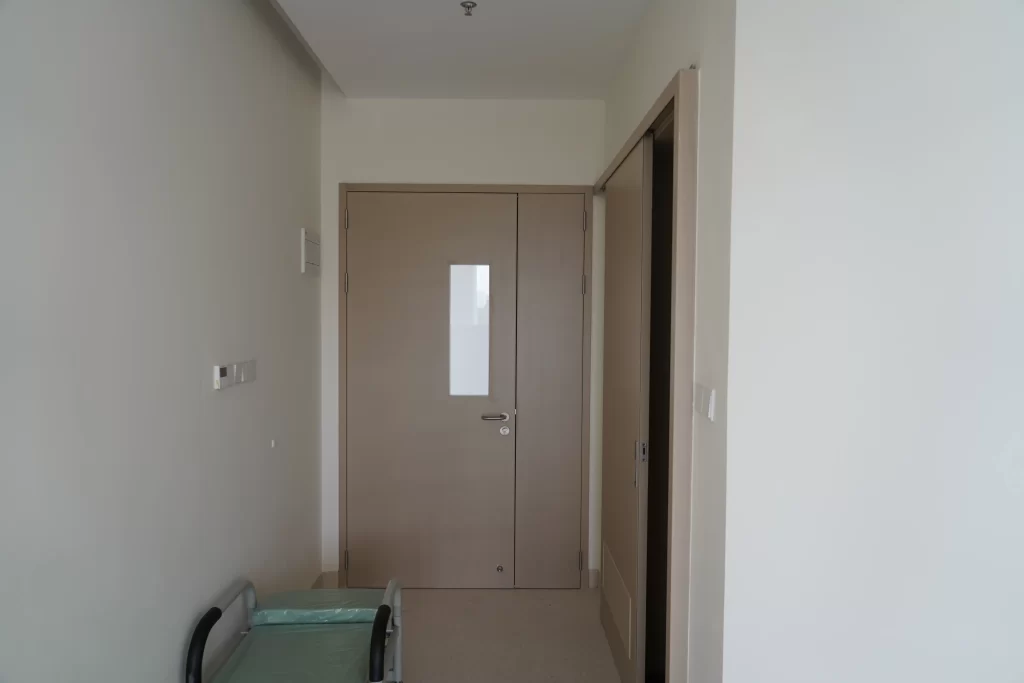
What Is a Cleanroom HPL Door?
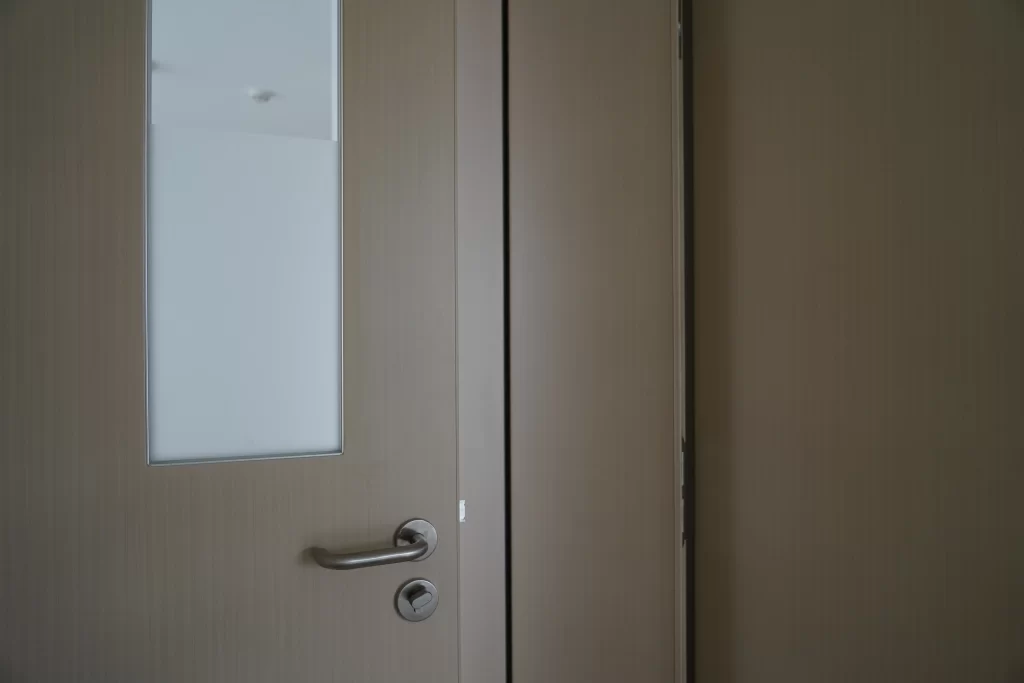
The surface uses HPL (High Pressure Laminate). Specifically, HPL forms a composite material when manufacturers impregnate multiple layers of imported decorative color paper and kraft paper with melamine and phenolic resins. They then press these layers under high temperature and high pressure. Moreover, manufacturers usually use aluminum honeycomb or high-strength flame-retardant PU foam as the core, which they bond through a lamination process. Thus, its core lies in the lightweight structure of a non-metallic finish combined with a composite core.
II. Hardcore Performance Comparison
Now let us examine how these two door types perform across critical metrics.
1. Material Strength and Impact Resistance
In a cleanroom, doors must not only meet airtightness requirements but also withstand collisions from material carts and pallets. As a result, this directly relates to the compliance of cleanroom door impact resistance.
Steel Door Performance
Since both the frame and panels consist of metal, steel doors possess extremely high structural rigidity. For instance, taking a 1.2mm thick galvanized steel sheet as an example, in a standard falling ball impact test, the steel plate may suffer minor local dents. However, the overall door leaf structure rarely undergoes plastic deformation. Consequently, this ensures the frame engagement and airtightness remain intact. Therefore, for heavy-duty material passages, steel doors serve as the ultimate physical barrier.
HPL Door Performance
While the HPL material itself has extremely high surface hardness, its resistance to blunt impact heavily depends on the internal core. When violent impacts strike, the HPL surface may not rupture. Yet, the impact force directly transmits to the interior. This can cause the aluminum honeycomb core to delaminate or crush, forming internal hidden damage. Unfortunately, this structural damage proves irreversible and extremely difficult to restore through surface repairs.
2. Cleanability and Disinfection Tolerance
For pharmaceutical and biosafety laboratories, the door surface must withstand high-intensity chemical disinfection. Hence, this serves as the core indicator for evaluating VHP resistant cleanroom doors, which directly impacts cleanroom door maintenance costs.
Steel Door Performance
The surface remains dense, non-porous, and free of splicing seams. Moreover, a stainless steel door or a steel door with high-quality fluorocarbon paint can perfectly withstand 35% concentration VHP space decontamination. After hundreds of VHP cycles, the surface maintains an extremely low roughness (Ra value ≤0.4μm). As a result, it will not shed particles or breed bacteria.
HPL Door Performance
The HPL surface stays extremely smooth and demonstrates excellent stain resistance against conventional disinfectants like 75% alcohol. However, its fatal weakness lies in long-term exposure to high-concentration VHP. Specifically, the strong oxidizing property of VHP will cause microscopic degradation of the melamine resin layer. This manifests as fading and loss of gloss. Once the gloss disappears, the surface roughness increases, making it more prone to trapping dirt.
3. Corrosion Resistance and Edge Sealing
Cleanroom doors require frequent wiping. Therefore, edge treatment serves as the core test of craftsmanship and the weak point for moisture intrusion.
Steel Door Performance
Galvanized steel sheets have excellent rust-proof capabilities. Additionally, manufacturers usually treat the edges with stainless steel edge banding or full-weld grinding, providing excellent overall sealing. Consequently, moisture and disinfectants cannot penetrate the door interior. Note, however, that if hard objects deeply scratch a standard painted steel door, the exposed steel may rust. Therefore, we highly recommend stainless steel or high-film-thickness paint for core areas.
HPL Door Performance
The HPL panel itself has excellent corrosion resistance, but the risk lies entirely in the edge banding. Typically, HPL doors use PVC or aluminum alloy edge banding bonded with PUR glue. If long-term wiping damages the edge banding, moisture will seep into the internal core. This causes the core to expand and mold, leading to the direct scrapping of the entire door leaf.
4. Cost and Lifecycle Maintenance
Procurement cannot just look at the initial quote. Rather, it must evaluate the true cleanroom door cost by combining CAPEX and OPEX.
Initial Procurement Cost (CAPEX)
The initial procurement cost of HPL doors typically runs 15% to 30% lower than that of high-quality painted steel doors. Therefore, in projects with tight budgets, HPL doors prove highly attractive.
Maintenance Cost (OPEX)
For steel doors, minor surface scratches allow repair with a touch-up pen. Moreover, workers can locally correct slight deformations, and replacing worn hardware remains relatively easy. Conversely, for HPL doors, surface scratches cannot be repaired. Once the edge suffers damage, workers usually need to replace the entire door. Furthermore, this replacement period may affect the pressure balance and normal production, resulting in extremely high hidden downtime costs.
TCO Conclusion
In low-frequency traffic areas with no risk of heavy impact, the 10-year TCO of HPL doors stays lower. However, in areas with high-frequency traffic or requiring frequent VHP decontamination, steel doors offer a more advantageous 10-year TCO due to their ultra-long service life and extremely low maintenance rate.
III. Scenario Matching Guide
Talking about selection without specific scenarios remains purely theoretical. Therefore, after clarifying the performance boundaries of cleanroom steel door vs hpl door, here we present a practical selection decision tree based on ISO 14644 and GMP standards.
Scenario 1: Core Production Areas / Grade A or B Clean Zones
Recommended Selection: Cleanroom Steel Door (Stainless steel or high-quality painted steel doors preferred).
Engineering Logic: As the core configuration for pharmaceutical cleanroom doors, Grade A/B areas serve as the absolute core of contamination control. Moreover, they require frequent VHP space decontamination and have extremely strict requirements for particle generation. Steel doors have stable structures and can withstand greater pressure differentials. Additionally, they integrate more easily with pass-through boxes or complex interlocking control systems.
Scenario 2: Material Passages / Logistics Corridors
Recommended Selection: Steel Door (Must be equipped with anti-collision plates).
Engineering Logic: This serves as the high-impact zone where carts and pallets frequently enter and exit. The high impact resistance of steel doors can withstand daily physical collisions. Consequently, this protects the door structure from deformation and ensures the long-term effectiveness of the airtight seals. Therefore, we recommend installing 304 stainless steel anti-collision plates on the lower half of the door leaf to solve the most vulnerable problem at the lowest cost.
Scenario 3: Personnel Gowning Areas / Grade C or D Clean Zones
Recommended Selection: Cleanroom HPL Door.
Engineering Logic: These areas mainly serve personnel traffic, with no risk of heavy impact. HPL doors offer rich colors and textures, which can effectively alleviate the visual oppression of enclosed cleanroom spaces. More importantly, under the premise of meeting GMP Grade C/D requirements, HPL doors can significantly save the project's initial budget.
Scenario 4: Biosafety Laboratories / Hospital Operating Rooms / Semiconductor Cleanrooms
Recommended Selection: Depends on specific working conditions.
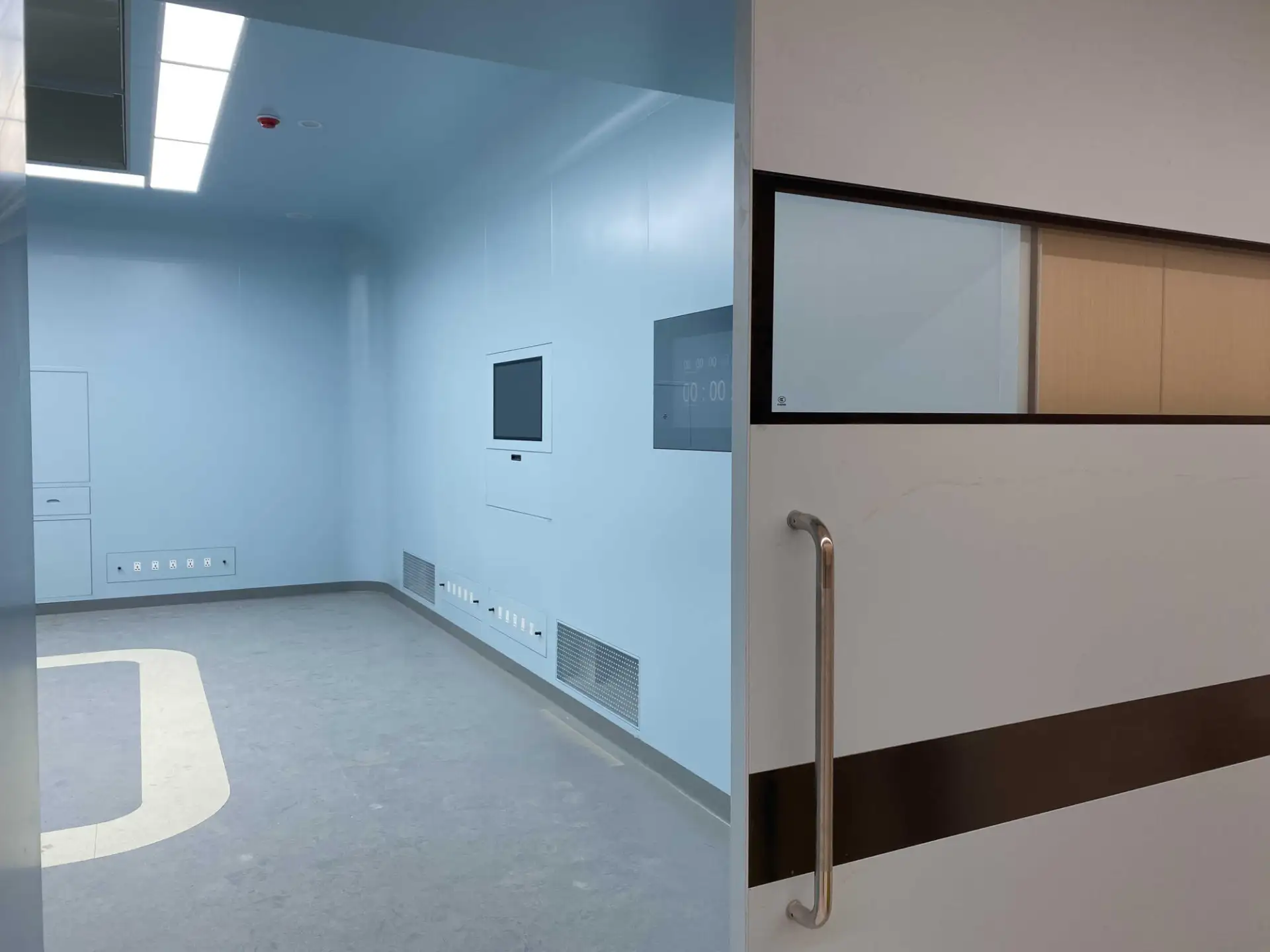
Engineering Logic: For hospital operating rooms, as high-standard hospital cleanroom doors, we prefer antibacterial painted steel doors or stainless steel doors. These can withstand frequent wiping with chlorine-based disinfectants. For semiconductor facilities, we prefer anti-static painted steel doors. They can achieve a surface resistance controlled at 10^6 to 10^9 ohms, ensuring no interference with precision processes like photolithography. For BSL-2/BSL-3 laboratories, if terminal VHP decontamination becomes necessary, teams must select stainless steel doors to ensure absolute biosafety.
IV. Engineering and Procurement Pitfall Guide
Whether you ultimately choose steel or HPL doors, when interfacing with cleanroom door manufacturers or cleanroom door suppliers, ignoring the following engineering details will lead to project acceptance failure.
Hardware Compatibility
Cleanroom doors must never use standard commercial hardware. Rather, cleanroom-specific hardware remains mandatory. Hinges must be lift-off hinges to avoid friction and particle generation. Moreover, teams must equip an automatic drop seal to ensure airtightness. Since HPL door leaves are lighter, teams must pay special attention to the load-bearing matching of hardware to prevent sagging.
Door Frame Installation and Wall Adaptation
Cleanroom door frames usually adopt a T-shaped or C-shaped profile to adapt to different wall thicknesses. During installation, workers must fully fill the gap between the door frame and the wall with polyurethane foam. They should then seal it with neutral silicone weatherproof sealant on both sides. Never use cement mortar for gap filling, as later settlement may cause the door frame to deform.
Interlocking Systems and Fire Alarm Integration
Manufacturers often equip cleanroom doors with electronic interlocking systems. When procuring, procurement teams must clearly specify the fire alarm integration requirements. In the event of a power outage or fire alarm, the electromagnetic lock must automatically release (Fail-safe) to ensure unobstructed escape for personnel.
Edge Banding Process and Fire Inspection
For HPL doors, procurement teams must inspect the factory's edge banding process. Moreover, we prefer manufacturers using PUR hot melt adhesive or laser edge banding. Additionally, when facing strict fire inspections, HPL doors must provide a B1 grade or above combustion performance test report for the internal core material. Many projects have seen supervisors reject entire batches of HPL doors because suppliers could not provide qualified core material fireproof certificates. Therefore, procurement teams must write this into the technical agreement during bidding.
V. Conclusion
In summary, the selection of cleanroom steel door vs hpl door essentially balances structural strength against initial cost-effectiveness. Steel doors win with their rock-solid stability and fearlessness towards extreme decontamination. Conversely, HPL doors win with their wear-resistant surfaces and rich colors, serving as a highly cost-effective choice for low-risk areas.
Ultimately, there is no absolutely perfect door, only the door that best matches the working conditions. If you find yourself hesitating about the specific cleanroom grade, flow line planning, or fire protection requirements for your project, please feel free to contact our cleanroom door control experts. We provide customized selection solutions and precise quotations based on actual working conditions.
-
 Cleanroom Glass Windows Are The Key to Maintaining a Clean Environment
 -
 Top Aluminium Profile Manufacturers in China: Leading the Global Market
 -
 The Evolution of Air Tight Sliding Doors
 -
 AHU Aluminium Profile: A Comprehensive Guide
 -
 The Importance of Choosing the Right Cleanroom Door in Vietnam
 -
 The Benefits of Hospital Automatic Doors: Enhancing Efficiency and Safety
 -
.jpg) The Best Bathroom Door Manufacturers - Unlocking Endless Possibilities!
The Best Bathroom Door Manufacturers - Unlocking Endless Possibilities! -
 Unlock the Possibilities with AJ Manufacturing Doors
 -
 Make a Statement with Manufactured Home Interior Doors!
 -
 what is aluminum profile? Aluminum Profiles for Your Home is the best option
-
 Hospital Emergency Exit Doors: 90 Minute Fire Rating Meets Infection Control
 -
 ICU and Isolation Door Requirements Hospitals Often Overlook
 -
 Laboratory Door Requirements for BSL-2 and BSL-3 Containment
 -
 Retrofitting Hospital Sliding Doors: Upgrade Wards Without a Rebuild
 -
 Why Airtight Hospital Sliding Doors Are Critical for Infection Control
 -
 Automatic cleanroom door systems: sensor, actuator and access control integration
 -
 Cleanroom Door Materials: Stainless Steel vs HPL vs FRP vs Aluminum Comparison
 -
 X-Ray Room Door Buying Guide: Lead Thickness & Compliance
 -
 Operating Room Doors: Hermetic & Infection-Control Guide
 -
 Hospital ICU Door Selection: Sealing, Sterility & Workflow



-

Home
-

Tel
-

Email
-

Contact


Guangzhou Yizhong Aluminum Industry Co., Ltd.
We are always providing our customers with reliable products and considerate services.
We are always providing our customers with reliable products and considerate services.
Speak Your Mind