Cleanroom Sliding Door vs Swing Door: Which Is Better for GMP Areas?
Managing a cleanroom project brings tough choices. Choosing the right door for an airlock or core area often causes major headaches. A wrong choice causes cramped corridors and doors bumping into carts. Worse, a smoke test during a GMP audit might reveal massive pressure spikes.
GMP compliant cleanroom doors are not just passageways. They form the critical first line of defense. They maintain pressure cascades and prevent cross-contamination. The landscape of cleanroom door types for pharmaceutical facilities is complex. How do you decide? In the debate of cleanroom sliding door vs swing door, which fits your project best?
Today, we skip the dry regulatory jargon. We dive straight into real-world facility management. We will break down six critical dimensions—space, airflow, sealing, and more. This will help you nail down your selection strategy and avoid costly engineering pitfalls.
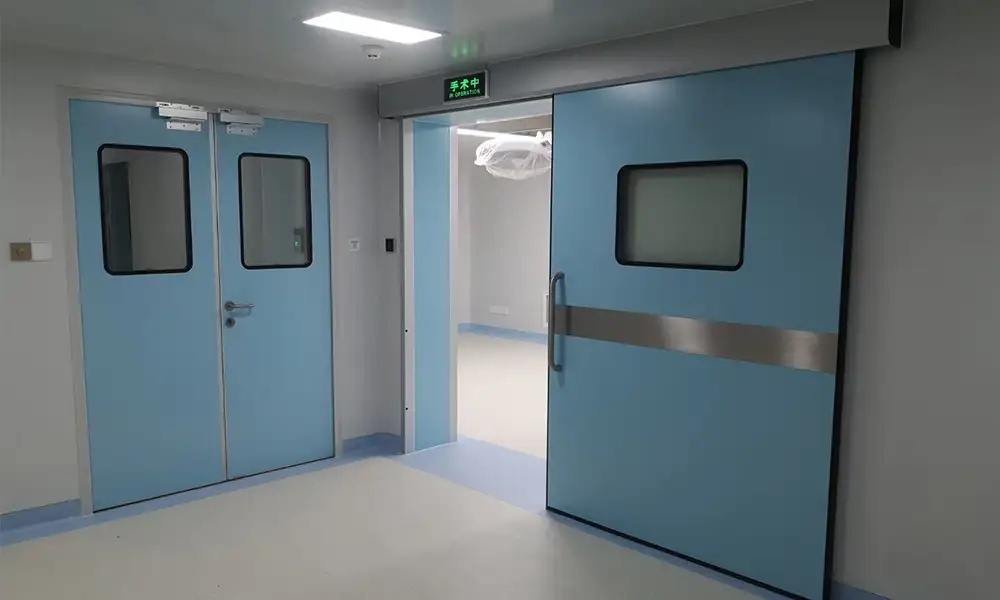
I. Core Dimensions: A Deep-Dive Comparison
1. Space Utilization & Layout Optimization
Cleanroom construction costs are notoriously high. Maximizing the "Net Cleanable Area" drives design choices. This directly impacts your ability to meet stringent cleanroom airlock door requirements.
- Swing Doors: The biggest spatial drawback is the mandatory swing radius. A standard 900mm single-leaf swing door consumes about 1.2 to 1.5 square meters of arc space when opened to 90 degrees. In narrow cleanroom corridors or compact gowning airlocks, this wastes valuable clean space. It also increases the risk of the door leaf colliding with stainless steel carts or personnel. This leads to physical damage and particle shedding.
- Sliding Doors: Sliding doors operate by moving parallel to the wall. The door leaf hides within a wall pocket or moves flush against the surface. This consumes virtually zero floor space. For space-constrained GMP areas, automatic cleanroom sliding door installation typically saves 1.5 to 2.5 square meters. This spatial efficiency allows designers to plan layouts that strictly adhere to unidirectional flow principles.
2. Airflow Disturbance & Pressure Control
Maintaining a stable pressure differential (typically 10-15 Pa) between clean zones prevents cross-contamination. Opening and closing a door directly disrupts this balance. Therefore, managing the cleanroom door pressure differential presents a dynamic challenge.
- Swing Doors: The swinging motion generates a significant "piston effect." Closing the door rapidly displaces air. This causes an instantaneous spike in local positive pressure. Conversely, opening the door creates a suction effect. These transient pressure fluctuations can reach ±5 Pa or more. They easily disrupt laminar or turbulent airflow patterns downstream of HEPA filters. This draws lower-grade air from the corridor into high-risk zones.
- Sliding Doors: The leaf moves parallel to the wall. Its physical displacement of indoor air is far less than a swing door. Modern cleanroom automatic doors typically feature Variable Frequency Drives (VFD) and soft start/stop functions. These systems control opening and closing speeds within a gentle 0.3-0.5 m/s range. This minimizes airflow disturbance and pressure fluctuations. It helps the HVAC system maintain dynamic airflow balance. This meets the strict airflow visualization requirements of EU GMP Annex 1.
3. Sealing Performance & Cleanliness Maintenance
Sealing integrity blocks particle and microbial infiltration. This is especially critical in high-risk aseptic areas like ISO 5 (Grade A/B). Here, the performance of hermetic cleanroom doors is absolutely vital.
- Swing Doors: Swing doors possess an inherent structural advantage in sealing. Multi-point locking systems and heavy-duty hinges exert uniform mechanical compression. This compresses medical-grade silicone or EPDM gaskets by 30%-40% upon closure. This "hard seal" effectively resists pressure differentials on both sides. It ensures exceptional airtightness. However, over time, cleanroom swing door seal replacement becomes a routine maintenance necessity. This guarantees sustained sealing efficacy.
- Sliding Doors: Edge and bottom sealing have historically challenged sliding door designs. The moving leaf cannot apply vertical compression like a swing door. However, high-end GMP-grade sliding doors bridge this gap through innovative designs. For instance, they feature automatic drop seals. These deploy upon closure to compress tightly against the floor. Alternatively, they use inflatable seals. These expand to form a hermetic bond with the frame once the door closes. Paired with precision track alignment, modern cleanroom door seals technology enables sliding doors to meet ISO 5-level particle control requirements. This keeps leakage rates exceptionally low.
4. Traffic Frequency & Personnel Flow
Personnel generate the most particles and microbial contamination in a cleanroom. Optimizing personnel flow minimizes contact and dwell time. This is a crucial aspect of GMP management. Therefore, touchless cleanroom entry represents a clear industry trend.
- Swing Doors: Manual swing doors easily become bottlenecks in high-traffic areas. Personnel must use their hands to operate the handle. This increases the risk of transferring hand bioburden to the door surface. It is also highly inconvenient when carrying items. Upgrading to automatic swing doors helps. However, anti-pinch safety standards (such as EN 16005) restrict their opening speeds. This limits the improvement in traffic efficiency.
- Sliding Doors: Automatic sliding doors enable touchless entry perfectly. Non-contact sensors like microwave radars, infrared photoelectric sensors, or foot switches trigger the door. The door opens smoothly and automatically as personnel approach. In high-traffic areas like gowning airlocks or main corridors, automatic sliding doors significantly enhance flow efficiency. They eliminate cross-contamination risks associated with hand contact. This perfectly aligns with strict GMP requirements for personnel hygiene.
5. Equipment Access & Logistics Efficiency
A cleanroom houses large-scale process equipment, not just personnel. Door selection for logistics corridors must account for equipment dimensions. This directly ties into ISO 7 cleanroom door specifications and higher-tier logistics design.
- Swing Doors: Double-leaf swing doors or rebate doors possess an unbeatable logistics advantage. Opening both leaves to 180 degrees provides a maximized net clear opening. This width virtually equals the total frame width. This allows large bioreactors, isolators, or massive filling lines to pass through smoothly. Thus, they are the standard configuration for logistics main entrances in pharmaceutical cleanroom doors.
- Sliding Doors: Wall length and leaf overlapping ratios limit sliding doors. The overlap is typically 50% or 60%. Therefore, the maximum effective pass-through width is usually only half of the total frame width. For example, a 2000mm wide opening yields a net clear width of only 1000mm with a double-leaf sliding door. Multi-leaf telescopic sliding door systems can solve this for extra-wide corridors. However, they significantly increase mechanical complexity and failure rates. This causes initial procurement and long-term maintenance costs to skyrocket.
6. Maintenance Cost & Compliance Auditing
In GMP environments, equipment cleanability and Life Cycle Cost (LCC) drive audits and operations. Facilities must establish and execute a comprehensive cleanroom door maintenance checklist. This is a mandatory compliance requirement.
- Swing Doors: The mechanical structure is relatively simple. It primarily consists of hinges, closers, and handles. Daily maintenance costs remain low. The flat surfaces lack obvious dirt-trapping dead corners. This makes passing cleaning validation during GMP audits easier. Main maintenance tasks include periodic hinge lubrication, closer force adjustment, and checking for gasket degradation.
- Sliding Doors: Sliding doors demand stricter maintenance. The top sliding track or floor track is a "hotspot" for particle and microbial deposition. Facilities must incorporate cleanroom sliding door track cleaning into strict, periodic cleaning Standard Operating Procedures (SOPs). This requires specialized lint-free tools and compatible disinfectants like VHP or isopropanol. Additionally, automatic motors, timing belts, sensors, and complex sealing mechanisms require regular calibration and Preventive Maintenance (PM). This ensures the sealing pressure upon closure always meets specifications. Although initial and long-term maintenance costs are slightly higher, automation efficiency gains typically offset these expenses.
II. GMP Scenario Selection Decision Matrix
The debate of cleanroom sliding door vs swing door has no absolute winner. It all comes down to matching the right door to the specific application scenario. Below is a selection decision matrix based on EU GMP Annex 1 and ISO 14644 standards:
Scenarios Recommending Swing Doors:
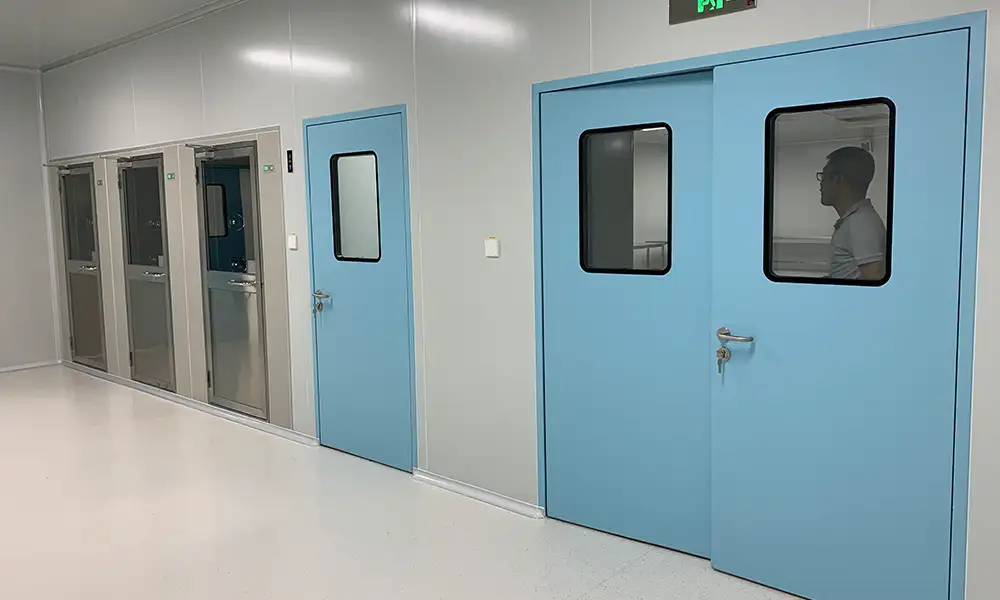
- High-Cleanliness Core Risk Areas: Such as aseptic filling zones, isolator operation areas, and cell culture rooms (typically ISO 5 / Grade A/B). These areas demand extreme pressure stability and sealing, making the mechanical compression of swing doors the most reliable choice.
- Main Logistics Entrances for Large Equipment: Areas requiring frequent access for large process equipment, Automated Guided Vehicles (AGVs), or large material pallets. Double-leaf swing doors provide an unobstructed, maximum net clear opening.
- Budget-Sensitive, Low-Traffic Auxiliary Areas: Such as equipment mezzanines or lower-grade cleanrooms, where simple mechanical structures can reduce initial investment and maintenance complexity.
Scenarios Recommending Sliding Doors:
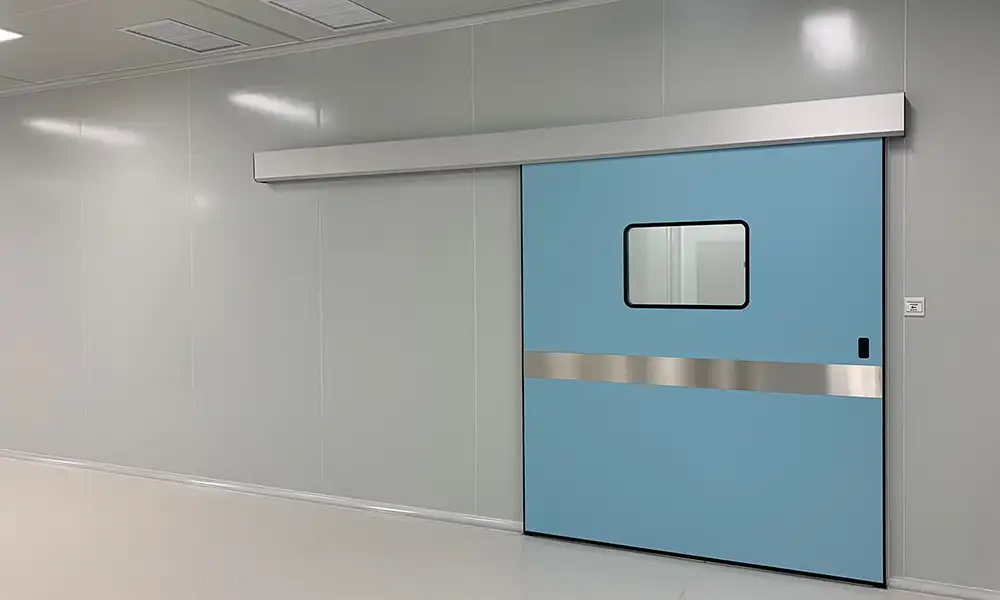
- Space-Constrained Transition Areas: Such as personnel gowning airlocks and material airlocks. Sliding doors effectively prevent the spatial waste and personnel congestion caused by swing radii.
- Medium-to-Low Cleanliness & High-Traffic Areas: Such as packaging zones, QC lab corridors, or CNC (Controlled Not Classified) areas (typically ISO 7/8 or Grade C/D). With frequent personnel flow, the touchless entry of automatic sliding doors significantly boosts efficiency and lowers cross-contamination risks.
- Dynamic Balance Areas Sensitive to Airflow Disturbance: When the HVAC system has limited air volume margin and cannot withstand the severe "piston effect" pressure fluctuations caused by swing doors, sliding doors equipped with soft start/stop functions are the superior solution.
III. Conclusion
In cleanroom engineering, door selection is a systematic decision. You must balance space, airflow, sealing, logistics, and maintenance. Swing doors dominate core areas with superior sealing and large openings. Sliding doors offer high space utilization and touchless efficiency. They are the ideal solution for compact layouts and high-traffic flows. The right choice must strictly anchor to your specific cleanliness class, spatial layout constraints, and daily operational flow needs.
Unsure which door fits your GMP area? Submit your door opening dimensions and target cleanliness class (e.g., ISO 7 / Grade C). Our cleanroom door control system experts will provide a free, customized compliant selection proposal and 3D layout evaluation.
-
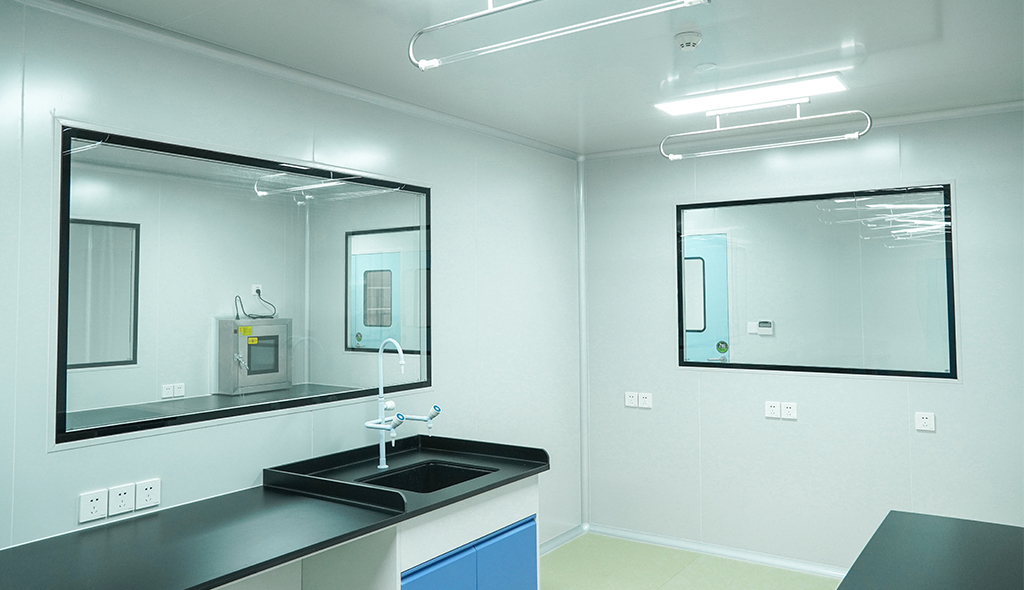 Cleanroom Glass Windows Are The Key to Maintaining a Clean Environment
 -
 Top Aluminium Profile Manufacturers in China: Leading the Global Market
 -
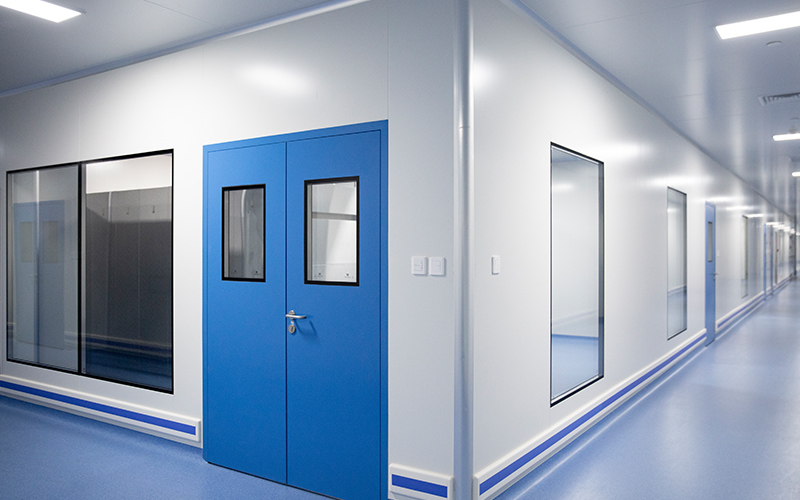 The Evolution of Air Tight Sliding Doors
 -
 AHU Aluminium Profile: A Comprehensive Guide
 -
 The Importance of Choosing the Right Cleanroom Door in Vietnam
 -
 The Benefits of Hospital Automatic Doors: Enhancing Efficiency and Safety
 -
.jpg) The Best Bathroom Door Manufacturers - Unlocking Endless Possibilities!
The Best Bathroom Door Manufacturers - Unlocking Endless Possibilities! -
 Unlock the Possibilities with AJ Manufacturing Doors
 -
 Make a Statement with Manufactured Home Interior Doors!
 -
 what is aluminum profile? Aluminum Profiles for Your Home is the best option
-
 5 Hermetic Door Mistakes That Break the Seal
 -
 Hospital Room Door Size by Room Type: Width and Clearance
 -
 Retrofit Manual Doors with Electronic Glass Operators
 -
 Hospital Emergency Exit Doors: 90 Minute Fire Rating Meets Infection Control
 -
 ICU and Isolation Door Requirements Hospitals Often Overlook
 -
 Laboratory Door Requirements for BSL-2 and BSL-3 Containment
 -
 Retrofitting Hospital Sliding Doors: Upgrade Wards Without a Rebuild
 -
 Why Airtight Hospital Sliding Doors Are Critical for Infection Control
 -
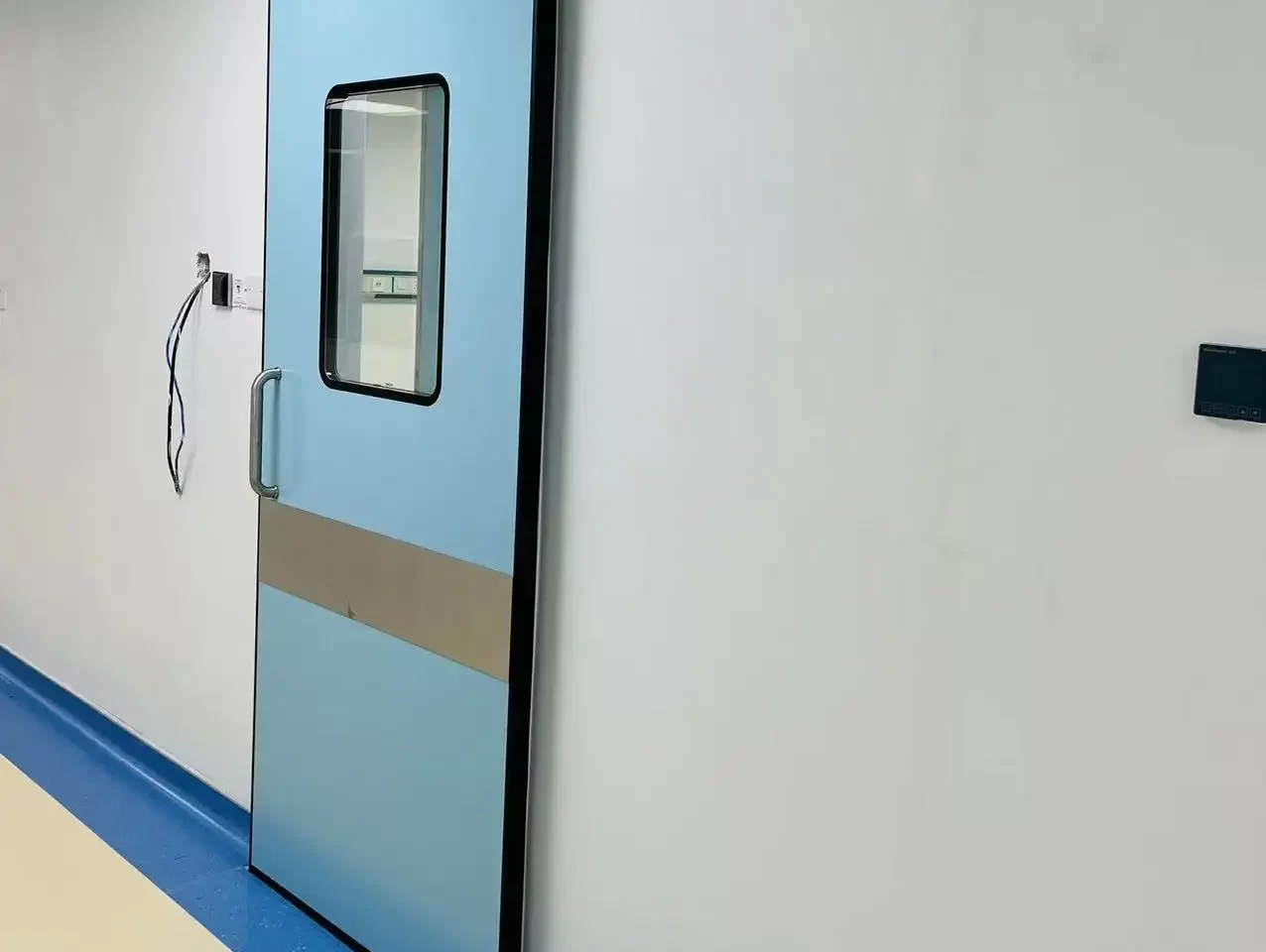 Automatic cleanroom door systems: sensor, actuator and access control integration
 -
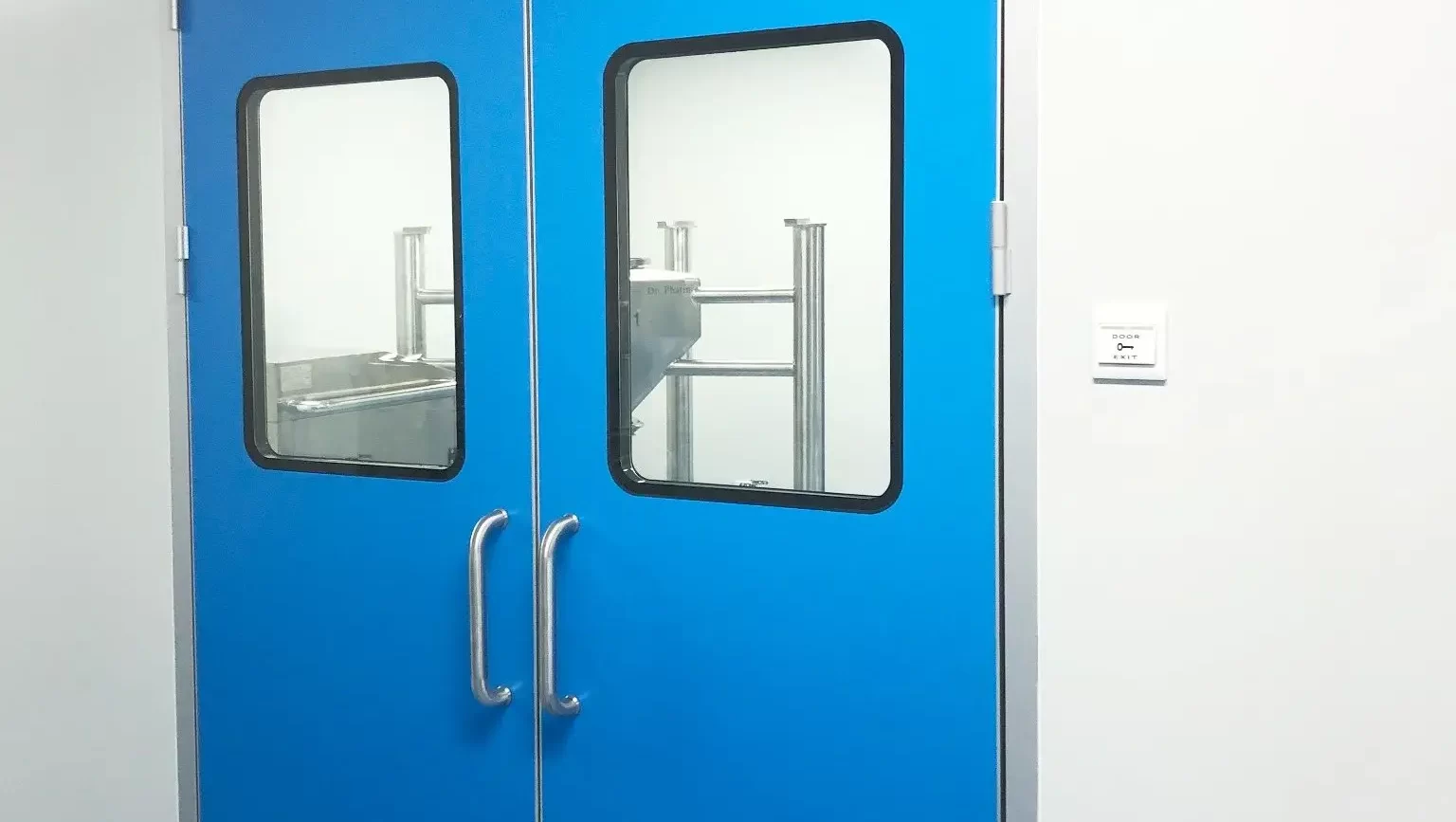 Cleanroom Door Materials: Stainless Steel vs HPL vs FRP vs Aluminum Comparison

-

Home
-

Tel
-

Email
-

Contact


Guangzhou Yizhong Aluminum Industry Co., Ltd.
We are always providing our customers with reliable products and considerate services.
We are always providing our customers with reliable products and considerate services.
Speak Your Mind