
Hospital Double Doors for Emergency, Ward and Equipment Access
I. The Temperature and Efficiency Behind the Door
Imagine an emergency corridor at 2:00 AM. You hear the rolling sound of gurneys and the hurried footsteps of medical staff. A door opens repeatedly and forcefully.
In modern healthcare architecture, a hospital double door is never just a cold building material. It is a critical hub among healthcare facility doors. Specifically, it serves as:
- The "speed channel" for saving lives in the emergency room.
- The "vital gateway" for the safe entry of large imaging equipment.
- The "acoustic barrier" guarding patient sleep in the wards.
- The "airtight defense line" blocking cross-infection in operating rooms.
For hospital developers, medical contractors, and procurement officers, selecting products that meet strict hospital door standards is paramount. In our actual engineering practice, we have found a clear pattern. Every compromised parameter during selection causes future problems. These include frequent maintenance requests from medical staff, patient discomfort, or even infection control hazards. Therefore, an excellent set of medical double doors must withstand hundreds of physical impacts daily. Furthermore, it must deeply align with the real pain points of clinical workflows.
This article takes you back to real clinical scenarios. We will deeply analyze the actual demands for hospital door systems across four core areas. Consequently, we provide a professional configuration guide that truly understands healthcare and engineering.
II. Emergency Corridors: Emergency Workflows and Safety Protection
The Emergency Department (ED) is the frontline of any hospital. The design of its hospital entrance doors must adhere to two core principles: racing against time and absolute safety. In this scenario, the primary task of a hospital double door is to ensure unimpeded emergency workflows. Additionally, it must withstand high-frequency, high-impact physical stress.
2.1 Strict Standards for Clear Width and Opening Mechanisms
Standard medical stretchers are typically 600mm–700mm wide. Medical staff need space to push from both sides. They also need room for emergency equipment like portable ventilators. Therefore, the effective clear width of an ED double door must be ≥ 1400mm. In some large general hospitals, the main ED corridor requires up to 1600mm. For opening mechanisms, hospital automatic doors are a preferred choice. Alternatively, heavy-duty manual double doors equipped with delayed-action closers work well. A 15- to 30-second delay ensures stretcher fleets pass smoothly. This prevents the door from rebounding prematurely and causing secondary injuries.
2.2 Ultimate Impact Resistance and Durability
The ED corridor is the most frequently impacted area in a hospital. Compliant with hospital door specifications, contractors must equip the lower section of the door leaf with high-strength stainless steel kick plates. These plates must be ≥ 400mm in height. Installers should mount them flush or recessed to prevent catching clothing. Furthermore, the internal door frame must utilize thickened galvanized steel. This is a fundamental requirement for premium medical facility doors. It allows the door to resist long-term impacts from stretcher wheels without deforming.
2.3 Fire Compliance and Emergency Egress
As hospital fire rated doors, ED double doors must meet stringent fire safety codes. They typically require EI 90 or EI 120 certification. This guarantees 90 to 120 minutes of fire integrity and insulation. Furthermore, contractors must install code-compliant panic hardware on the egress side. This is a critical component of hospital door hardware. It ensures that during a power outage or emergency evacuation, individuals can instantly open the door. They only need to apply minimal force, typically ≤ 60N.
III. Equipment Access: Guaranteeing Safe Entry for Large Equipment
Large medical equipment features massive dimensions and extreme weight. For example, a 3.0T MRI scanner can weigh 5 to 8 tons. It is also highly sensitive to vibration. Poorly designed hospital double doors in equipment corridors create bottlenecks. They prevent equipment entry. Additionally, door vibrations during transport can cause irreversible damage to precision instruments.
3.1 Redundant Planning for Door Opening Dimensions
Planners cannot base doorway dimensions solely on the bare equipment size. Instead, they must account for the maximum packaged dimensions. This includes wooden crates and anti-vibration bases. According to industry-standard hospital door requirements, the clear width and height of the doorway should exceed the maximum packaged dimensions by at least 200mm to 300mm. This provides ample operational clearance and impact buffer. Consequently, it avoids last-minute engineering rework.
3.2 Frame Embedding and Structural Reinforcement
Standard expansion bolts are insufficient for heavy equipment corridors. Therefore, contractors must implement specific measures during the civil engineering phase. This is a critical step in hospital door installation. First, they must use wall-embedded steel plates or high-strength chemical anchors for deep reinforcement. Second, the door frame profile thickness should be ≥ 2.0mm. This ensures the overall structure does not shift or deform. For example, it prevents damage if hydraulic forklifts accidentally strike the frame.
3.3 Floor Transition and Impact-Resistant Door Leaves
- Floor Treatment: Equipment carts experience severe jolting at thresholds. Therefore, equipment access double doors must feature a zero-threshold design. If a threshold is mandatory for fire containment, builders must custom-fabricate a gentle ramp. The slope must be ≤ 1:12.
- Door Leaf Reinforcement: The door leaf interior requires a dense grid of reinforcing ribs. Manufacturers surface this with high-impact HPL (High-Pressure Laminate) or thickened steel plates. This is the standard configuration for professional medical door solutions.
IV. Ward Areas: Acoustic Privacy and High-Frequency Use
Inpatient wards are the core areas for patient rest and recovery. The hospital swing doors here face a dual test of "quiet" and "clean". They must isolate corridor noise and protect patient privacy. Additionally, they must withstand hundreds of daily openings and closings by medical staff, visitors, and cleaning carts.
4.1 Medical-Grade Acoustic Control
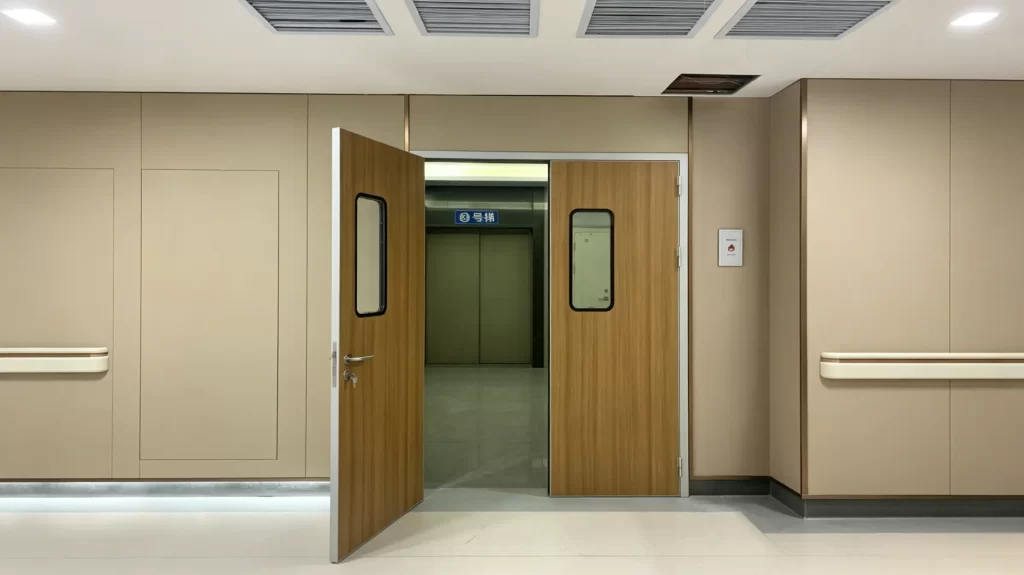
A ward door's sound insulation directly impacts patient recovery. Therefore, a professional hospital double door requires specific acoustic configurations. Manufacturers fill the door leaf with high-density mineral wool or an aluminum honeycomb core to block sound transmission. Additionally, they equip the bottom with drop seals. These seals automatically lower to fill the gap when closed. They also retract when opened. Combined with perimeter compression seals, the entire door system achieves a Sound Transmission Class (STC or Rw) of 35dB or higher. Consequently, this effectively blocks corridor noise.
4.2 Infection Control and Easy-Clean Surfaces
As critical infection control doors, ward door surfaces must possess excellent antimicrobial properties. We recommend specially treated antimicrobial HPL. Its dense, non-porous surface effectively inhibits common healthcare-associated pathogens. These include Staphylococcus aureus and E. coli. Furthermore, it withstands daily high-frequency wiping with chlorine-based disinfectants. For example, it resists 1000mg/L sodium hypochlorite without fading, peeling, or delaminating.
4.3 Human-Centric and Safety Details
- Vision Panels: Doors should feature large, flush vision panels. This allows medical staff to conduct nighttime rounds without opening the door. The glass should be double-paned tempered safety glass with rounded edges.
- Anti-Pinch Design: The door edge must feature a safe-edge design. Furthermore, the door frame corners should be rounded. This is a human-centric standard for hospital corridor doors. It maximizes safety for elderly, pediatric, and mobility-impaired patients.
V. Clean Spaces: Airtight Design and Infection Control
In clean medical spaces, the core mission of a hospital double door changes. These spaces include operating rooms, Intensive Care Units (ICUs), and Pharmacy Intravenous Admixture Services (PIVAS). Here, the door must maintain strict pressure differentials and prevent cross-infection.
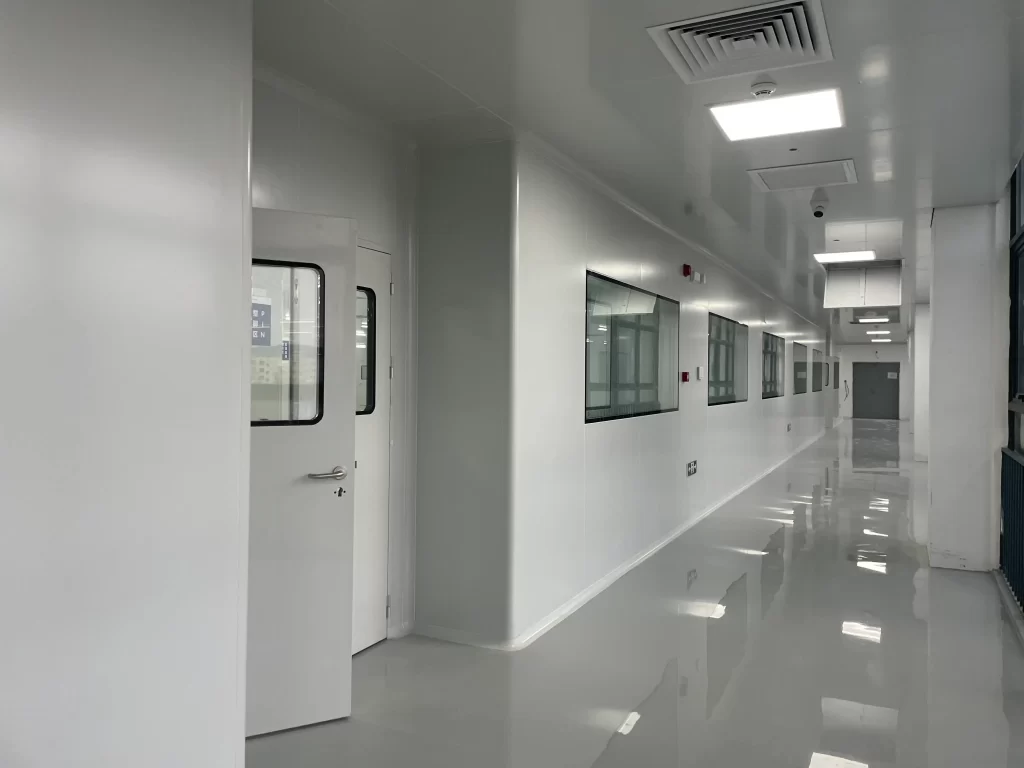
5.1 Ultimate Airtight Design
Clean area double doors must work in tandem with the hospital's HVAC system. This ensures stable positive or negative pressure. For example, operating rooms typically require a positive pressure of +5Pa to +15Pa relative to the corridor. Professional hospital cleanroom doors utilize a heavy-duty mechanical compression sealing structure. Furthermore, a multi-point locking system ensures uniform compression force on the frame seals when closed. This achieves ultimate airtightness.
5.2 Flush Design Craftsmanship
To eliminate dust accumulation, clean area double doors must achieve absolute visual and tactile flatness. This is the technical core of top-tier hospital door manufacturers.
- First, the door leaf and frame feature a flush design with no protruding lines.
- Second, manufacturers seamlessly recess or hide hardware like hinges and locks.
- Third, the door surface contains no exposed fasteners like rivets or screws.
- Finally, installers seamlessly seal all joints with medical-grade anti-mold silicone.
5.3 Smart Interlocking and Touchless Activation
- Electronic Interlocking System: In clean area anterooms, a PLC controller ensures the two doors cannot logically open simultaneously. This effectively blocks direct airflow exchange and maintains pressure stability.
- Touchless Activation: Hand contact increases cross-infection risks. Therefore, we highly recommend configuring foot sensors, elbow-activated panels, or microwave radar sensors. This represents the intelligent trend of modern medical door systems.
VI. Procurement Guide: Core Configuration and Selection Checklist
Procurement officers and contractors face complex clinical scenarios. Therefore, they must translate these requirements into specific technical parameters. Below is the core configuration checklist for a hospital double door. You can directly use this as a technical attachment for tender documents.
- Dimension Planning Logic
- Do not rely on empirical estimation. Obtain the 3D dimensions of the largest equipment or stretcher in the clinical workflow.
- Add a 200mm–300mm clearance to determine the final clear width and height of the doorway.
- Clearly label "architectural finished dimensions" on the drawings. This avoids civil engineering tolerances.
- Door Leaf Structure Selection
- Steel Doors: These offer high strength and excellent fire performance. They are the mainstream choice for hospital fire rated doors, suitable for EDs and equipment corridors.
- HPL/Resin Doors: These provide a warm texture and are antimicrobial. They suit wards, nurse stations, and areas requiring patient-friendly aesthetics.
- Internal Core: Manufacturers must use fire-rated mineral wool or high-strength aluminum honeycomb. This ensures the door leaf does not sag or deform under long-term, high-frequency use. Consequently, this strictly adheres to hospital door specifications.
- Vision Panel Configuration
- Standard Areas: Use double-paned tempered safety glass with flush glazing beads. This is easy to clean and impact-resistant.
- Radiology/Interventional Corridors: These must feature custom-fabricated leaded glass vision panels. The lead equivalence must strictly match the wall shielding standards (typically 1.5mmPb to 2.0mmPb). This ensures zero radiation leakage.
- Hardware System Standards
- Hinges: Contractors must use heavy-duty medical-grade load-bearing hinges. These require a single-leaf load capacity of ≥ 150kg and 3D adjustability. This prevents sagging and is a core requirement for hospital door hardware.
- Door Closers: Select medical-grade silent door closers with buffering functions. They feature adjustable latching speed to prevent loud slamming.
- Levers and Locks: Use lever handles with antimicrobial coatings (e.g., silver ions). Avoid spherical knobs, as they are difficult to clean. Clean areas require specialized flush-design cleanroom locks.
VII. Conclusion & Custom Consultation
Selecting a professional hospital double door is a strategic investment. It improves clinical efficiency and patient safety. Furthermore, it reduces the long-term operational costs of a healthcare facility.
Is your hospital project facing complex workflow planning? Or perhaps large equipment access modifications? If so, contact our healthcare architectural door and window expert team immediately. We provide customized dimension recommendations and door structure drawings. Additionally, we offer hardware configuration lists and installation technical support tailored to your project. This ensures fully compliant, one-stop medical door solutions that meet the latest hospital door standards.
-
 Cleanroom Glass Windows Are The Key to Maintaining a Clean Environment
 -
 Top Aluminium Profile Manufacturers in China: Leading the Global Market
 -
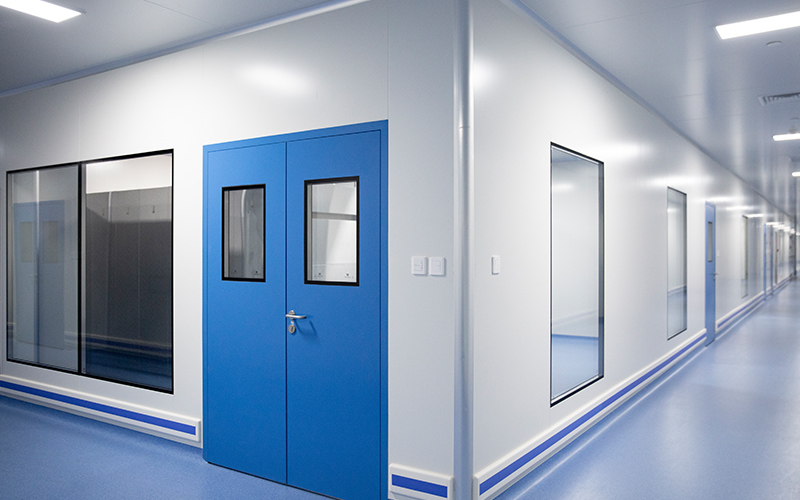 The Evolution of Air Tight Sliding Doors
 -
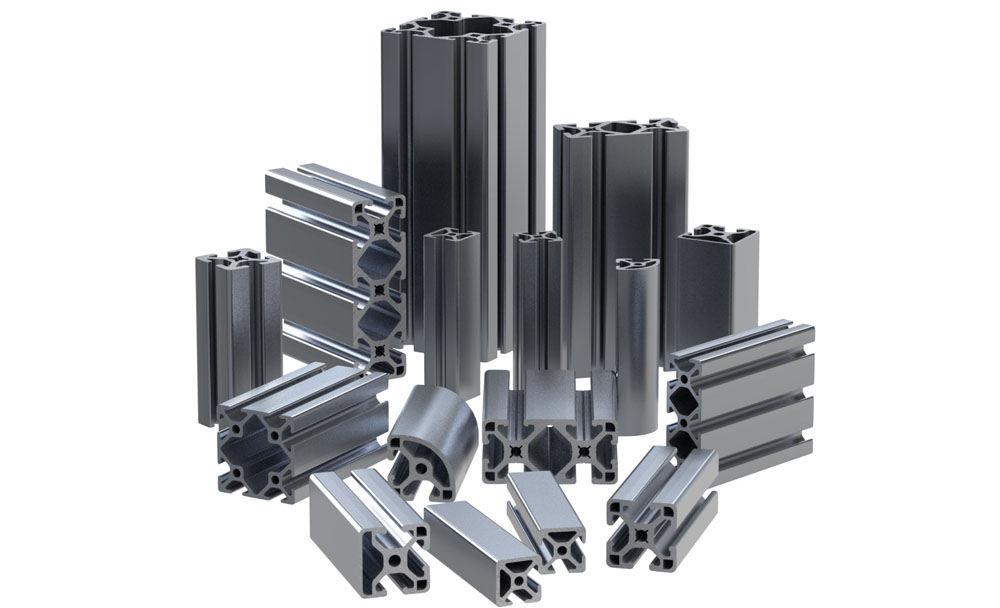 AHU Aluminium Profile: A Comprehensive Guide
 -
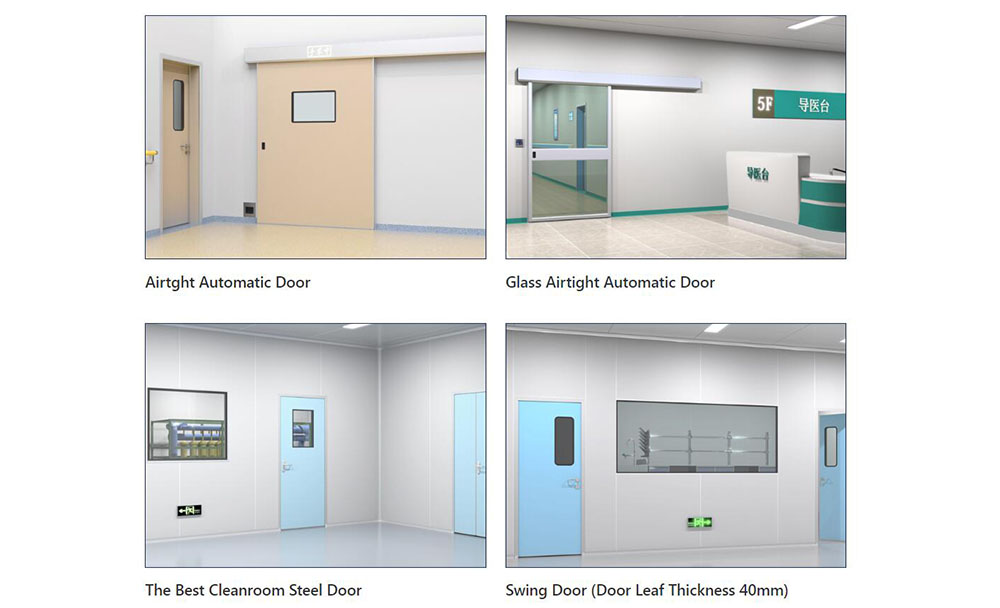 The Importance of Choosing the Right Cleanroom Door in Vietnam
 -
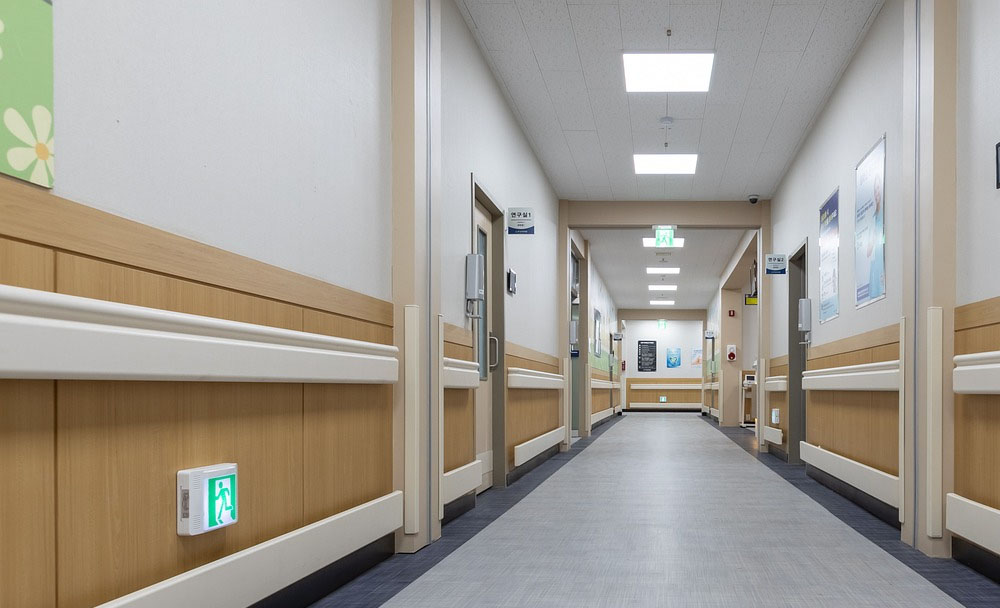 The Benefits of Hospital Automatic Doors: Enhancing Efficiency and Safety
 -
.jpg) The Best Bathroom Door Manufacturers - Unlocking Endless Possibilities!
The Best Bathroom Door Manufacturers - Unlocking Endless Possibilities! -
 Unlock the Possibilities with AJ Manufacturing Doors
 -
 Make a Statement with Manufactured Home Interior Doors!
 -
 what is aluminum profile? Aluminum Profiles for Your Home is the best option
-
 Hospital Emergency Exit Doors: 90 Minute Fire Rating Meets Infection Control
 -
 ICU and Isolation Door Requirements Hospitals Often Overlook
 -
 Laboratory Door Requirements for BSL-2 and BSL-3 Containment
 -
 Retrofitting Hospital Sliding Doors: Upgrade Wards Without a Rebuild
 -
 Why Airtight Hospital Sliding Doors Are Critical for Infection Control
 -
 Automatic cleanroom door systems: sensor, actuator and access control integration
 -
 Cleanroom Door Materials: Stainless Steel vs HPL vs FRP vs Aluminum Comparison
 -
 X-Ray Room Door Buying Guide: Lead Thickness & Compliance
 -
 Operating Room Doors: Hermetic & Infection-Control Guide
 -
 Hospital ICU Door Selection: Sealing, Sterility & Workflow




-

Home
-

Tel
-

Email
-

Contact


Guangzhou Yizhong Aluminum Industry Co., Ltd.
We are always providing our customers with reliable products and considerate services.
We are always providing our customers with reliable products and considerate services.
Speak Your Mind