GMP Stainless Steel Double Doors Configuration Guide
In pharma manufacturing and lab environments, a door isn't just something you walk through. It's a pressure boundary. A contamination control point. And when auditors walk the facility, it's one of the first things they look at.
I've seen cleanrooms fail pressure cascade tests because someone spec'd the wrong door configuration. Not the wrong brand. The wrong understanding of how air moves between rooms. This guide covers what actually matters: material grades, surface finishes, interlock logic, and seals. Based on real installations, not catalog sheets.
Understanding cGMP cleanroom door requirements
Regulators care about your final product. They also care about where every surface in your facility came from and why you chose it. Before you pick a finish or interlock type, figure out what classification you're building for.
FDA and EU GMP Annex 1 requirements
The 2022 EU GMP Annex 1 revision put Contamination Control Strategies (CCS) at the centre of the conversation. For doors, the practical impact is straightforward: no places for microbes to settle, and the door has to survive whatever your cleaning rotation throws at it.
FDA 21 CFR Part 211 is equally direct. Facility surfaces must be non-reactive, non-absorptive, and smooth. The materials can't shed particles, and they can't degrade when exposed to VHP or quaternary ammonium disinfectants.
ISO 14644 classification and door specs
Your ISO target determines your door spec. An ISO 5 (Grade A) suite and an ISO 8 (Grade D) packaging area call for different doors. Air leakage rates and particle shedding characteristics need to match the room's classification. In critical zones, the door has to let the room recover its pressure baseline after each open-close cycle.
Stopping cross-contamination at the door
Here's the physics. Opening a door creates a pressure transient. If both doors in an airlock open at once, the pressure cascade between adjacent rooms — usually 10 to 15 Pascals — collapses. Unfiltered air moves into spaces it shouldn't.
Two things prevent this: tight sealing, and an interlock that physically blocks both doors from opening at the same time.
Material selection: 304 vs. 316L stainless steel
Grade choice determines corrosion resistance, door lifespan, and whether your validation goes smoothly.
304 stainless steel: where it works and where it doesn't
304 is fine for general-purpose cleanroom environments. It welds well, forms well, handles standard cleaning agents.
The catch: no molybdenum. Without it, 304 is vulnerable to pitting and crevice corrosion from chlorides and aggressive acid disinfectants. It's acceptable for ISO 8 support areas, corridors, and non-sterile packaging zones.
316L stainless steel: what pharma actually needs
For areas where product meets environment, spec 316L. The "L" means low carbon. It prevents chromium carbide precipitation during welding, which is what creates corrosion-prone zones along weld seams.
The 2 to 3 percent molybdenum is what matters. It blocks pitting from chlorides and oxidative disinfectants like VHP. Running a sporicidal rotation? Aseptic processing suite? Use 316L.
Gowning rooms deserve a special mention. These doors sit between unclassified corridors and your ISO 7/8 manufacturing suite. They take daily hits of alcohol-based hand sanitisers and disinfectant wipes. 304 won't hold up. Spec 316L here.
Material choice by cleanroom zone
| Cleanroom Zone | Classification | Recommended Grade |
|---|---|---|
| Aseptic / Core Manufacturing | ISO 5-7 | 316L |
| Gowning Rooms & Material Airlocks | Variable Buffer | 316L |
| Support Zones / Corridors | ISO 8 | 304 (avoid chlorides) |
| Cold Rooms / High Humidity | Variable | 316L |
Seamless welded construction
Grade isn't the whole story. GMP-compliant doors need continuously welded panels, ground flush. Rivets, mechanical fasteners, and spot welds create micro-crevices. Bacteria love them. Auditors notice them.
Surface treatment and finish options
Grade handles corrosion. Finish handles cleanability.
Electropolished finish
Electropolished doors are standard in aseptic spaces. The process strips microscopic peaks off the metal surface, leaving a finish at Ra 0.4 to 0.8 micrometres. Fewer attachment points for microbes. Disinfectants sheet off cleanly. Biofilm has a harder time forming.
Electropolishing does something else worth knowing: it strengthens the passive chromium oxide layer. A 316L door with electropolished finish resists corrosion roughly 30 times better than a standard mill finish.
Brushed finish
Brushed or satin finishes (Ra 1.0 to 1.6 micrometres) cost less and hide handling scratches better than polished surfaces. The trade-off is real: those microscopic grooves trap particulates. Brushed finishes work for ISO 7 and 8 non-critical areas only.
Passivation and surface validation
After fabrication, every GMP door surface gets passivated — typically a citric or nitric acid bath — to restore the chromium oxide layer. Your manufacturer should provide surface roughness certificates (Ra values) and passivation reports (ASTM A967). These feed into your IQ/OQ documentation.
Interlocking systems and airlock configuration
The interlock is the difference between a double door and a real airlock. It enforces the pressure cascade by keeping both leaves from opening at the same time.
How interlocks work
Open Door A. A magnetic contact tells the controller to lock Door B. Modern systems use electromagnetic locks with solid-state controllers and adjustable time-delay relays. Door A has to be fully closed and re-latched before Door B releases. This stops the pressure drops that happen when doors fight each other.
Hermetic sealing and pressure differentials
Interlocks don't help if the doors leak when closed. Hermetic doors use specialised gasketing to hold pressure differential setpoints. When you're troubleshooting pressure issues in a cleanroom, door seals should be your first check. A properly configured door holds the room's pressure cascade even through minor HVAC fluctuations.
Airlock design for gowning rooms
Gowning room doors need sequential flow logic. In high-traffic facilities, cascade interlocks track direction of travel. Nobody bypasses gowning steps by wedging a door open.
Biosafety level laboratory doors
BSL-2 and BSL-3 doors tie the interlock into the exhaust system. In a BSL-3 airlock, doors interlock with negative pressure status. Pressure drops below the safe threshold, the inner door locks. The corridor stays protected.
Automation and hardware options
How the door moves affects throughput and contamination.
Automatic vs. manual
Automatic doors are the right call for ISO 5-7 areas. Motion sensors or push buttons mean hands-free entry when carrying materials. No high-touch surfaces.
Manual doors are fine for ISO 8 corridors. Lower traffic, lower risk.
Hinged vs. sliding
Hinged doors seal better. The gasket compresses harder as the door closes. You need swing clearance, though.
Sliding doors save floor space and eliminate swing hazards. The problem is the top-hung tracks. They collect dust and resist cleaning. For GMP environments, I'd go with hinged doors unless space makes it impossible.
Flush-mount hardware
Everything flush. No ledges, no protrusions. Handles recessed. Vision panels double-glazed and sealed flush with the door face. Use continuous non-shedding gaskets or liquid silicone sealant. This keeps condensation out and stops particulates from collecting.
BMS integration
The door controller should talk to the Building Management System. Status signals (Open, Closed, Locked, Fault) feed real-time pressure monitoring and create an auditable digital log. Both are useful during troubleshooting and inspections.
Sealing systems and air leakage
The seal is the most important part of an airtight door.
Inflatable gasket systems are for VHP decontamination rooms and ISO 5 airlocks. The door closes, an air pump inflates a silicone tube in the frame, and you get a uniform high-pressure seal around the entire perimeter. Leakage approaches zero.
Compression gasket systems work for ISO 7 and 8 areas. EPDM or silicone, continuously bonded to the door stop or frame. Mitered corners, not butt joints.
Vision panel sealing is where a lot of doors fail inspection. Double-glazed, flush-mounted, with inner and outer glass sealed independently to the door skin. Without this, you get inter-pane condensation and structural problems.
Door sizing and passage efficiency
Standard sizes and custom work
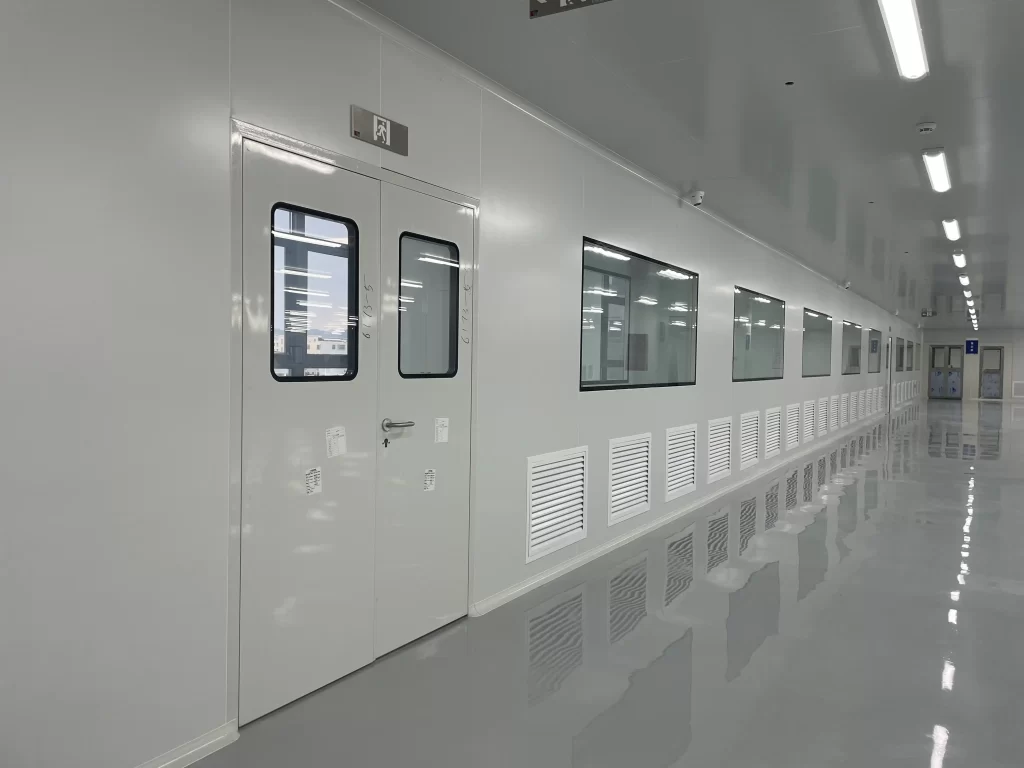
The industry standard for a stainless steel double door with an observation window is 1400mm wide by 2100mm high. Clear opening of roughly 1300mm. Enough for personnel and standard carts. Custom sizes add 2 to 4 weeks for honeycomb core processing.
Single-leaf vs. double-leaf
A 1000mm single-leaf door takes less wall. A 1400mm double door moves more people. Two people can pass at once, larger equipment fits through. The active leaf handles daily traffic; the inactive leaf stays locked, reducing wear on the interlock and hinges.
Observation window placement
Vision panels at eye level, centre roughly 1500mm from the floor. Put the panel on the active leaf so people can see through before entering. For process monitoring, a larger full-height panel on the inactive leaf is an option.
Special hardware and compliance documentation
GMP door hardware
Commercial hardware fails GMP audits. Cleanroom doors need continuous or heavy-duty butt hinges with flush pins. Electromagnetic or motorised locks, fully enclosed. If you use kick plates, they need to be flush-mounted and continuously welded at the edges.
Validation documentation
The door is half of what you're buying. The paperwork is the other half. You need material certificates (EN 10204 3.1), surface finish Ra reports, FAT data, and IQ/OQ protocol templates. Without these, validation stalls.
Configuration checklist
Before signing the PO, check:
- 316L for all ISO 5-7 and VHP-exposed areas?
- Ra at or below 0.8 micrometres (electropolished) for critical zones?
- All seams continuously welded and ground flush?
- Interlock logic integrated with pressure cascade and BMS?
- Inflatable gaskets for decontamination rooms?
- All hardware flush-mounted, crevice-free?
- IQ/OQ templates and material certs included?
Before committing to a full facility order, get a mock-up panel of your spec'd material and finish. Let QA test it with your actual disinfectants and verify the Ra values in your own lab. A small cost now beats redoing dozens of door installations later.
Wrapping up
Specifying cleanroom double doors comes down to a handful of decisions. Grade. Finish. Interlock logic. Seals. Get those right, and validation goes smoothly. Get any of them wrong, and you're fixing pressure issues and answering auditor questions.
E-ZONG builds cleanroom entry systems for pharma and biotech facilities. Our engineering team can review your layouts and put together a configuration that matches your GMP requirements. If that sounds useful, reach out.
-
 Cleanroom Glass Windows Are The Key to Maintaining a Clean Environment
 -
 Top Aluminium Profile Manufacturers in China: Leading the Global Market
 -
 The Evolution of Air Tight Sliding Doors
 -
 AHU Aluminium Profile: A Comprehensive Guide
 -
 The Importance of Choosing the Right Cleanroom Door in Vietnam
 -
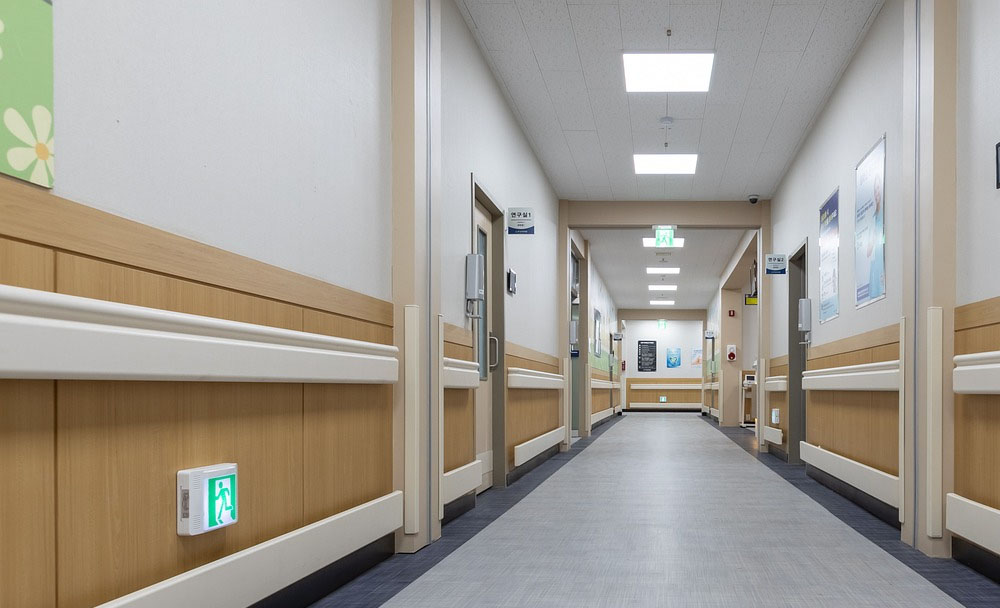 The Benefits of Hospital Automatic Doors: Enhancing Efficiency and Safety
 -
.jpg) The Best Bathroom Door Manufacturers - Unlocking Endless Possibilities!
The Best Bathroom Door Manufacturers - Unlocking Endless Possibilities! -
 Unlock the Possibilities with AJ Manufacturing Doors
 -
 Make a Statement with Manufactured Home Interior Doors!
 -
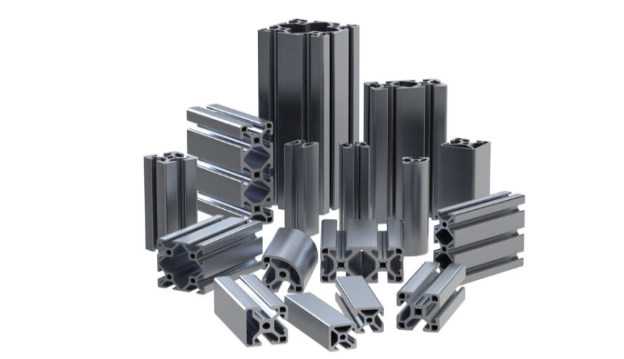 what is aluminum profile? Aluminum Profiles for Your Home is the best option
-
 Hospital Emergency Exit Doors: 90 Minute Fire Rating Meets Infection Control
 -
 ICU and Isolation Door Requirements Hospitals Often Overlook
 -
 Laboratory Door Requirements for BSL-2 and BSL-3 Containment
 -
 Retrofitting Hospital Sliding Doors: Upgrade Wards Without a Rebuild
 -
 Why Airtight Hospital Sliding Doors Are Critical for Infection Control
 -
 Automatic cleanroom door systems: sensor, actuator and access control integration
 -
 Cleanroom Door Materials: Stainless Steel vs HPL vs FRP vs Aluminum Comparison
 -
 X-Ray Room Door Buying Guide: Lead Thickness & Compliance
 -
 Operating Room Doors: Hermetic & Infection-Control Guide
 -
 Hospital ICU Door Selection: Sealing, Sterility & Workflow


-

Home
-

Tel
-

Email
-

Contact


Guangzhou Yizhong Aluminum Industry Co., Ltd.
We are always providing our customers with reliable products and considerate services.
We are always providing our customers with reliable products and considerate services.
Speak Your Mind