
Fast Action Doors for Pharma and Food Cleanrooms: Key Benefits
In pharmaceutical manufacturing and food processing, your controlled environment relies on its weakest physical barrier. While HVAC systems and HEPA filters dominate cleanroom design, traditional manual doors create a massive vulnerability. Every time a standard swing door opens, conditioned air escapes. Unfiltered ambient air infiltrates, and the critical pressure differential collapses. Facility managers and validation engineers see the direct results. These results include spiked energy bills, compromised product integrity, and increased audit risks. Fortunately, the engineered solution exists: the fast-action door. Unlike standard industrial rollers, pharmaceutical cleanroom doors and food processing high-speed doors seal environments in seconds. This article explores how rapid-action technology delivers measurable energy savings. Furthermore, it ensures hygienic compliance and optimizes material flow in GMP-regulated facilities.
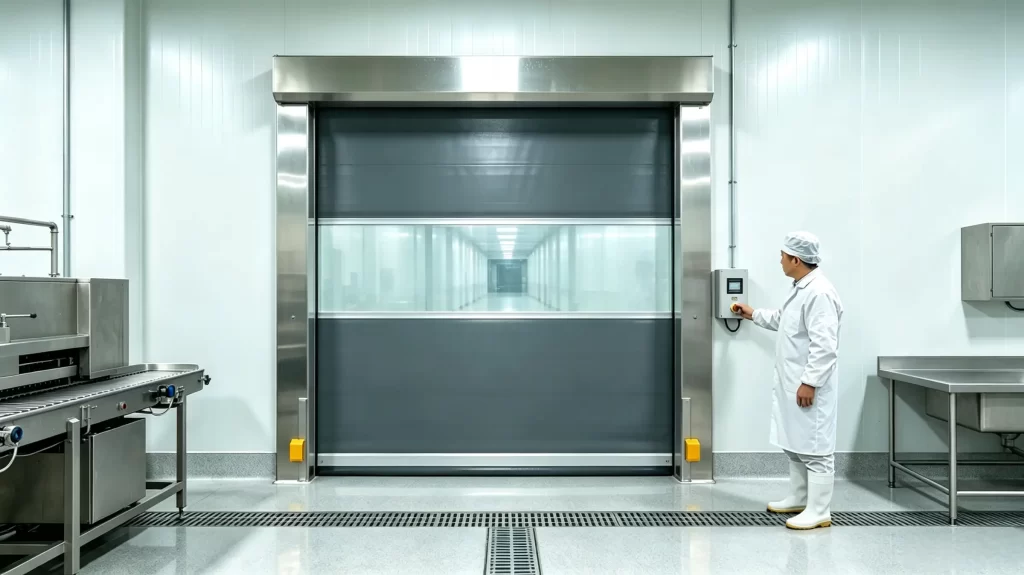
High Speed Cleanroom Doors
To specify the right equipment, engineering and procurement teams must first understand the operational mechanics. These mechanics differentiate true cleanroom high-speed doors from standard warehouse rollers.
What is a fast action door in a cleanroom?
A fast-action door in a controlled environment acts as a high-cycle, rapid-sealing barrier. Manufacturers design these doors to minimize the time an opening exposes the room to adjacent spaces. Operating at speeds between 1.5 and 2.5 meters per second, these doors drastically reduce open-cycle time. They cut the time from 15-30 seconds down to just 3-5 seconds. In a cleanroom context, this speed serves a critical purpose. It acts as a vital contamination and energy control strategy. By minimizing the physical opening time, high-speed cleanroom doors limit unconditioned air breaches. Consequently, they protect the sterile or climate-controlled boundary.
Fast action door vs swing door cleanroom
When evaluating transition zones, the comparison between fast-action and swing doors reveals stark differences in environmental control.
- Air Infiltration: Manual swing doors rely on personnel to push, walk through, and pull them shut. In high-traffic areas, workers frequently prop these doors open. Conversely, a fast-action door automates the close sequence. Therefore, the system restores the barrier immediately after passage.
- Pressure Recovery: When a swing door opens, the room's pressure cascade drops. An HVAC system might take several minutes to re-pressurize the space. However, a rapid door restores the physical boundary in seconds. As a result, the HVAC system maintains baseline pressure with minimal effort.
- Traffic Flow: Swing doors create physical bottlenecks for personnel carrying materials. Fast-action doors, activated via touchless sensors, maintain continuous workflow. Thus, operators never need hands-on operation.
Key specifications for pharmaceutical and food applications
Specifying pharmaceutical cleanroom doors requires you to look beyond basic dimensions. You must evaluate several critical specifications:
- Cycle Rating: True industrial-grade doors should achieve 500,000+ cycles without major component replacement.
- Sealing Mechanism: Manufacturers use brush seals, inflatable gaskets, or specialized zipper-track systems. These features ensure an airtight seal when closed.
- Activation Methods: Systems integrate radar, motion sensors, or interlocked access control. This ensures touchless operation.
Engineering Insight: When specifying motor sizing for high-cycle applications, do not just look at the door's weight. Instead, calculate the friction coefficient of the track system. You must also determine the required acceleration and deceleration rates. A properly sized motor with a high torque reserve will operate cooler. Ultimately, this extends the lifespan of the drive components in 24/7 facilities.
Hygienic Rapid Roll Doors for GMP Cleanrooms
Speed is only half the equation. In regulated environments, the physical construction of the door must actively prevent contaminants. Furthermore, it must withstand rigorous cleaning protocols.
Hygienic design features that eliminate contamination risks
Hygienic rapid roll doors for GMP cleanrooms follow one primary directive: cleanability. Traditional doors feature hollow tubes, exposed fasteners, and overlapping panels. These elements create blind spots where moisture and microbes accumulate. Modern hygienic designs actively eliminate these traps. Key features include:
- Flush-mounted components: Technicians conceal all hardware, sensors, and wiring within the frame.
- Smooth, continuous surfaces: The door curtain and frame lack ledges or crevices.
- Touchless activation: Utilizing radar or infrared sensors ensures operators never physically touch the door. Therefore, this prevents cross-contamination from gloves or hands.
Stainless steel frame high speed doors for washdown environments
In food processing and certain biotech applications, facilities subject doors to daily chemical washdowns. Therefore, stainless steel frame high-speed doors become mandatory in these zones. E-ZONG engineers specify 304 or 316L stainless steel for these frames. The choice depends on the chemical agents used in the facility. Workers continuously weld and grind the steel smooth to a surface roughness of Ra < 0.8 µm. This mirror-like finish prevents biofilm formation. Additionally, it allows caustic cleaning agents to sheet off the surface without pooling. Furthermore, the manufacturer seals electrical enclosures and motor housings to IP65 or IP66 standards. This protects internal components from high-pressure water ingress.
Meeting HACCP, FSMA, and EU GMP Annex 1 requirements
Regulatory compliance is not an afterthought. Manufacturers build compliance directly into the door's design.
- HACCP & FSMA (Food): These frameworks require equipment to be easily cleanable. They also demand non-toxic, non-absorbent materials. Hygienic stainless steel doors directly satisfy these Critical Control Point (CCP) requirements.
- EU GMP Annex 1 (Pharma): The 2022 revision of Annex 1 places a massive emphasis on Contamination Control Strategy (CCS). Regulators explicitly identify doors as potential contamination vectors. Hygienic rapid roll doors support Annex 1 compliance. They provide a physical barrier that maintains pressure differentials. Moreover, their design prevents particulate shedding and microbial harboring.
Expert Recommendation: Do not accept "food-grade" as a marketing buzzword. Instead, request specific material certificates (e.g., 3.1 EN 10204) for the stainless steel. You should also request FDA/EC 1935/2004 compliance documentation for the PVC curtain. Ultimately, true hygienic design requires full material traceability.
Energy Efficient High Speed Doors for Controlled Environments
For facility directors and HVAC engineers, rapid-action doors offer a compelling argument. They deliver an immediate impact on the facility's energy footprint.
Reducing HVAC energy loss in cleanroom facilities
Reducing HVAC energy loss in cleanroom facilities drives capital expenditure on high-performance doors. When a door opens, the system loses two types of energy. These include sensible heat (temperature difference) and latent heat (moisture difference). Collectively, engineers call this enthalpy. Consider a standard cleanroom maintained at 20°C and 45% RH. Now, imagine it sits adjacent to a warehouse at 25°C and 60% RH. If a manual door stays open for 20 seconds per cycle, the HVAC system works continuously. It must condition all that infiltrating air. However, if you reduce the open time to 4 seconds with a fast-action door, you reduce air infiltration by 80%. As a result, facilities consistently report a 20% to 40% reduction in localized HVAC energy loads.
Maintaining pressure differential cascade with rapid sealing
Cleanrooms rely on a pressure differential cascade. This cascade ensures air flows from cleaner areas to less clean areas. When a door opens, this cascade collapses. The air infiltration rate forces the HVAC system to dump massive amounts of air into the room. Consequently, the system attempts to recover the pressure. However, energy-efficient high-speed doors close in seconds. Therefore, the physical boundary restores before the pressure cascade fully collapses. This allows the HVAC system to operate at its steady-state baseline. Ultimately, this reduces fan energy and extends filter life.
Frequency inverter drive motor technology for energy optimization
The motor acts as the heart of the door's energy profile. Modern energy-efficient high-speed doors utilize frequency inverter drive motor (VFD) technology. Traditional constant-speed motors draw maximum current upon startup. In contrast, a VFD gradually ramps up the motor speed. This soft start eliminates the massive inrush current. Therefore, it reduces peak electrical demand. Furthermore, the VFD allows for precise control over acceleration and deceleration. This ensures smooth operation and reduces mechanical wear. Ultimately, it optimizes the motor's overall energy consumption during every single cycle.
Calculating ROI: Energy savings vs. capital investment
Facilities often realize the return on investment for high-speed doors in under 24 months.
Buyer Tip: You can calculate your specific ROI using a simplified framework. First, multiply the cost of energy per kWh by the HVAC system efficiency. Next, factor in the volume of air lost per open cycle and the number of cycles per year. This determines your annual energy waste. Then, compare the annual energy waste of a manual door (e.g., 15 seconds open) against a fast-action door (e.g., 4 seconds open). The delta represents your annual energy savings. When you add reduced maintenance costs and the avoided cost of a single batch rejection, the payback period shrinks dramatically.
GMP Compliant Cleanroom Doors
In regulated industries, a door serves as more than just a physical barrier. It acts as a validated component of the facility's quality management system.
Cleanroom airlock door systems with integrated interlocks
In pharmaceutical and advanced biotech facilities, personnel and materials must pass through airlocks. Cleanroom airlock door systems utilize integrated interlock systems for fast-action doors. These interlocks prevent both the entry and exit doors from opening simultaneously. This interlocking mechanism remains critical for maintaining the room's pressure cascade. It also prevents cross-contamination. Modern interlocks hardwire directly into safety PLCs to ensure fail-safe operation. If the system detects a fault, it defaults to a locked state. Consequently, this prevents accidental breaches of the controlled environment.
Validation documentation and compliance support
GMP-compliant cleanroom doors require rigorous documentation. When you procure doors for a GMP facility, you must ensure the manufacturer provides a complete validation dossier. This dossier should include:
- FAT/SAT Protocols: Factory and Site Acceptance Test documentation verifies the door meets specified parameters.
- IQ/OQ/PQ Templates: Manufacturers provide pre-formatted templates to accelerate your validation engineering team's workflow.
- Material Certificates: These documents provide traceability for all wetted and non-wetted parts.
Integration with building management systems (BMS)
Modern facilities require real-time visibility into equipment performance. Facility managers frequently ask whether rapid roll doors can integrate with BMS. The answer is yes. Advanced high-speed doors feature communication gateways. These gateways support protocols like BACnet, Modbus TCP, or Profinet. This integration allows the BMS to monitor door status and track cycle counts. Furthermore, it logs alarm histories for predictive maintenance. If a door fails to seal properly, the BMS triggers an immediate alarm. Therefore, facility managers can address the issue before it impacts environmental compliance.
Application-Specific Solutions
The versatility of fast-action technology allows facilities to deploy it across various critical zones.
Warehouse to cleanroom transition zones
The transition between a general warehouse and a production cleanroom represents the highest risk area for particulate ingress. Warehouse-to-cleanroom transition doors must handle heavy traffic. This includes pallet jacks and forklifts. At the same time, they must maintain strict environmental boundaries. Therefore, engineers specify high-speed doors with impact-resistant transparent PVC vision panels. They also require heavy-duty bottom edge seals. These features withstand physical impacts while ensuring rapid closure.
High-cycle production areas and packaging lines
Inside the cleanroom, doors separating different processing stages experience extreme traffic. In high-cycle production areas and packaging lines, doors may trigger 100 to 300 times per hour. Consequently, you must specify doors with reinforced zipper-track systems. Additionally, high-torque VFD motors ensure the equipment handles this relentless operational tempo. This prevents derailing and reduces the need for frequent mechanical adjustments.
Cold storage and freezer applications
In biotech and certain food applications, facilities use fast-action doors to separate ambient cleanrooms from cold rooms. In these environments, technicians fit energy-efficient high-speed doors with thermal break frames. They also install heated bottom seals to prevent ice buildup. The rapid closing speed becomes even more critical here. The enthalpy difference between ambient and sub-zero temperatures results in massive energy loss. Therefore, rapid closure prevents frost accumulation.
Secure Your Cleanroom Environment and Optimize Energy Costs
Upgrading to fast-action doors represents more than just an operational improvement. It acts as a strategic investment in compliance, energy efficiency, and product quality. By minimizing air infiltration and ensuring a hygienic design, you protect your bottom line. Furthermore, you safeguard your batch integrity.
Ready to specify the right high-speed doors for your facility? Our engineering team specializes in hygienic design, energy consumption assessment, and GMP compliance solutions.
-
 Cleanroom Glass Windows Are The Key to Maintaining a Clean Environment
 -
 Top Aluminium Profile Manufacturers in China: Leading the Global Market
 -
 The Evolution of Air Tight Sliding Doors
 -
 AHU Aluminium Profile: A Comprehensive Guide
 -
 The Importance of Choosing the Right Cleanroom Door in Vietnam
 -
 The Benefits of Hospital Automatic Doors: Enhancing Efficiency and Safety
 -
.jpg) The Best Bathroom Door Manufacturers - Unlocking Endless Possibilities!
The Best Bathroom Door Manufacturers - Unlocking Endless Possibilities! -
 Unlock the Possibilities with AJ Manufacturing Doors
 -
 Make a Statement with Manufactured Home Interior Doors!
 -
 what is aluminum profile? Aluminum Profiles for Your Home is the best option
-
 Hospital Emergency Exit Doors: 90 Minute Fire Rating Meets Infection Control
 -
 ICU and Isolation Door Requirements Hospitals Often Overlook
 -
 Laboratory Door Requirements for BSL-2 and BSL-3 Containment
 -
 Retrofitting Hospital Sliding Doors: Upgrade Wards Without a Rebuild
 -
 Why Airtight Hospital Sliding Doors Are Critical for Infection Control
 -
 Automatic cleanroom door systems: sensor, actuator and access control integration
 -
 Cleanroom Door Materials: Stainless Steel vs HPL vs FRP vs Aluminum Comparison
 -
 X-Ray Room Door Buying Guide: Lead Thickness & Compliance
 -
 Operating Room Doors: Hermetic & Infection-Control Guide
 -
 Hospital ICU Door Selection: Sealing, Sterility & Workflow


-

Home
-

Tel
-

Email
-

Contact


Guangzhou Yizhong Aluminum Industry Co., Ltd.
We are always providing our customers with reliable products and considerate services.
We are always providing our customers with reliable products and considerate services.
Speak Your Mind