Cleanroom Sliding Door Selection Guide for GMP Facilities
1. Introduction
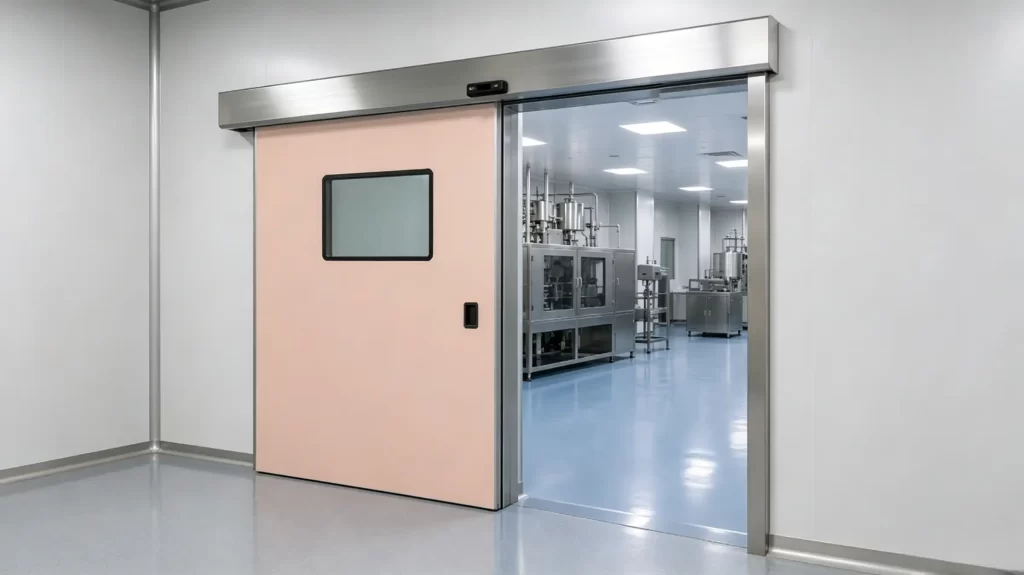
In GMP facilities, cleanroom space is prime real estate, and pressure control is everything. While traditional swing doors waste valuable space and disrupt laminar airflow, the cleanroom sliding door has emerged as the industry standard.
But a true GMP cleanroom door is much more than just tracks and motors. Can it hold the pressure? Survive harsh VHP decontamination cycles? Avoid maintenance nightmares?
Cutting through the marketing fluff, this GMP cleanroom sliding door selection guide breaks down the 5 critical dimensions—airtightness, space utilization, automation, cleanability, and maintenance—to help you choose the right automatic cleanroom sliding door for a flawless regulatory validation.
2. The 5 Core Dimensions of Cleanroom Sliding Door Selection
1. Airtightness: The Lifeline for Maintaining Pressure Differentials and Preventing Cross-Contamination
Under GMP regulations, distinct cleanroom classifications must maintain a clear pressure differential gradient (typically ≥10 Pa between adjacent areas of different grades, with even stricter requirements for Grade A/B core areas). The airtightness of the cleanroom sliding door directly determines whether it can effectively resist air infiltration caused by this pressure differential when closed.
- Sealing Structure Selection: For general Grade C/D cleanrooms, mechanical compression seals paired with EPDM or high-grade silicone gaskets are usually sufficient. However, for high-risk Grade A/B areas, we strongly recommend selecting an airtight sliding door equipped with an inflatable seal system. This technology uses a built-in air pump to inflate the sealing bladder around the door frame once fully closed, achieving a 100% seamless fit and ensuring pressure fluctuations remain within ±1 Pa.
- Pressure Differential Tolerance Testing: During selection, you must require the supplier to provide deformation test reports of the door under specific pressure differentials (e.g., 15 Pa or 30 Pa). Products that comply with EN 12207 or higher cleanroom door airtightness classification standards are a prerequisite for successfully passing Performance Qualification (PQ).
2. Space Utilization: Maximizing Effective Cleanroom Area
The construction and HVAC operating costs of cleanrooms are exceptionally high, making the maximization of effective floor space a critical engineering objective.
- Operation Trajectory and Space Saving: A traditional swing door requires a 1.0 to 1.5 square meter arc-shaped clearance, which easily interferes with process equipment or material carts. In contrast, a cleanroom sliding door glides parallel to the wall, reducing space occupation to near zero.
- Telescopic Sliding Doors: In scenarios with narrow corridors or restricted doorway widths (e.g., a clear doorway width of only 2000mm), a standard double-leaf sliding door typically offers a clear opening of just 1000mm, which is insufficient for large equipment. In such cases, you should select telescopic cleanroom doors. Through a precision pulley system, multiple door panels can stack neatly on one side. For a 2000mm doorway, this can provide a clear opening width of 1300mm to 1400mm (an opening rate of >65%), perfectly balancing spatial constraints with traffic efficiency.
3. Automation and Smart Control: Seamless Integration and Compliance
In modern GMP facilities, access control systems are deeply integrated into the factory’s automation network as intelligent nodes, not just simple mechanical openers.
- Drive System: You must select a drive system powered by a Brushless DC (BLDC) motor. Compared to traditional motors, BLDC motors operate with extreme smoothness and low noise (typically <50 dB). Crucially, they eliminate the particulate contamination risk associated with carbon brush wear, boasting a Mean Time Between Failures (MTBF) of over 1 million cycles.
- Interlock Logic: In personnel or material airlocks, the automatic cleanroom airlock door must be equipped with a PLC-based hardware or software automatic interlock door system. This ensures that under no circumstances can both doors open simultaneously, preventing direct air convection and maintaining the pressure gradient.
- BMS/SCADA Integration: To meet data integrity requirements (e.g., FDA 21 CFR Part 11), high-end pharmaceutical plant cleanroom doors should feature controllers that support standard industrial communication protocols like OPC UA, Modbus TCP, or BACnet. This allows door status, fault alarms, and interlock logs to be uploaded in real-time to the Building Management System (BMS), enabling remote monitoring and Audit Trails.
- Safety Configuration: Selection must include millimeter-precision safety light curtains and highly sensitive anti-pinch microwave radar. According to the EN 16005 standard for power-operated doors, the door must instantly reverse upon detecting an obstacle, ensuring the pinching force remains <150N. Additionally, a fail-safe manual opening function is mandatory for fire safety compliance.
4. Cleanability: Withstanding Harsh Decontamination Procedures
Cleanroom sliding door surfaces undergo rigorous daily cleaning and disinfection. Material selection directly dictates the product's lifespan and microbial control efficacy.
- Base Material: Panels and frames must be made of SUS 304 or SUS 316L medical-grade stainless steel. For Grade A/B areas frequently exposed to high-concentration disinfectants or high humidity, 316L (with added molybdenum for superior corrosion resistance) is the only recommended option and the standard for premium cleanroom stainless steel sliding doors.
- Surface Finish and Roughness: The stainless steel surface must undergo fine mechanical or electropolishing to ensure a surface roughness of Ra ≤ 0.8μm. A smooth surface effectively prevents particulate adhesion and eliminates the formation of biofilms.
- Disinfectant Compatibility: You must verify that the door materials and seals can withstand the harsh disinfectants commonly used in pharma plants, specifically by selecting a proven VHP-resistant cleanroom door for pharmaceutical plants. High-quality sealing materials must endure thousands of Vaporized Hydrogen Peroxide (VHP) decontamination cycles without yellowing, embrittlement, or coating delamination.
- Dead-Space-Free Design: The door should feature a fully flush panel design, with all joints utilizing continuous welding that is ground smooth. Observation windows must use double-glazed tempered glass, installed flush-mounted with the door panel, and feature large-radius (R-angle) transitions to completely eliminate any sanitary dead zones where dust or microbes could accumulate.
5. Maintenance Requirements and Total Cost of Ownership (TCO)
Procurement decisions should not be based solely on initial Capital Expenditure (CAPEX), but must evaluate the Total Cost of Ownership (TCO), where maintenance convenience is paramount.
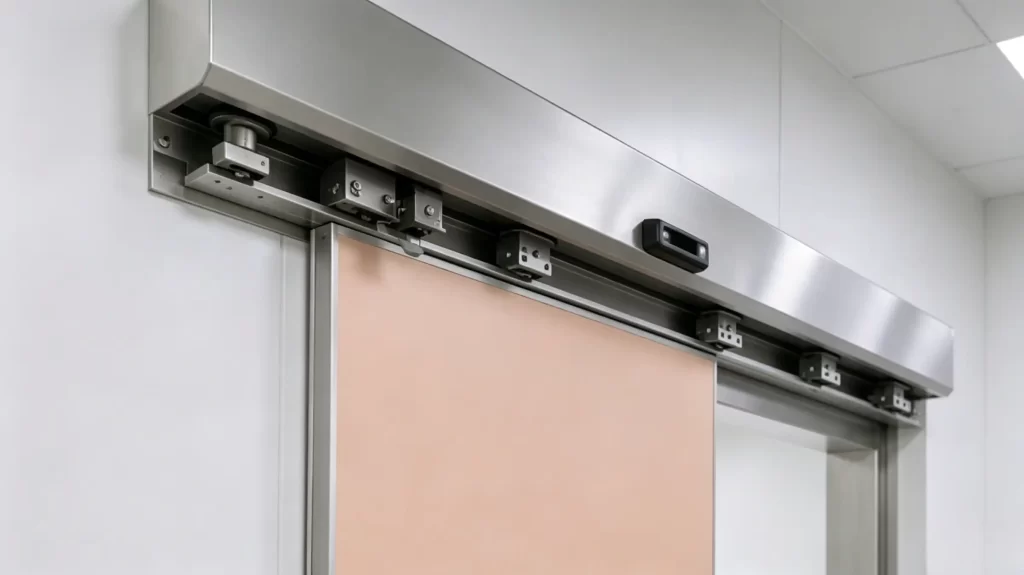
- Top-Hung Track: This is an absolute red line in GMP cleanroom sliding door selection. You must firmly reject any form of floor track. Floor grooves are "natural collectors" for particulates, liquids, and microbes, making them nearly impossible to clean and constituting a severe GMP violation. A top-hung cleanroom sliding door places all load-bearing and guiding mechanisms at the header, achieving a perfectly flat, obstacle-free floor that is fully compatible with scrubber-dryers or manual mopping.
- Modular and Quick-Release Design: During selection, evaluate whether the drive module, controller, and pulley assemblies support "tool-less quick release." In the event of routine Preventive Maintenance (PM) or unexpected breakdowns, engineering staff should be able to replace core components within 15 minutes, minimizing cleanroom downtime.
3. Scenario Matching: Selection Recommendations for Different GMP Grades
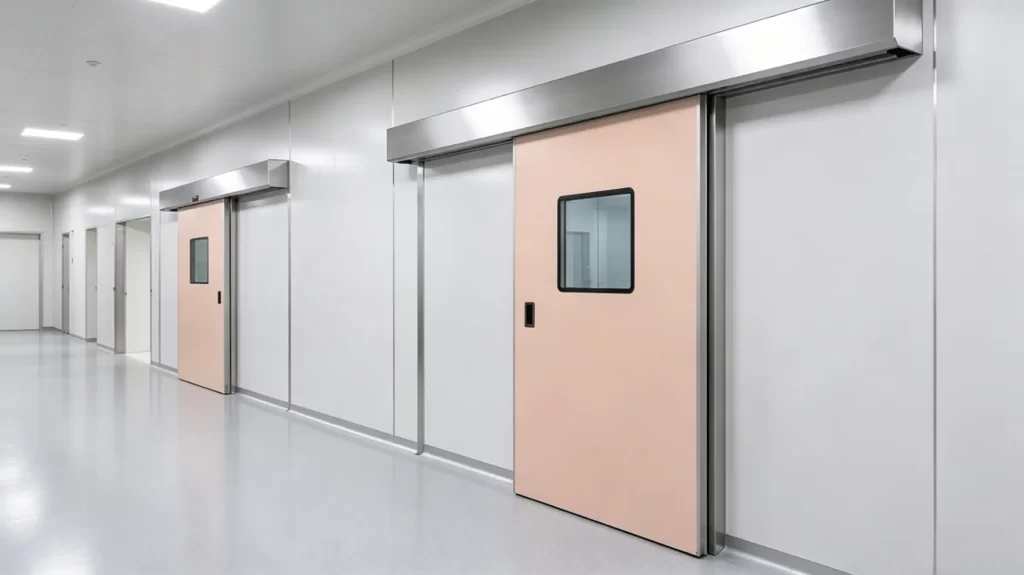
To balance ROI with regulatory compliance, we recommend differentiated selection based on specific application scenarios:
- Grade A/B Core Areas (e.g., Aseptic Filling Lines, Isolator Interfaces):
- Recommended Configuration: SUS 316L + Inflatable Seal System + VHP Resistance Certification + Top-Hung Track + Strict PLC Interlock + Flush-Mounted Double-Glazed Window.
- Core Objective: Ultimate particulate control, absolute airtightness, and tolerance to the most stringent sterilization procedures.
- Grade C/D General Areas (e.g., Solid Dosage Workshops, Packaging, Clean Warehousing):
- Recommended Configuration: SUS 304 + High-Quality Mechanical Compression Seals + BLDC Drive + Top-Hung Track.
- Core Objective: High durability, excellent cost-effectiveness, and meeting basic pressure retention and traffic efficiency requirements.
- Personnel/Material Airlocks:
- Recommended Configuration: Double-leaf cleanroom sliding door assembly + Smart interlock controller with pressure differential monitoring + Safety light curtains.
- Core Objective: Guaranteeing that both doors never open simultaneously, maintaining the dynamic pressure gradient relative to adjacent areas.
4. Common Pitfalls in the "Selection" Phase of Cleanroom Sliding Doors
Note: This guide focuses on pitfalls during the preliminary planning and specification confirmation phases, aiming to prevent design flaws, not installation errors.
- Pitfall 1: Ignoring Future Process Changes and Failing to Reserve Automation Interfaces. Many projects opt for "island-type" doors with only basic remote or push-button controls to save initial costs. When the plant later upgrades its digital infrastructure and needs to integrate door status into the central SCADA system, they discover the controller lacks standard communication protocols, forcing a costly full-system replacement.
Solution: In your GMP cleanroom sliding door selection guide specifications, explicitly require the controller to have expandable communication modules (e.g., Modbus/OPC UA) and dry contact signal outputs. - Pitfall 2: Focusing Solely on Initial Cost and Ignoring Disinfectant Compatibility Testing. Some buyers choose doors that look similar but use standard industrial coatings or inferior rubber seals. After 1-2 years of frequent VHP or sodium hypochlorite wiping, the door surfaces suffer severe corrosion, yellowing, or seal hardening/cracking, leading to cleanroom Qualification failure.
Solution: Demand third-party compatibility test reports or accelerated aging test data for your specific disinfectants from the supplier. - Pitfall 3: Inadequate Pressure Differential Tolerance Assessment, Leading to Validation Failure. During cleanroom design, the maximum expected pressure differential across the door is not accurately calculated. Selecting a commercial-grade sliding door meant for ambient pressure environments leads to micro-deformation when the HVAC system runs at full load (e.g., >15 Pa differential). The seals fail to close completely, causing the Pressure Hold Test to fail.
Solution: When requesting quotes, you must explicitly provide the supplier with the maximum design pressure differential for the door's installation location and demand an airtightness guarantee under that specific pressure.
5. Conclusion
Bottom line: In a GMP facility, a cleanroom sliding door is never just a simple passageway. It is the "gatekeeper" that helps you stabilize pressure differentials and pass stringent regulatory validations. Paying close attention to the details and aligning the specifications during the selection phase will save you countless headaches during validation and daily maintenance, while significantly reducing hidden long-term costs.
If you are preparing for a GMP project or feel uncertain about your current access control solution, don't struggle with the parameters alone. As a professional cleanroom stainless steel sliding door manufacturer, our technical team is on standby. Whether you need to customize special dimensions (such as telescopic solutions for narrow passages), calculate airtightness grades, or plan automated interlocking and BMS integration, we are here to help.
👉 Contact us directly. Tell us your specific operating conditions and pain points, and we will provide you with the most suitable cleanroom sliding door customization plan and quotation. Let’s get your cleanroom build right the first time, ensuring a smooth, one-pass validation!
-
 Cleanroom Glass Windows Are The Key to Maintaining a Clean Environment
 -
 Top Aluminium Profile Manufacturers in China: Leading the Global Market
 -
 The Evolution of Air Tight Sliding Doors
 -
 AHU Aluminium Profile: A Comprehensive Guide
 -
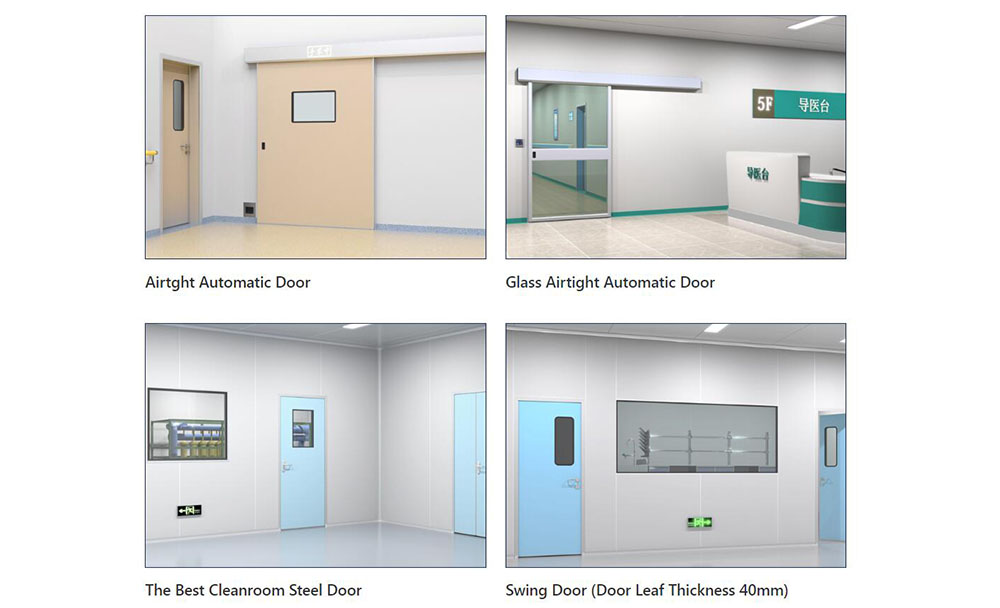 The Importance of Choosing the Right Cleanroom Door in Vietnam
 -
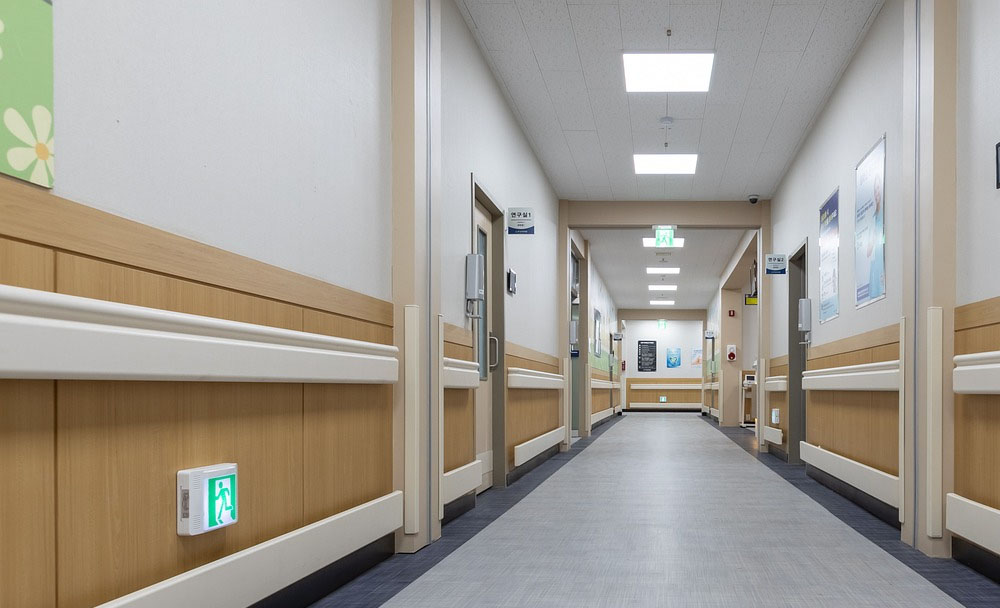 The Benefits of Hospital Automatic Doors: Enhancing Efficiency and Safety
 -
.jpg) The Best Bathroom Door Manufacturers - Unlocking Endless Possibilities!
The Best Bathroom Door Manufacturers - Unlocking Endless Possibilities! -
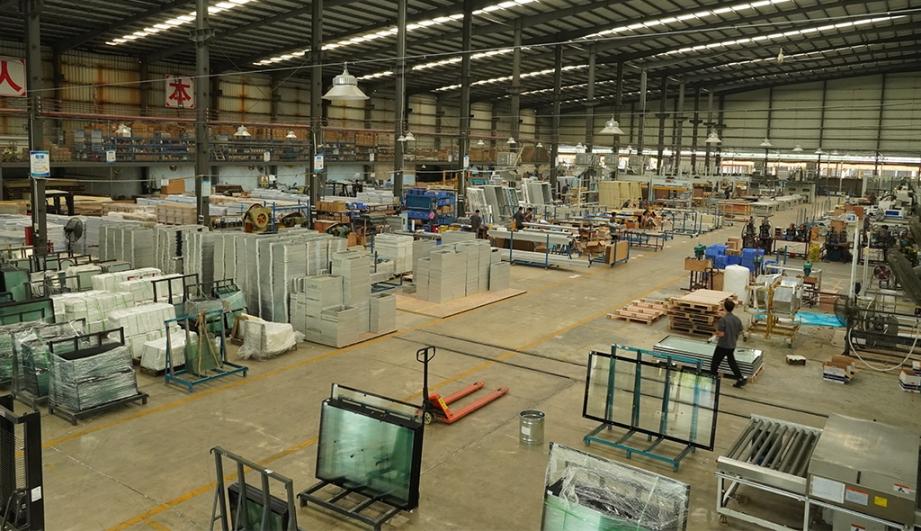 Unlock the Possibilities with AJ Manufacturing Doors
 -
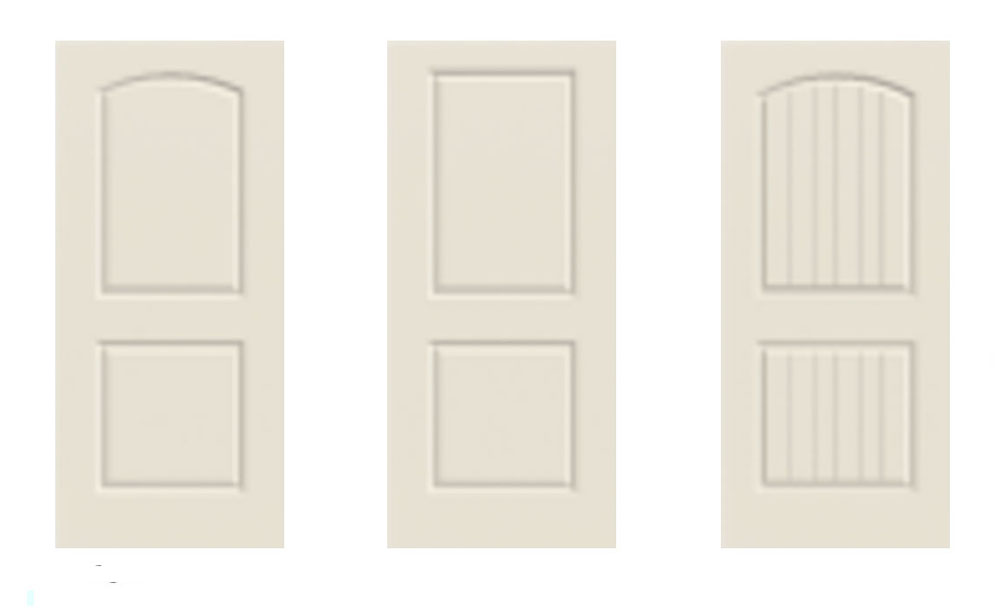 Make a Statement with Manufactured Home Interior Doors!
 -
 what is aluminum profile? Aluminum Profiles for Your Home is the best option
-
 Hospital Emergency Exit Doors: 90 Minute Fire Rating Meets Infection Control
 -
 ICU and Isolation Door Requirements Hospitals Often Overlook
 -
 Laboratory Door Requirements for BSL-2 and BSL-3 Containment
 -
 Retrofitting Hospital Sliding Doors: Upgrade Wards Without a Rebuild
 -
 Why Airtight Hospital Sliding Doors Are Critical for Infection Control
 -
 Automatic cleanroom door systems: sensor, actuator and access control integration
 -
 Cleanroom Door Materials: Stainless Steel vs HPL vs FRP vs Aluminum Comparison
 -
 X-Ray Room Door Buying Guide: Lead Thickness & Compliance
 -
 Operating Room Doors: Hermetic & Infection-Control Guide
 -
 Hospital ICU Door Selection: Sealing, Sterility & Workflow
-

Home
-

Tel
-

Email
-

Contact


Guangzhou Yizhong Aluminum Industry Co., Ltd.
We are always providing our customers with reliable products and considerate services.
We are always providing our customers with reliable products and considerate services.
Speak Your Mind