
Hospital Glass Doors: Why Visibility Matters in Modern Medical Spaces
In a hospital, a door is never just a cold physical barrier. It is the "eyes" through which medical staff monitor patient conditions and the "window" through which patients feel the care of the outside world. Unlike cleanrooms that demand extreme airtightness and sterility, hospital public halls, outpatient clinics, and nurse stations require a "warm transparency."
However, how do we protect patient privacy while meeting the clinical need for line-of-sight monitoring? How do we introduce natural light while ensuring ultimate safety and ease of daily cleaning? This is the core proposition that hospital glass doors must answer. This article focuses on medical public and clinical spaces, exploring how professional material selection and design can find the perfect balance between visibility, safety glass, patient privacy, cleanability, and long-term durability for medical facility glass doors.
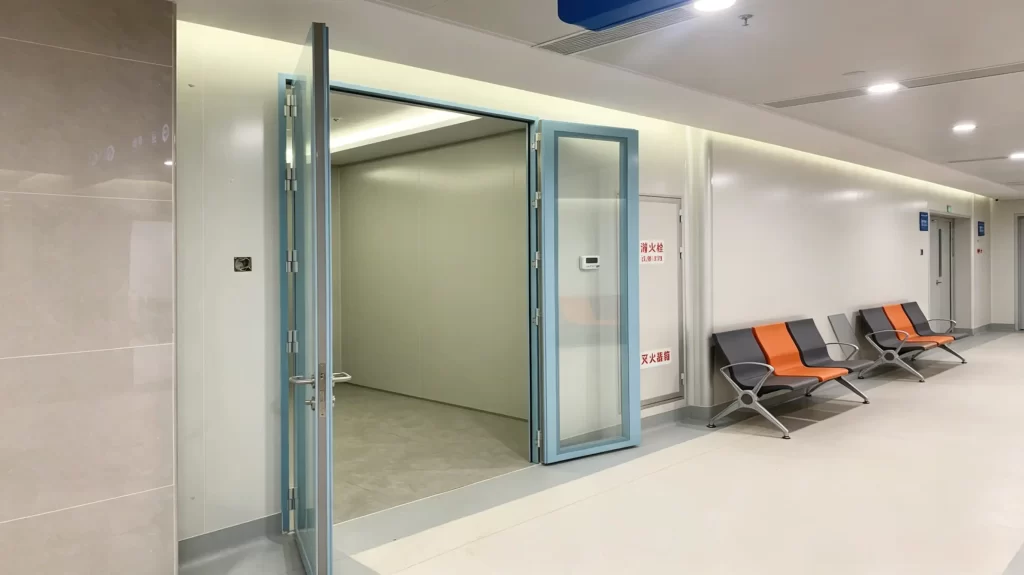
1. The Value of Visibility in Public and Clinical Areas
Evidence-Based Design (EBD) demonstrates that the physical characteristics of a healthcare environment directly impact patient recovery rates and staff efficiency. In public and clinical zones, rational visibility design offers irreplaceable dual value.
1. Enhancing Clinical Observation and Patient Safety
In nurse stations, recovery rooms, pediatric wards, or isolation observation rooms, transparent hospital glass doors provide crucial "line-of-sight monitoring" capabilities. Medical staff can continuously observe vital signs, IV status, or behavioral dynamics without intrusive entry. This non-invasive observation not only shortens response times to emergencies by critical seconds but also reduces unnecessary staff movement, optimizing workflow and elevating overall ward safety.
2. Optimizing Wayfinding and Psychological Well-being
Traditional solid doors can create a sense of oppression and a maze-like effect in crowded public areas. High-quality hospital entrance glass doors maximize natural light, breaking the sense of confinement. Ample daylight has been proven by multiple medical studies to lower cortisol (stress hormone) levels, alleviating "white coat hypertension" and preoperative anxiety. Furthermore, transparent materials enhance wayfinding, helping patients and visitors intuitively locate departments, reducing inquiry costs and confusion.
3. Fostering Doctor-Patient Communication
In consultation or counseling rooms, semi-open glass door designs eliminate claustrophobia while protecting basic dignity. This "semi-transparent" boundary signals openness and transparency to patients, helping to alleviate tension and build a more equitable, trusting communication environment.
2. Specifying Medical-Grade Safety Glass
Hospitals are high-traffic environments with unique risks, such as emergency conflicts, high-speed gurney collisions, or pediatric activity. Therefore, specifying safety glass for medical facilities must strictly adhere to building codes to eliminate any risk of secondary injury from glass breakage.
1. Tempered Glass Doors: The Baseline Safety Standard
As the foundational configuration for hospital glass doors, tempered glass undergoes physical or chemical treatment to create surface compression, making its impact resistance 3 to 5 times greater than annealed glass. Its core safety mechanism lies in its failure mode: when subjected to extreme force, it shatters into blunt, honeycomb-like granules rather than sharp shards, minimizing laceration risks to staff and patients.
2. Laminated Safety Glass: Upgraded Defense for High-Risk Zones
In emergency rooms, psychiatric wards, pediatric activity areas, or high-traffic public corridors, laminated safety glass is highly recommended. This glass consists of two or more layers bonded with PVB (Polyvinyl Butyral) or SGP (SentryGlas Plus) interlayers under high heat and pressure.
- Anti-Penetration & Fallout Prevention: Even if shattered by severe impact (e.g., a heavy cart collision), the interlayer holds the fragments intact, maintaining the door's structural integrity and preventing penetration or falling debris.
- Compliance: Premium laminated glass easily passes rigorous medical building impact standards, such as ANSI Z97.1 or EN 12600 (pendulum impact test), ensuring absolute safety in extreme scenarios.
3. Fire-Rated Glass Doors for Hospitals: Compliance for Life Safety Routes
In stairwell anterooms, fire compartment divisions, or specific isolation corridors, hospital door systems must possess fire-resistant capabilities. According to building fire codes, composite or monolithic potassium-based fire-resistant glass must be used, paired with compatible fire-rated frames and hardware. Qualified fire-rated glass doors must maintain fire integrity (E-rating, blocking flame and smoke penetration) during the initial stages of a fire, while higher-grade areas require fire insulation (I-rating). This ensures that during emergency evacuations, the glass door maintains visibility to guide escape while effectively delaying fire spread.
3. Balancing Transparency and Patient Privacy
Healthcare spaces have stringent ethical and legal privacy requirements (e.g., HIPAA compliance or local medical privacy regulations). The core challenge for designers and procurement teams is how to maintain the transparency advantage of glass doors while effectively shielding sensitive medical procedures.
1. Clinic Glass Doors with Frosted Glass
This is the most cost-effective and widely adopted solution for outpatient clinics and treatment rooms. By applying sandblasting or privacy film at eye level (typically 1.2m to 1.5m from the floor), a frosted band is created. This cleverly blocks direct lines of sight to examination beds while preserving upper transparency and natural light, complying with privacy norms without the oppressive feel of a fully enclosed room.
2. Privacy Glass Doors for Patient Rooms
Ideal for premium private hospitals, VIP wards, or flexible multi-purpose rooms, Polymer Dispersed Liquid Crystal (PDLC) smart glass is the optimal choice. It operates by controlling liquid crystal molecule alignment via electrical current: when powered on, the glass is transparent for clinical observation; when powered off, the molecules scatter, turning the glass opaque in 10 milliseconds to provide absolute visual privacy. This one-touch switching is highly technological and completely eliminates the hygiene issues associated with traditional fabric curtains.
3. Integrated Blinds
In traditional clinics or hospital administrative meeting rooms, integrated blinds within double-glazed units offer flexible physical shading and privacy control. The blinds are completely sealed within the airspace of the glass, operated via external magnets or motors. The ultimate "maintenance-free" advantage is that the blinds never contact the external environment, completely eliminating the accumulation of dust, bacteria, or bodily fluids, perfectly aligning with medical hygiene requirements.
4. Infection Control and High Durability Design
For hospital procurement and contractors, the lifecycle cost and maintenance of hospital glass doors are critical decision factors. Medical environments face high-frequency usage and harsh chemical disinfection daily, imposing extreme demands on the durability and corrosion resistance of the door system.
1. Antibacterial Hospital Door Frames
Standard aluminum oxidizes, corrodes, and peels when frequently exposed to hospital-grade chlorine-based disinfectants, hydrogen peroxide, or alcohol. Therefore, hospital glass door frames should prioritize 304 or 316L medical-grade stainless steel, where the addition of molybdenum significantly enhances resistance to chloride corrosion. If high-strength aluminum is chosen for cost or weight reasons, it must feature a specialized antimicrobial powder coating (e.g., silver-ion technology). This not only ensures excellent chemical wipe-down resistance but also achieves a surface bacteria reduction rate of 99.9%+, cutting off contact transmission at the source.
2. Seamless Design for Infection Control Doors
The core of infection control is eliminating dead zones. Premium medical glass doors avoid complex right-angle grooves or exposed screws in their structural design. Joints between the frame and glass must be seamlessly sealed with medical-grade mold-resistant silicone. This flat, smooth surface design allows cleaning staff to perform rapid, thorough wipe-downs with disinfectant mops or cloths, preventing the accumulation of dust, blood, bodily fluids, or drug-resistant bacteria like MRSA in crevices.
3. Heavy-Duty Hardware and Durability Components
Glass doors in public areas may face hundreds or even thousands of cycles daily. Standard commercial hardware will sag, squeak, or fail to close properly within months. Medical-grade glass doors must be equipped with heavy-duty hinges and high-damping soft-close mechanisms. These core components must pass rigorous fatigue testing (e.g., EN 1191 standard, exceeding 500,000 cycles without failure) and include safety edges to ensure smooth, silent operation over a 10+ year lifespan, drastically reducing engineering maintenance frequency and replacement costs.
5. Customization and System Integration
Modern healthcare architecture is increasingly personalized, and standardized door products often fall short of complex clinical needs. Premium suppliers of hospital glass doors must possess robust customization and system integration capabilities.
1. Automatic Glass Doors for Hospitals and Accessibility Integration
To enhance traffic flow and meet strict accessibility standards (e.g., ADA or Universal Design), glass doors can seamlessly integrate automatic sliding or swing drive systems. Paired with microwave or infrared sensors, they enable touchless passage for staff pushing gurneys or wheelchairs. Automation systems must feature obstacle-reversal safety mechanisms, ensuring a clear opening width of at least 900mm to 1000mm to accommodate standard medical beds and large equipment.
2. Flexible Custom Sizing and Frame Configurations
To meet diverse architectural aesthetics and functional needs, suppliers should offer varied configurations ranging from full-frame (providing maximum structural integrity and sealing), to semi-frameless (balancing modern aesthetics with stability), to frameless (maximizing visual transparency). Whether it is extra-wide double doors or non-standard heights, precise engineering ensures flawless execution.
3. Acoustic Performance Considerations
In clinical areas requiring sound isolation (e.g., audiology rooms, counseling rooms, or clinics adjacent to noisy corridors), glass doors can be upgraded to double-glazed acoustic configurations. By using asymmetrical glass thicknesses (e.g., 6mm + 12mm) combined with high-damping PVB interlayers, the coincidence effect is effectively eliminated. This allows the entire door assembly to achieve a weighted sound reduction index (Rw or STC) of 35-40 dB or higher, effectively blocking corridor noise and providing a quiet environment for patients.
6. Conclusion
Selecting the right hospital glass doors is never a simple procurement task; it is a comprehensive decision involving clinical needs, building codes, infection control, and long-term operational efficiency. The correct specification not only elevates the aesthetics and functionality of the medical space but also safeguards patient and staff privacy while minimizing lifecycle maintenance costs.
Planning your next healthcare project?
Contact us today to request a detailed technical brochure and free consultation on medical-grade glass types, antibacterial door frames, and custom sizing for your hospital glass doors.
-
 Cleanroom Glass Windows Are The Key to Maintaining a Clean Environment
 -
 Top Aluminium Profile Manufacturers in China: Leading the Global Market
 -
 The Evolution of Air Tight Sliding Doors
 -
 AHU Aluminium Profile: A Comprehensive Guide
 -
 The Importance of Choosing the Right Cleanroom Door in Vietnam
 -
 The Benefits of Hospital Automatic Doors: Enhancing Efficiency and Safety
 -
.jpg) The Best Bathroom Door Manufacturers - Unlocking Endless Possibilities!
The Best Bathroom Door Manufacturers - Unlocking Endless Possibilities! -
 Unlock the Possibilities with AJ Manufacturing Doors
 -
 Make a Statement with Manufactured Home Interior Doors!
 -
 what is aluminum profile? Aluminum Profiles for Your Home is the best option
-
 5 Hermetic Door Mistakes That Break the Seal
 -
 Hospital Room Door Size by Room Type: Width and Clearance
 -
 Retrofit Manual Doors with Electronic Glass Operators
 -
 Hospital Emergency Exit Doors: 90 Minute Fire Rating Meets Infection Control
 -
 ICU and Isolation Door Requirements Hospitals Often Overlook
 -
 Laboratory Door Requirements for BSL-2 and BSL-3 Containment
 -
 Retrofitting Hospital Sliding Doors: Upgrade Wards Without a Rebuild
 -
 Why Airtight Hospital Sliding Doors Are Critical for Infection Control
 -
 Automatic cleanroom door systems: sensor, actuator and access control integration
 -
 Cleanroom Door Materials: Stainless Steel vs HPL vs FRP vs Aluminum Comparison




-

Home
-

Tel
-

Email
-

Contact


Guangzhou Yizhong Aluminum Industry Co., Ltd.
We are always providing our customers with reliable products and considerate services.
We are always providing our customers with reliable products and considerate services.
Speak Your Mind