
Pharmaceutical Facility Doors: Choosing the Right Door for Each Production Zone
In the planning, construction, and continuous operation of pharmaceutical facilities, pharmaceutical facility doors are often reduced to mere conventional building envelope components. However, in dynamic GMP production environments, engineering missteps in cleanroom door selection for pharma can trigger a cascade of operational issues:
- Airflow organization disruption causing localized cleanliness fluctuations
- HVAC system energy consumption surging by 15%–30%
- Logistics bottlenecks impacting production line OEE (Overall Equipment Effectiveness)
- Increased risk of particulate cross-contamination and batch deviation rates
For pharmaceutical engineering contractors, GMP facility planners, and procurement decision-makers, door selection is far from a simple "size + material" purchasing checklist. It is a systematic engineering endeavor that deeply integrates aerodynamics, traffic flow planning, automation control, and Total Cost of Ownership (TCO).
This article focuses on core zones—including production areas, clean corridors, packaging zones, and material/personnel passageways. By examining pressure differential control, opening/closing frequency, BMS integration, and operational efficiency, we provide a practical methodology for configuring HVAC energy saving cleanroom doors. This enables engineering teams to meet dynamic production demands while optimizing the energy efficiency and capacity output of pharmaceutical facility doors.
1. Foundational Engineering Logic for Zonal Door Selection (Beyond Compliance & Materials)
Door selection in pharmaceutical plants must return to physical and engineering fundamentals. In microenvironmental control, doors act as the "dynamic boundary" between clean and non-clean areas, or between different cleanliness grades. The core design challenge lies in maintaining environmental parameter stability despite frequent physical opening and closing.
1.1 Pressure Gradient & Airflow Direction
The cleanroom pressure gradient (typically ±5–15 Pa) serves as the first line of defense against cross-contamination. The instantaneous opening/closing of a door triggers a Pressure Drop Spike. Engineering selection must prioritize the following parameters:
- Sealing Class: Prioritize micro-pressure sealing doors structures compliant with EN 12207 Class 4 or higher.
- Opening/Closing Speed: High-speed doors (≥1.5 m/s) can limit pressure fluctuations to within ±3 Pa.
- Recovery Time: A premium door system should restore pressure setpoints within 15 seconds.
- Leakage Rate Control: Recommend <0.5 L/s·m² when fully closed.
Field data indicates that a standard swing door opening for 3 seconds can cause a localized pressure drop of 8–12 Pa. Therefore, the cleanroom door automation system must align with the zone's airflow organization (unidirectional or non-unidirectional) to prevent vortex formation at door edges that could trap or settle particulates.
1.2 Traffic Flow Type & Frequency Matching
Traffic flow analysis is the cornerstone of determining door dimensions and operating modes. Different traffic requirements dictate distinct engineering configurations:
- Personnel Walkways: Clear width ≥1.2 m; prioritize automatic swing/sliding doors.
- Handcart Passages: Clear width ≥1.5 m; require impact buffer zones and floor guide tracks.
- AGV/Pallet Cart Passages: Clear width ≥2.0 m; recommend geomagnetic guidance + automatic sensor triggering.
- Large Equipment Entry Routes: Clear width ≥2.5 m; require structural load assessment and modular dismantling plans.
High-frequency scenarios (>50 openings/hour) demand low mechanical wear and high-cycle-life door types. In practice, it is recommended to build in a 15%–20% traffic redundancy based on historical cycle data to prevent production line halts due to door jams.
1.3 Control Logic Priority Design
The safety and logic architecture of door control systems must follow a strict priority hierarchy:
- Fail-Safe: Automatically switches to a preset safe state during power/pneumatic failure.
- Process Interlock: Prevents simultaneous opening of both doors to avoid pressure collapse; delay settings of 3–8 seconds.
- Energy-Saving Mode: Dynamic opening/closing strategy based on occupancy detection.
- Manual Override: Mechanical unlock authority in emergencies supersedes automatic logic.
The controller algorithms for GMP airlock interlock doors must be adaptive, dynamically adjusting closing speed and interlock timing based on real-time pressure sensor feedback, enabling an upgrade from "fixed logic" to "dynamic response."
1.4 Cleaning & Sterilization Cycle Compatibility
GMP environmental surface cleaning and periodic sterilization impose stringent structural requirements on door bodies. Selection must verify compatibility with:
- Resistance to common disinfectants: 75% ethanol, quaternary ammonium compounds, sodium hypochlorite, etc.
- Compatibility with sterilization processes: VHP (Vaporized Hydrogen Peroxide), ozone, UV, etc.
- Dead-zone-free structure: Integrated molded frames, R≥5 mm fillet transitions, quick-release seals.
- Maintenance convenience: Seals support tool-less replacement (<2 minutes), concealed hardware installation.
2. Production & Processing Zones
2.1 Zone Characteristics
Production and formulation core zones demand the highest cleanliness levels and see the most intensive process activity. Typical features include:
- High-frequency process operations and personnel access.
- Potential aerosol/powder generation risks.
- Strict positive/negative pressure control switching requirements.
- Complex conditions like large equipment hoisting and utility penetrations through walls.
2.2 Recommended Door Types
To address the unique demands of production zones, the following combination is recommended:
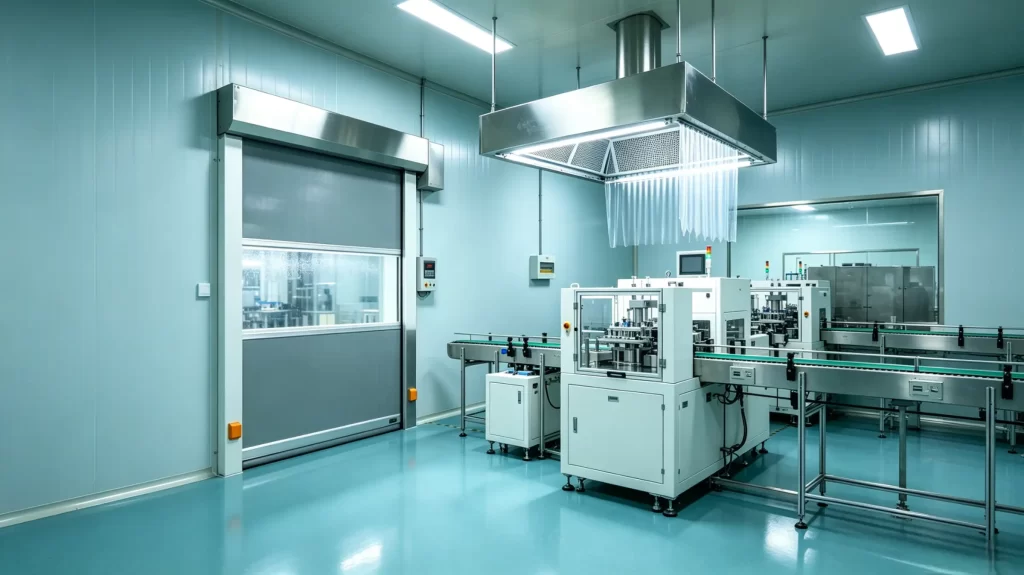
- Rapid Roll-up Cleanroom Doors
- Opening speed: 1.5–2.5 m/s
- Application: High-frequency personnel/small material access
- Core advantage: Minimizes HVAC purge time, reduces energy consumption
- Hermetic Sliding Doors for Pharmaceutical
- Sealing configuration: Bottom automatic lifting rubber seal
- Application: Main process corridors, isolator docking areas
- Core advantage: Smooth, vibration-free operation, adapts to complex utility layouts
- Passbox Interlock System
- Functional configuration: Pressure equalization valve + HEPA filtration unit
- Application: Unidirectional transfer of sample bottles, tools, and intermediates
- Core advantage: Clean material transfer without external environmental exposure
2.3 Engineering Considerations
Door selection in production zones must resolve the conflict between "opening size and airflow disruption." Key control points include:
- Size Balancing: Every 0.5 m increase in door width can raise instantaneous air exchange loss by 15%–20% during opening. A "main door + auxiliary wicket door" configuration is recommended.
- Power-Failure Protection: Equip with power-off self-locking clutches or gravity-balanced counterweight systems to prevent unintended door sliding.
- Airflow Simulation: Utilize CFD to evaluate the impact of door opening on downstream airflow from Laminar Air Flow (LAF) hoods or isolators.
- Transient Compensation: Install Dynamic Air Curtains as temporary barriers during door openings when necessary.
3. Clean Corridors & Interlocked Passageways
3.1 Zone Characteristics
Clean corridors act as the "pressure transmission backbone" connecting functional rooms. Core challenges include:
- Maintaining a stable cascade pressure gradient.
- Ensuring absolute physical segregation between clean and dirty traffic flows.
- Managing dynamic loads from converging multi-directional personnel and material flows.
- Preventing pressure backflow or cross-contamination events.
3.2 Recommended Door Types
Corridor airlock systems should adopt the following configuration combinations:
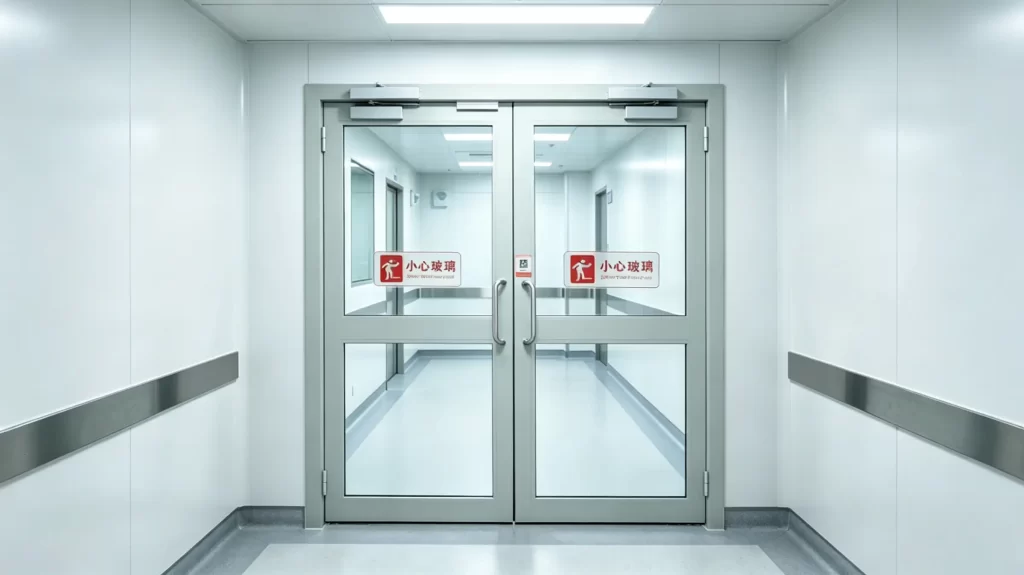
- Dual-Door Electronic Interlock Sliding/Swing Doors
- Control method: PLC or dedicated door controller implementing "one-open, one-closed" logic.
- Safety level: Hardware-level anti-double-open protection.
- Magnetic Sealing + Floor Guidance Components
- Sealing material: Embedded neodymium magnets + medical-grade silicone.
- Performance metric: Leakage rate <0.5 L/s·m² when closed.
- Occupancy Sensor Integration System
- Detection method: Microwave/IR composite sensing with strong anti-interference capability.
- Control logic: "Open upon approach, fast close upon departure," reducing ineffective openings.
3.3 Engineering Considerations
The engineering implementation of interlock logic is the core of corridor door design. Key technical details include:
- Dual-Condition Interlock: The inner door unlocks only when the internal pressure stabilizes at the setpoint (e.g., +10 Pa) AND the outer door is fully closed.
- Sensor Layout: Door contacts and differential pressure transmitters (range 0–50 Pa, accuracy ±1% FS) connect directly to the BMS via Modbus RTU/BACnet.
- Emergency Egress: Configure hardwired fire alarm interfaces to ensure fire signals override interlock logic, enabling millisecond power-release.
- Reset Strategy: Automatically enters a "normally closed, pending reset" state post-evacuation to prevent prolonged pressure system instability.
4. Packaging & Secondary Processing
4.1 Zone Characteristics
Packaging zones typically operate at Grade D or CN levels. While cleanliness requirements are slightly lower than core zones, they exhibit distinct operational traits:
- Massive throughput: 100–200 daily passages per shift.
- Diverse logistics equipment: Mixed traffic of pallet carts, AGVs, and forklifts.
- Low environmental tolerance: Temperature/humidity fluctuations must be controlled within ±2°C / ±5% RH.
- High pacing demands: Door wait times must be <3 seconds to avoid logistics congestion.
4.2 Recommended Door Types
To meet the high-frequency, heavy-duty, and fast-paced demands of packaging zones, the following solutions are recommended:
- High-Speed Cleanroom Doors(Spiral/Hard High-Speed)
- Opening speed: 2.0–3.5 m/s
- Door panel structure: Double-layer aluminum foam insulation, thermal transmittance U≤1.8 W/m²·K
- Wind load resistance: Class 4 or higher, suitable for large logistics openings
- Heavy-Duty Impact-Resistant Doors
- Anti-collision configuration: Buffer strips + auto-reset mechanism, withstands impact energy <500 J
- Application: Main logistics corridors with frequent forklift/AGV traffic
- Maintenance advantage: Modular rail design; single-point failure does not compromise overall operation
- WMS/MES-Linked Scheduled Opening Systems
- Communication protocols: Supports OPC UA, Modbus TCP, RESTful API
- Control logic: "Door opens upon vehicle arrival, closes immediately after passage," eliminating manual wait times
- Data integration: Path-level coordination with AGV Routing Control Systems (RCS)
4.3 Engineering Considerations
Lifecycle assessment and energy control for packaging zone doors must rely on quantified data:
- Cycle Life: Standard motors and rails often develop clearance gaps after 100,000 cycles/year. Industrial servo motors + heavy-duty linear guides are recommended.
- Energy Modeling: Calculate "air exchange loss per passage (m³/pass)" to evaluate energy-saving potential.
- Logistics Integration: Open standard interfaces in door control systems to enable staggered opening logic based on route planning.
- Preventive Maintenance: Set current/vibration monitoring thresholds to provide early warnings of mechanical wear.
5. Material & Personnel Passageways
5.1 Zone Characteristics
Personnel and material passageways must be strictly physically segregated. Core management requirements include:
- Integration into gowning/degowning SOPs.
- Complete audit trail capabilities.
- Material routes must support primary packaging removal, clean transfer, and unidirectional waste exit.
- Physical barriers against reverse contamination and pest intrusion.
5.2 Recommended Door Types
For personnel/material segregation scenarios, the following specialized configurations are recommended:
- Personnel Airlock Doors with Access Control
- Identity verification: Biometric (fingerprint/face) or RFID badge access.
- Permission management: Supports multi-level authorization and temporary visitor access.
- Data logging: Dual backup (local/cloud) of swipe records, compliant with 21 CFR Part 11.
- Pharmaceutical Pass-Through Doors(Transfer Hatches/Carousels)
- Basic functions: Mechanical/electronic interlock + pressure equalization + UV sterilization.
- Advanced configuration: Supports VHP in-situ sterilization, real-time particle counting monitoring.
- Application: Clean transfer of APIs, intermediates, and sterile components.
- Waste Exit Doors for Cleanrooms
- Unidirectional control: Mechanical check hinge + electromagnetic lock combination; opens outward only from the clean zone.
- Sealing reset: Auto-locks and reseals after use to prevent reverse contamination.
- Cleanable design: Horizontal-dust-free surfaces, supports rapid washdown and disinfection.
5.3 Engineering Considerations
Enforcing unidirectional flow relies on dual mechanical and logical safeguards:
- Mechanical Check: Waste routes use unidirectional hinges + gravity self-closing designs to physically prevent reverse opening.
- Logical Interlock: Access control systems link with pressure sensors; routes auto-lock during pressure anomalies.
- Cleaning Pathways: All hardware is concealed; seals support tool-less quick replacement (<2 minutes).
- Data Traceability: Door control systems output standardized logs (timestamp, personnel ID, door status, pressure values) and integrate with LIMS or MES via OPC/MQTT.
6. Engineering Integration & Lifecycle Optimization
6.1 BMS/IIoT Integration
Modern pharmaceutical facility door systems have evolved from "isolated actuators" to "intelligent sensing nodes." Typical integration applications include:
- Status Monitoring: Hall effect sensors track door position; motor current monitoring modules assess operational resistance.
- Predictive Maintenance: Vibration accelerometers + machine learning algorithms provide 3–7 day early warnings for mechanical faults.
- Energy Linkage: Door status signals trigger HVAC fan VFD compensation, achieving "10%–15% instantaneous airflow boost during opening."
- Alert Pushing: Anomalies (prolonged open, interlock failure, pressure excursions) are pushed in real-time to maintenance terminals via SCADA.
6.2 Energy Consumption & TCO Model
Procurement decisions should be scientifically evaluated using a quantified model:
TCO = Initial Purchase & Installation Cost + (Annual Energy Consumption × Equipment Lifespan) + (Expected Maintenance Frequency × Cost per Service Visit) + Downtime Loss Conversion
Reference comparison for high-speed doors:
- Initial Cost: 30%–50% higher than traditional swing doors.
- Energy Savings: With ≤2-second cycle times and ≤0.8 L/s·m² leakage, annual HVAC savings reach ¥15,000–¥30,000 per door.
- Maintenance Cost: >5-year major overhaul-free cycle; single service cost reduced by 40%.
- Break-Even Point: Comprehensive modeling shows TCO break-even typically occurs at 3.2–4.1 years.
6.3 New Build vs. Retrofit Strategies
Different project types require differentiated implementation strategies:
| Scenario Type | Core Constraints | Recommended Solution | Key Advantages |
|---|---|---|---|
| New Build | No existing structural limits | Modular pre-fabricated frames + embedded utilities | Rapid assembly, 30% shorter lead time |
| Retrofit | Structural load/utility conflicts/continuous operation | Lightweight door panels + external reinforcement rails | Minimizes construction disruption, phased implementation |
| Expansion/Upgrade | Frequent process adjustments | Swappable control modules + universal sealing components | Reduces secondary renovation costs & risks |
6.4 Vendor Evaluation Dimensions
Establish a scientific vendor scorecard focusing on:
- Technical Openness: Whether control algorithms support secondary development via standard industrial protocols (BACnet/Modbus/OPC UA).
- Spare Parts Universality: Whether core motors, controllers, and seals use industry-standard components with <2-week lead times.
- On-Site Commissioning Capability: Availability of resident engineers for pressure calibration, interlock logic programming, and BMS integration.
- After-Sales SLA: <4-hour fault response, >80% local spare parts inventory rate, annual preventive maintenance coverage.
- Engineering Acceptance Standards: Post-installation commissioning should reference ISO 14644-2:2015 for pressure stability and particle count re-verification, ensuring door systems synergize with overall cleanroom performance. FAT/SAT validation processes should align with the ISPE Baseline® Guide.
Conclusion
Core Summary
pharmaceutical facility doors are far more than simple physical partitions; they are the nexus of airflow organization, traffic flow efficiency, and intelligent operations in pharmaceutical facilities. Precision selection must adhere to the following principles:
- Zone Matching: Production zones prioritize airtightness, corridors prioritize interlocking, packaging zones prioritize durability, and passageways prioritize traceability.
- Data-Driven: Core evaluation metrics should focus on pressure stability, cycle life, BMS integration, and TCO.
- Systems Thinking: Integrate BMS-integrated cleanroom doors into the overarching cleanroom control architecture to enable dynamic response and predictive maintenance.
Looking for expert guidance on pharmaceutical facility door selection?
Door selection is a systematic decision that requires the integration of zone-specific parameters, operational data, and engineering expertise. Whether you are in the project planning, construction implementation, or operational optimization phase, professional technical assessment can help you mitigate potential risks and enhance system efficiency.
-
 Cleanroom Glass Windows Are The Key to Maintaining a Clean Environment
 -
 Top Aluminium Profile Manufacturers in China: Leading the Global Market
 -
 The Evolution of Air Tight Sliding Doors
 -
 AHU Aluminium Profile: A Comprehensive Guide
 -
 The Importance of Choosing the Right Cleanroom Door in Vietnam
 -
 The Benefits of Hospital Automatic Doors: Enhancing Efficiency and Safety
 -
.jpg) The Best Bathroom Door Manufacturers - Unlocking Endless Possibilities!
The Best Bathroom Door Manufacturers - Unlocking Endless Possibilities! -
 Unlock the Possibilities with AJ Manufacturing Doors
 -
 Make a Statement with Manufactured Home Interior Doors!
 -
 what is aluminum profile? Aluminum Profiles for Your Home is the best option
-
 Hospital Emergency Exit Doors: 90 Minute Fire Rating Meets Infection Control
 -
 ICU and Isolation Door Requirements Hospitals Often Overlook
 -
 Laboratory Door Requirements for BSL-2 and BSL-3 Containment
 -
 Retrofitting Hospital Sliding Doors: Upgrade Wards Without a Rebuild
 -
 Why Airtight Hospital Sliding Doors Are Critical for Infection Control
 -
 Automatic cleanroom door systems: sensor, actuator and access control integration
 -
 Cleanroom Door Materials: Stainless Steel vs HPL vs FRP vs Aluminum Comparison
 -
 X-Ray Room Door Buying Guide: Lead Thickness & Compliance
 -
 Operating Room Doors: Hermetic & Infection-Control Guide
 -
 Hospital ICU Door Selection: Sealing, Sterility & Workflow



-

Home
-

Tel
-

Email
-

Contact


Guangzhou Yizhong Aluminum Industry Co., Ltd.
We are always providing our customers with reliable products and considerate services.
We are always providing our customers with reliable products and considerate services.
Speak Your Mind