
Isolation Room Doors: Pressure, Sealing & Smart Access
In modern healthcare facilities, isolation room doors function as active engineering control nodes rather than simple passageways. For IPC specialists, medical contractors, and procurement teams, the priority is precise pressure differentials, verified airtight sealing, and fail-safe access interlocks. This guide eliminates generic product overviews to focus strictly on engineering parameters, HVAC integration logic, and field commissioning protocols, providing a technical framework for compliant specification and long-term operational stability.
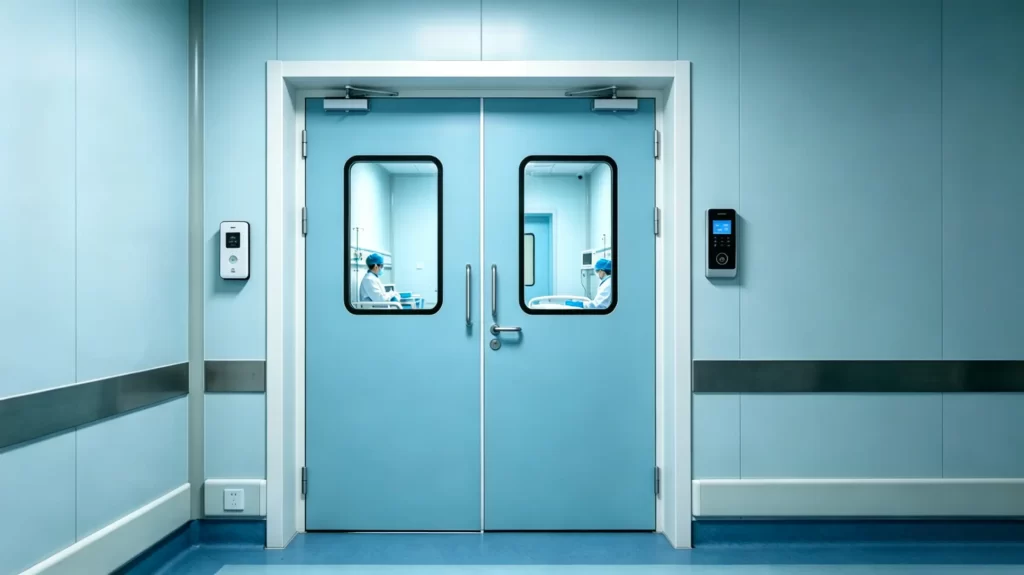
1. Pressure Control: The Core Carrier of Directional Airflow
The pressure differential in an isolation room is not a static metric but a dynamic equilibrium highly dependent on door operation. Standards for negative pressure isolation room door pressure control mandate that Airborne Infection Isolation Rooms (AIIRs) maintain -2.5 Pa to -5.0 Pa relative to the corridor (-8 Pa to -10 Pa for high-consequence pathogens), while Protective Environment (PE) units require +2.5 Pa to +5.0 Pa. The core engineering challenge lies in precisely matching the door leakage rate with the HVAC system's compensation capacity.
- Amplification Effect of Door Leakage on Pressure Stability: Experimental data shows that at a 50 Pa test pressure, if an isolation door's leakage exceeds 1.5 m³/(h·m), the room's air exchange rate must increase by 15–20% to maintain the target differential. The critical issue is transient disturbance: upon door opening, the corridor and room form a continuous cross-section, causing pressure to drop to <0.5 Pa within 0.8–1.2 seconds. Without buffering logic, frequent openings will directly trigger BMS pressure alarms and risk airflow reversal.
- Electromechanical Integration & PID Control Loop:Modern hospital airtight doors must integrate deeply with Building Management Systems (BMS). Door status signals should connect via hardwiring or Modbus RTU to DDC controllers, triggering PID feedforward compensation in VAV terminals or variable-frequency exhaust fans. Best practice recommends a "pre-opening compensation" strategy:
- Access control card swipe or IR sensor triggers an opening request.
- The system increases exhaust airflow by 10–15% exactly 0.5 seconds before the door physically opens.
- This offsets transient pressure loss, keeping the differential drop within the ≤1.2 Pa safety threshold.
- The gradient pressure protection algorithm in medical anteroom double-door interlock systems serves as the final software defense against airflow reversal. HVAC load calculations must explicitly incorporate door leakage into the supply/exhaust balance model. The outdated design inertia of "prioritizing mechanical plant over door airtightness" must be eliminated.
2. Sealing & Airtightness: The Physical Barrier Against Cross-Contamination
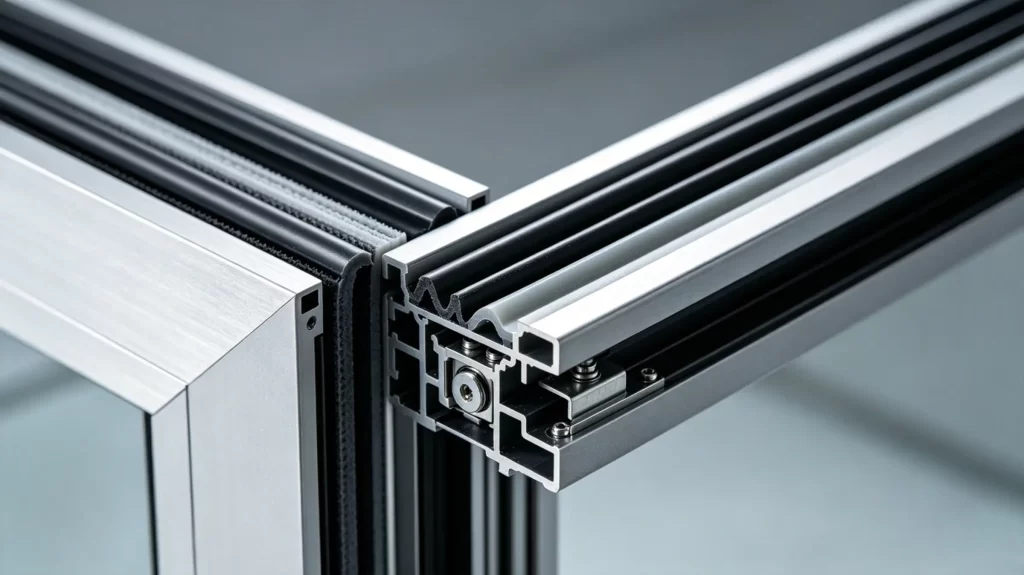
Airtightness is not just an energy metric; it is an IPC red line. Medical-grade isolation doors must achieve EN 12207 Class 4 certification and meet ISO 14644-3 leakage requirements for controlled environments. The physical foundation of any hospital infection control access solution lies in the seamless, continuous closure of the door's perimeter.
- Multi-Lip Composite Sealing Structure:Door frames typically feature embedded multi-lip EPDM/silicone composite gaskets with an Ω or double-barb cross-section. Upon closure, they generate a contact compression force of 1.5–2.0 N/mm, ensuring leakage rates ≤0.8 m³/(h·m) at 50 Pa. Bottom seals are high-failure zones and must feature an automatic drop seal/threshold seal:
- Closes: Vertically drops 8–12 mm via a cam linked to the door hinge, compressing tightly against the floor.
- Opens: Automatically lifts ≥40 mm, completely eliminating trip hazards and cross-contamination pathways from floor mopping.
- Material Compatibility & IPC Durability: Isolation doors endure 2–4 high-concentration disinfection cycles daily (500–1000 mg/L chlorine-based disinfectants, 3% hydrogen peroxide fogging, 75% ethanol wiping). Seals must pass ASTM G154 accelerated aging tests, guaranteeing ≤5% Shore hardness change and ≤8% compression set after 3,000 chemical wipe cycles. The replacement cycle for hospital airtight door seals is typically 3–5 years. Detailed designs should prioritize modular quick-change grooves to reduce replacement downtime to under 2 hours, avoiding ward turnover delays.
- Balancing Fire Rating & Airtightness: Doors must hold EI60/EI90 fire certifications alongside routine airtightness. Intumescent fire strips and airtight lips require "separate channel independent placement" to prevent high-temperature expansion from compromising the airtight layer. IPC departments should implement monthly pressure decay checks using smoke pencils or portable micromanometers to ensure dual fire/airtight certification for isolation room doors holds up under high-frequency disinfection and mechanical wear.
3. Access Control: The Intelligent Execution Terminal for IPC Workflows
Access control systems are the enforcement mechanisms for infection control workflows (clean/dirty segregation, staff/patient separation, independent material routes). The architecture for hospital isolation doors must prioritize high reliability, touchless operation, and data traceability.
- Touchless Activation & Anti-Tailgating Logic:To block contact transmission, prioritize IP65-rated foot pedals, microwave/IR touchless sensors, or NFC/RFID card integration. Permission tiers should sync with HIS scheduling systems to execute:
- Single-authorization passage with a 15-second auto-reset timer.
- Anti-passback monitoring; unauthorized tailgating triggers audiovisual alarms and central control alerts.
- High-containment zones require dual-factor authentication (card + face/fingerprint), logging staff ID and timestamps for full IPC traceability and audit compliance.
- Interlock System Engineering: Anterooms or suite doors require hardware-grade interlocks. Traditional relays suffer from contact oxidation and latency. Modern engineering uses PLC soft-interlocks with safety relay redundancy, achieving ≤0.3s response times and MTBF ≥100,000 cycles. Logic must clearly define "fire override" vs. "IPC priority" boundaries: In fire mode, electromagnetic locks release (Fail-Safe). In normal operation, lock-on-power-loss (Fail-Secure) requires UPS backup (≥30 mins) to prevent airflow collapse during outages.
- Data Traceability & System Integration: Controllers must carry IEC 60601-1-2 medical EMC certification, with enclosures rated IP54 or higher. Open frequency, pressure fluctuation curves, and alarm logs should support CSV/OPC UA export, integrating directly with IPC monitoring platforms. This enables multi-dimensional correlation: "staff entry → pressure transient → environmental swab positivity". Procurement must heavily weigh vendor commissioning capabilities, protocol compatibility, and spare parts response times.
4. Observation Windows: Balancing Clinical Visibility & Protection
Observation windows are critical for non-entry clinical rounds. Medical observation windows must balance optical clarity, structural integrity, and IPC cleanability without compromising the door's aerodynamic profile.
- Positioning & Airflow Avoidance: The visual centerline should sit 1.2–1.5 m above floor level, covering the bed's head-to-foot core zone. Placement must strictly avoid direct airflow from supply diffusers or return grilles to prevent condensation and subsequent microbial aerosol growth on the glass surface.
- Glazing Selection & Safety Ratings: Recommend double-glazed Low-E argon-filled units (6+12A+6 mm) with U-value ≤1.8 W/(m²·K) and dew point ≤-15°C. Laminated with 0.76 mm PVB film, they must meet EN 356 P2A impact resistance. Psychiatric or high-agitation areas should upgrade to P4A. For shading, switchable PDLC smart glass (fog/transparent transition in <0.1s) is rapidly replacing physical fabric blinds, eliminating dust accumulation and simplifying high-frequency disinfection protocols.
- Surface Validation: Glass-to-panel joints must use medical-grade silicone sealant (ISO 10993 biocompatibility compliant), curing to a pore-free, seamless finish. Vendors must provide third-party verification: "≤2% light transmittance degradation, zero cracking/delamination after 3,000 high-frequency disinfectant wipes," ensuring long-term clinical visibility and strict IPC compliance.
5. Procurement & Engineering Commissioning Guide
Scientific selection and rigorous commissioning are key to the lifecycle performance of isolation room doors. Technical specifications should shift from "lowest bid wins" to LCC (Life Cycle Cost) and data-driven validation frameworks.
1. Technical Parameter Checklist
- Airtightness: EN 12207 Class 4 or leakage ≤1.0 m³/(h·m) @ 50 Pa
- Pressure Stability: Transient drop ≤1.5 Pa upon opening, 90% recovery within 10 seconds
- Operating Force: ≤80 N manual force (including gasket compression, per EN 1125)
- Interlock Response: ≤0.3s for double-door hard interlock, misoperation rate <0.01%
- Surface Toxicology: Phthalate/heavy-metal free, resistant to H₂O₂/chlorine (ISO 10993-5 cytotoxicity report)
2. Vendor Evaluation Criteria
- Verify medical-specific manufacturing certifications and demand documented proof of successful negative/positive pressure project deployments, supported by independent third-party commissioning reports.
- Assess regional spare parts distribution networks and require explicit Service Level Agreements (SLAs) for critical component delivery (seals, interlock controllers) within 72 hours.
- Confirm the vendor's capability to supply standardized IPC daily inspection SOPs and provide dedicated technical support for BMS/HIS data protocol integration.
3. On-Site Commissioning (SOP)
- Pressure Stability Test: Execute 72-hour continuous data logging, isolating HVAC tuning phases from baseline operation. The pressure differential standard deviation (σ) must remain ≤0.8 Pa.
- Airtightness Spot Check: Utilize the pressure decay method. After isolating supply and exhaust airflow, measure the time required for pressure to drop from 10 Pa to 2 Pa. Results must fall within ±10% of the engineering design baseline.
- Disinfectant Tolerance Simulation: Subject door seals and observation window joints to continuous high-concentration chemical wiping over a 7-day period. Acceptance criteria mandate micro-deformation ≤5% with zero visible whitening, chalking, or adhesive delamination.
Life Cycle Cost (LCC) analysis must explicitly account for 3–5 year seal replacement cycles, interlock controller spares, and the discounted financial/clinical exposure of IPC breaches stemming from pressure failure. Implementing modular quick-change seal structures can reduce Total Cost of Ownership (TCO) by 18–25%, delivering measurable long-term ROI and minimizing operational downtime.
6. Conclusion
Isolation room doors are evolving from static physical barriers into dynamic, intelligent control nodes. Next-generation systems will integrate IoT micro-pressure self-compensating seals, AI workflow load prediction, and digital twin status monitoring, achieving a closed loop of "pressure forecasting → adaptive sealing → dynamic access optimization". IPC management, engineering detailing, and strategic procurement must align early in the design phase. Data validation must replace empirical guessing. By strictly enforcing pressure differentials, airtight integrity, and interlock reliability, every door becomes a robust, audit-ready barrier safeguarding patients, staff, and facility compliance.
-
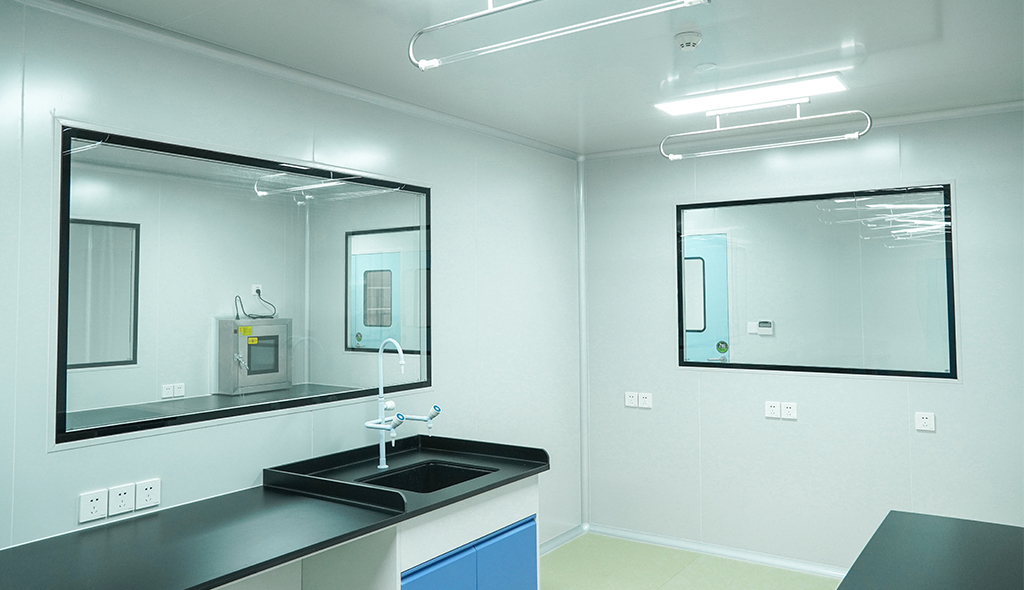 Cleanroom Glass Windows Are The Key to Maintaining a Clean Environment
 -
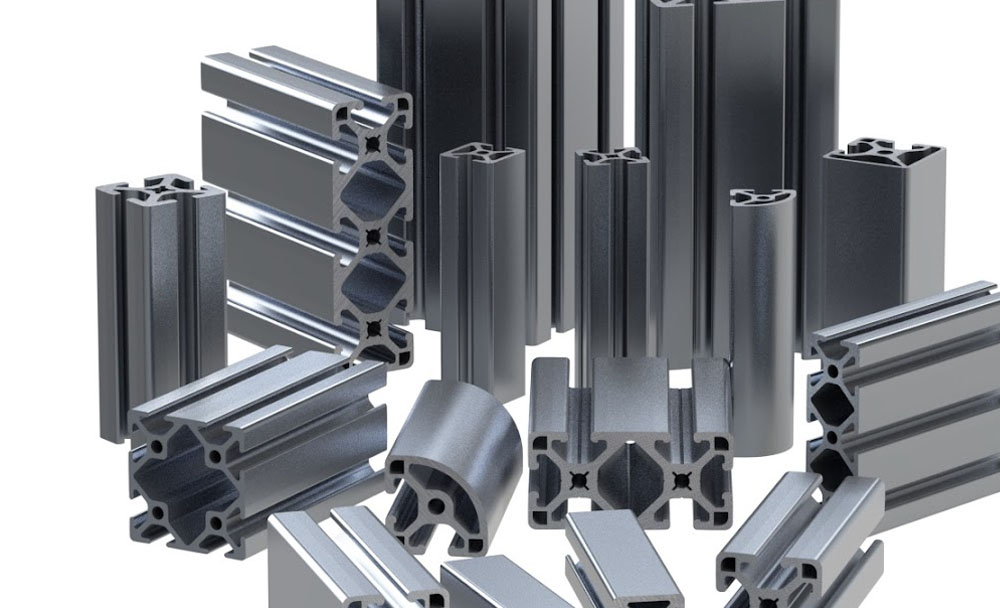 Top Aluminium Profile Manufacturers in China: Leading the Global Market
 -
 The Evolution of Air Tight Sliding Doors
 -
 AHU Aluminium Profile: A Comprehensive Guide
 -
 The Importance of Choosing the Right Cleanroom Door in Vietnam
 -
 The Benefits of Hospital Automatic Doors: Enhancing Efficiency and Safety
 -
.jpg) The Best Bathroom Door Manufacturers - Unlocking Endless Possibilities!
The Best Bathroom Door Manufacturers - Unlocking Endless Possibilities! -
 Unlock the Possibilities with AJ Manufacturing Doors
 -
 Make a Statement with Manufactured Home Interior Doors!
 -
 what is aluminum profile? Aluminum Profiles for Your Home is the best option
-
 Hospital Emergency Exit Doors: 90 Minute Fire Rating Meets Infection Control
 -
 ICU and Isolation Door Requirements Hospitals Often Overlook
 -
 Laboratory Door Requirements for BSL-2 and BSL-3 Containment
 -
 Retrofitting Hospital Sliding Doors: Upgrade Wards Without a Rebuild
 -
 Why Airtight Hospital Sliding Doors Are Critical for Infection Control
 -
 Automatic cleanroom door systems: sensor, actuator and access control integration
 -
 Cleanroom Door Materials: Stainless Steel vs HPL vs FRP vs Aluminum Comparison
 -
 X-Ray Room Door Buying Guide: Lead Thickness & Compliance
 -
 Operating Room Doors: Hermetic & Infection-Control Guide
 -
 Hospital ICU Door Selection: Sealing, Sterility & Workflow




-

Home
-

Tel
-

Email
-

Contact


Guangzhou Yizhong Aluminum Industry Co., Ltd.
We are always providing our customers with reliable products and considerate services.
We are always providing our customers with reliable products and considerate services.
Speak Your Mind