
Hospital Entrance Doors: Why the Door Closes on the Gurney
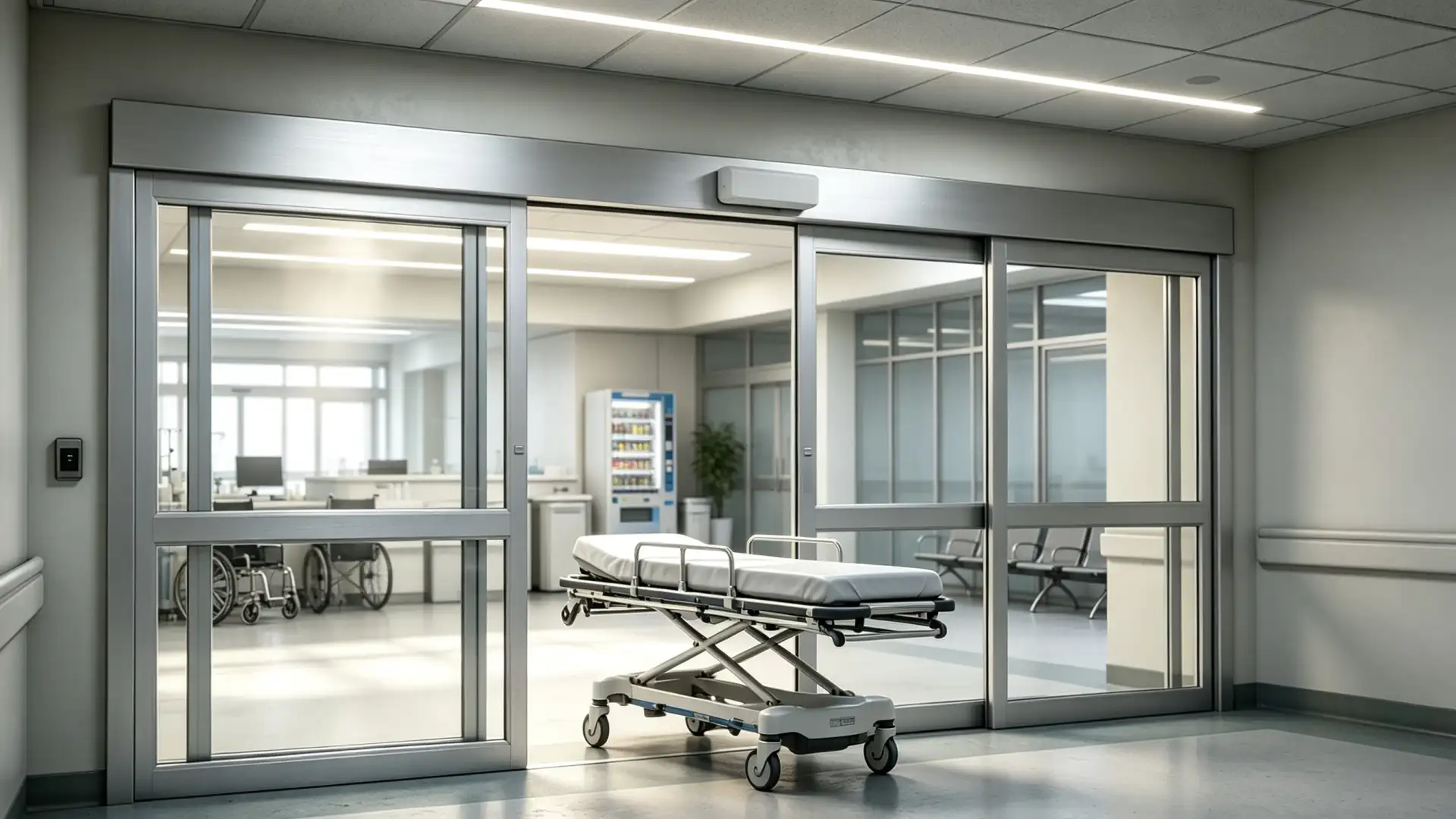
A gurney comes through the main entrance at seven in the morning with a patient on it and two staff alongside. The sliding door opens for the first person, then starts to close as the bed is still crossing. One of the staff stops pushing and puts a hand out to hold the leaf. The door re-opens, the bed gets through, and everyone carries on. By nine o'clock the same thing has happened a dozen times, and somebody has wedged the door open with a rubber stop so it stops happening at all.
Nobody specced a door that fails. They specced a door with a motion sensor, and the motion sensor was set up for people walking in through the front, not for a bed moving sideways across the opening. That is the gap. Hospital entrance doors are usually judged on the leaf, the operator, and the code compliance. The sensor and its timing decide whether the entrance works on a busy morning, and they are often the last thing anyone looks at.
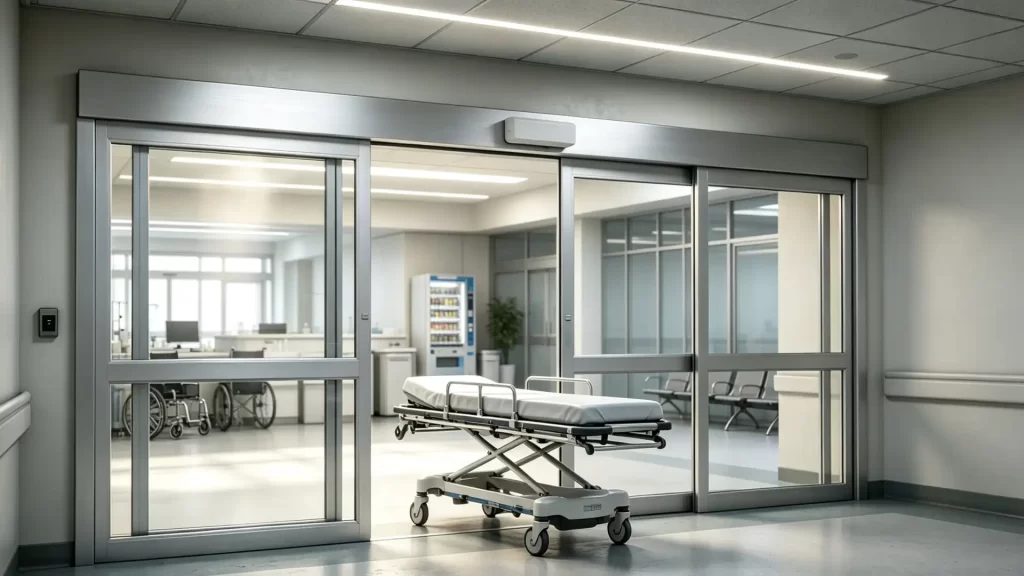
The sensor was aimed at walkers
Most automatic entrance sensors are radar units mounted above the opening. They look for movement in a zone in front of the door and tell the operator to open. The zone is set at installation, usually with a default pattern that suits an office lobby: a person walks toward the door, the sensor sees forward motion, the door opens and holds long enough for one person to pass.
A gurney does not behave like that. It is wide, it moves slowly, and the people pushing it are often walking beside or behind it rather than in front. The leading edge of the bed may be in the opening while the sensor is still looking at a zone that the staff have already passed through. A cart coming at the doorway from an angle can cross the detection band too quickly for the controller to treat it as a valid approach. The result is a door that opens late, closes early, or opens and then loses the target. To someone watching, it looks as though the sensor ignores the bed. In most cases the sensor sees movement and the control logic decides it is not a person approaching the threshold.
In hospital entrance doors, this is the failure mode worth designing against first. The hospital entrance spec guide warns against tuning the sensor for foot traffic. Sensors placed to catch walking visitors miss a bed pushed from the side or a cart coming head-on, the door closes on equipment, and staff learn to prop it. That warning is worth treating as the central design problem rather than a footnote.
Hold-open time is the number everyone guesses
The second reason a door closes on a gurney is that the hold-open timer is too short.
Five seconds is the working minimum for a hospital main entrance. A bed with two staff needs more than a person with a bag. It has to enter the opening, clear the leaf's swing or slide path, and pass the threshold before the operator starts to close. If the timer is set for office traffic, the leaf begins moving while the bed is still crossing. Longer is generally safer for throughput. Many operators allow the hold-open to be tuned by time of day, with a longer interval during morning arrivals and shift changes and a shorter one overnight. That kind of scheduling solves a real problem: a single fixed value is a compromise between the busiest hour and the quietest one, and it will be wrong for at least part of the day. The trade-off is that a longer hold lets conditioned air escape and gives more time for someone to tailgate through behind a gurney. That is why the number belongs in a spec with the traffic profile attached, rather than being left at the factory default. A facility that knows its morning rush runs from seven to nine can set a longer window for those hours and tighten it overnight without losing throughput when it matters.
Radar and floor mats fail in different ways, and knowing which one is fitted tells you where to look. A radar unit above the opening reads movement in a volume of space. It can be tuned for direction and range, but it struggles to tell a slow, wide object from a stationary background once the people pushing it stop moving. A floor mat reacts to weight crossing a zone, so it sees a gurney that radar has lost, but it needs to be placed where the wheels roll and it needs protection from water and debris tracked in from outside. Many entrances use both, with radar for approach and a mat to hold the door while a load crosses. If one of the two is out of alignment, the door behaves as though the sensor is broken even though only half the system is failing. Hold-open interacts with the sensor in a way that is easy to miss. If the sensor loses the gurney as it crosses, a long timer keeps the door open long enough anyway. If the sensor holds the target correctly, a short timer can still close on the load. The two settings are not alternatives. Both have to be right. A door that closes early is more than an inconvenience. Staff learn to defeat it, and once a hospital entrance is propped, the touchless operation, the infection-control benefit, and the security logic all stop working at that opening.
Why propping is the real failure
A rubber wedge under a hospital entrance looks like a small workaround. In practice it turns the front door into an unmanaged opening. The door was specified to control three things: who passes, how air moves at the threshold, and how much contact happens on the route from street to clinical area. A propped leaf removes all three at once. Anyone can walk in, the corridor and outside air mix freely, and the entrance stops being a controlled boundary.
The automatic entrance and infection control guide is clear that sliding doors suit main entrances because they give a wide, low-force opening and work with stretchers and wheelchairs. That only holds while the door is operating. A propped slider has none of those advantages and still carries the cost of the operator. Facilities usually prop doors because the alternative is worse: a gurney stuck halfway through, a staff member holding a leaf while pushing a patient, or a sensor that needs a second wave to re-trigger. Fix the behavior of the door and the wedge disappears. Ask staff to describe the moment they reach for it. Their answer will tell you which sensor zone or timer setting is wrong.
How to test the entrance with the real load
A door signed off during commissioning can still fail on the first busy morning because it was tested with a person, not with the things the hospital moves every day. Walk the entrance with the widest and slowest loads it sees. A gurney with a patient and two staff, a bariatric stretcher, a wheeled imaging machine, a loaded supply cart, and a person in a wheelchair. For each one, approach from straight ahead and then from an angle, because side approaches are where radar zones tend to lose a target.
Watch three things. Does the door open before the load reaches the leaf? Does it stay open until the load has fully cleared? Does it re-open cleanly if the load stalls in the threshold? A door that passes with a person walking through and fails with a bed is not commissioned, whatever the paperwork says. Then test the adjacent corridor. A well-zoned sensor opens for the person at the door and ignores someone passing thirty feet away. If the leaf cycles every time a nurse walks past in the corridor, the zone is too wide. The entrance becomes an energy leak and a nuisance, and staff start treating it as background noise rather than a controlled boundary. Change one thing at a time. Widen the detection zone or add a floor mat, then re-test with the bed. Adjust the hold-open, then re-test again. Adjusting both at once makes it impossible to know which change fixed the problem, and it is how entrances end up with a timer that is far longer than necessary.
The spec should describe the users, not the door
The cleanest way to avoid the problem is to write the users into the specification. A line that says automatic sliding entrance with sensors is not enough. It should name the loads, the approach directions, the hold-open time for peak periods, and the requirement that the door remain open until the widest load clears. Include the threshold and the floor in the same document. A slow, low gurney can be stopped by a lip that a walking visitor never notices. The entrance is the approach, the floor, the activation, the operator, and the leaf together. Treating the sensor as an accessory to the door is how a compliant assembly becomes a failed entrance. Security and egress belong in that document too. An entrance that has been tuned for beds still has to release from the inside under all conditions.
The conflict shows up when security is added later. A lockdown feature that holds the leaf shut for credential checking can lengthen the effective hold cycle, or release the door in a way that fights the sensor logic. A detection system that scans each person entering adds dwell at the threshold, and if the operator has been tuned for free-flowing foot traffic the door will close while someone is still being processed. Every addition to the entrance changes the timing, which is why security should be designed into the same sequence as the sensor and the hold-open rather than bolted on after commissioning.
Ask for the whole entrance to be demonstrated under the conditions that matter: a gurney during the morning rush, a wheelchair at shift change, a cart approaching from an angle, and the security mode switched on. A supplier who can show the door handling all four has specified an assembly. A supplier who demonstrates a person walking through in default mode has shown you the easiest case and nothing more.
Maintenance closes the loop. Radar drift, a mat that has absorbed water, a closer on the side panel that slows the reset, or a firmware change to the operator can each undo a setting that was correct on handover. Put the entrance into the same inspection rhythm as the rest of the building, and re-test it with a gurney after any change to the operator, sensor, or security system. A door that was right in year one can be closing on beds in year two without anyone having touched the spec.
Where the door feeds a controlled clinical zone, the sealing and hardware choices need to agree with the rest of the envelope. The airtight hospital sliding doors guide explains how a sealed leaf supports pressure and infection control, and the same attention to the assembly applies at the front door even though the performance targets differ.
FAQs
Why does the door open for a person but not for a bed?
Most sensors are set to detect a person approaching head-on. A gurney is wide, slow, and often pushed from the side, so the control logic can lose the target before the bed clears the threshold.
How long should the door stay open?
Five seconds is a working minimum for a hospital main entrance. Beds, stretchers, and carts usually need longer, and many operators allow the hold-open to vary by time of day.
Can I fix a door that closes early by adjusting the sensor only?
Sometimes, but the timer matters just as much. Test both. A sensor that holds the target with a short timer will still close on the load.
Is hold-open time the same as sensor range?
No. Range decides where the door notices a user. Hold-open decides how long it stays open after opening. Both have to be set for the traffic the entrance handles.
What is the fastest way to know if the entrance is wrong?
Watch what staff do. If they prop the door or hold it during busy periods, the entrance is not serving the loads it was specified for.
Conclusion
A hospital entrance is judged at seven in the morning with a gurney in the opening, not at commissioning with someone walking through. Specify the sensor zone, the hold-open time, and the threshold around the real loads, then prove them with the widest and slowest thing the hospital moves. Send your opening dimensions, traffic profile, and code requirements to E-ZONG for an entrance package sized around how the door will be used.
-
 Cleanroom Glass Windows Are The Key to Maintaining a Clean Environment
-
 Top Aluminium Profile Manufacturers in China: Leading the Global Market
-
 The Evolution of Air Tight Sliding Doors
-
 AHU Aluminium Profile: A Comprehensive Guide
-
 The Importance of Choosing the Right Cleanroom Door in Vietnam
-
 The Benefits of Hospital Automatic Doors: Enhancing Efficiency and Safety
-
 The Best Bathroom Door Manufacturers - Unlocking Endless Possibilities!
-
 Unlock the Possibilities with AJ Manufacturing Doors
-
 Make a Statement with Manufactured Home Interior Doors!
-
 what is aluminum profile? Aluminum Profiles for Your Home is the best option
-
 Hospital Entrance Doors: Why the Door Closes on the Gurney
-
 Clean Room Airlock Design: When Can the Second Door Open
-
 Hospital Double Doors: Why the Center Seal Leaks First
-
 ICU Doors Take More Daily Abuse Than Any Hospital Door
-
 Clean Room Door Accessories: Which Parts Wear Out First
-
 Lab Door Installation: Three Seals That Decide Pass or Fail
-
 Standard Door Width vs Custom: When Standard Falls Short
-
 Biotechnology Cleanroom Design: Zoning That Protects Process
-
 Airtight Door Room Map: Avoid Leaks Before the Audit
-
 Clean Room Airlock Not Holding Pressure? 6 Causes and Fixes




-

Home
-

Tel
-

Email
-

Contact


Guangzhou Yizhong Aluminum Industry Co., Ltd.
We are always providing our customers with reliable products and considerate services.
We are always providing our customers with reliable products and considerate services.
Speak Your Mind