ICU Doors Take More Daily Abuse Than Any Hospital Door
Stand by an ICU doorway at shift change and just watch it. A nurse comes through with a trolley of medication. A bed follows with three people steering it. Someone puts a shoulder against the leaf to hold it long enough for a monitor to get past. The door shuts, opens again, and shuts again before you have counted to twenty.
That is an ordinary ten minutes. Multiply it across a twelve-hour shift and the doorway has done more work than the hospital entrance, which nobody thinks twice about because entrances are built for it. An ICU door usually is not. It gets chosen from the same range as the ward doors down the corridor, and the problems start a few months later.
Start with what has to fit through the opening
A patient room door has an easy life. Staff come in to take observations, deliver a meal, or check on one patient. The door is often a wall-mounted air-tight swing leaf with a seal, a closer, and a window, and it does that job well. The patient room air-tight swing door lays out the features that matter in those rooms.
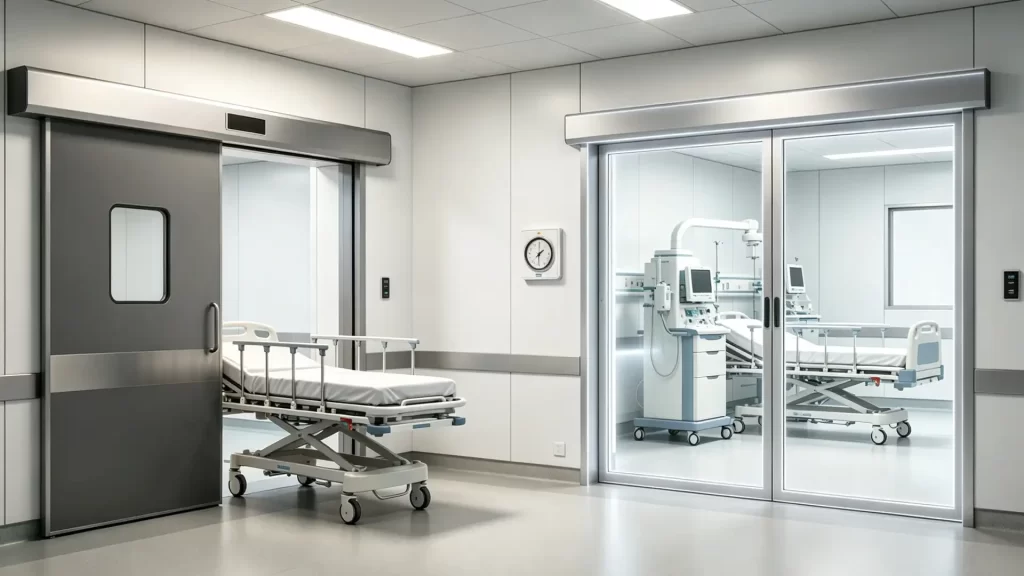
An ICU doorway carries a different load. Beds move in and out with a team around them. Portable imaging machines, ventilators, infusion pumps, and supply carts follow. Every one of those is wider than a person and heavier than a hand should have to stop.
This is where the number on the drawing stops being useful. A 900 mm leaf does not give you 900 mm to pass through. The frame, the gasket, and the hinge allowance each take a slice, and a bed with two people guiding it needs more than a catalog width suggests. Measure the widest loaded item that will go through, including the people steering it, before the opening is fixed. Getting it wrong later means cutting into a wall that is already finished.
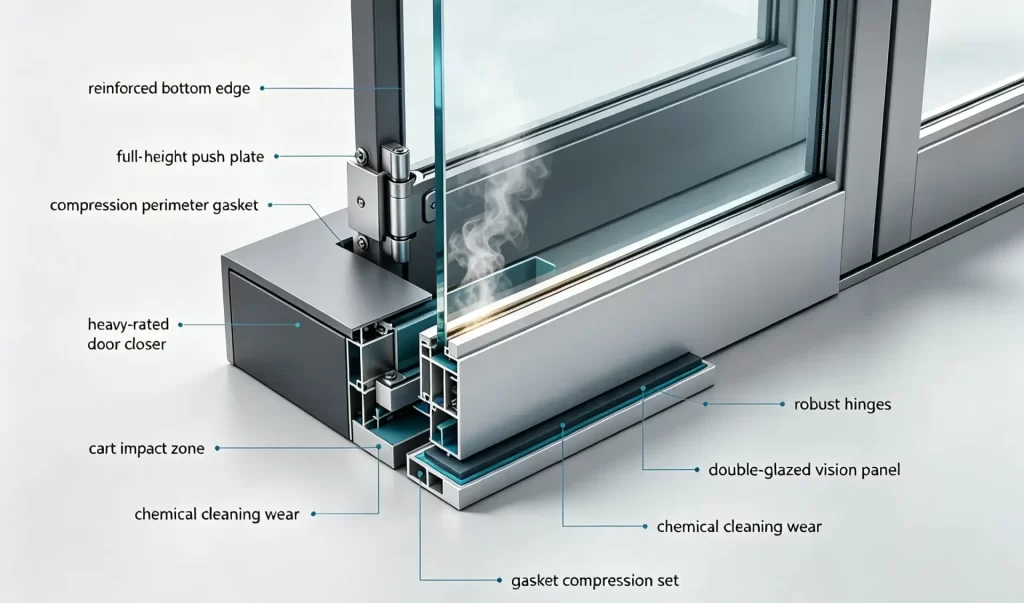
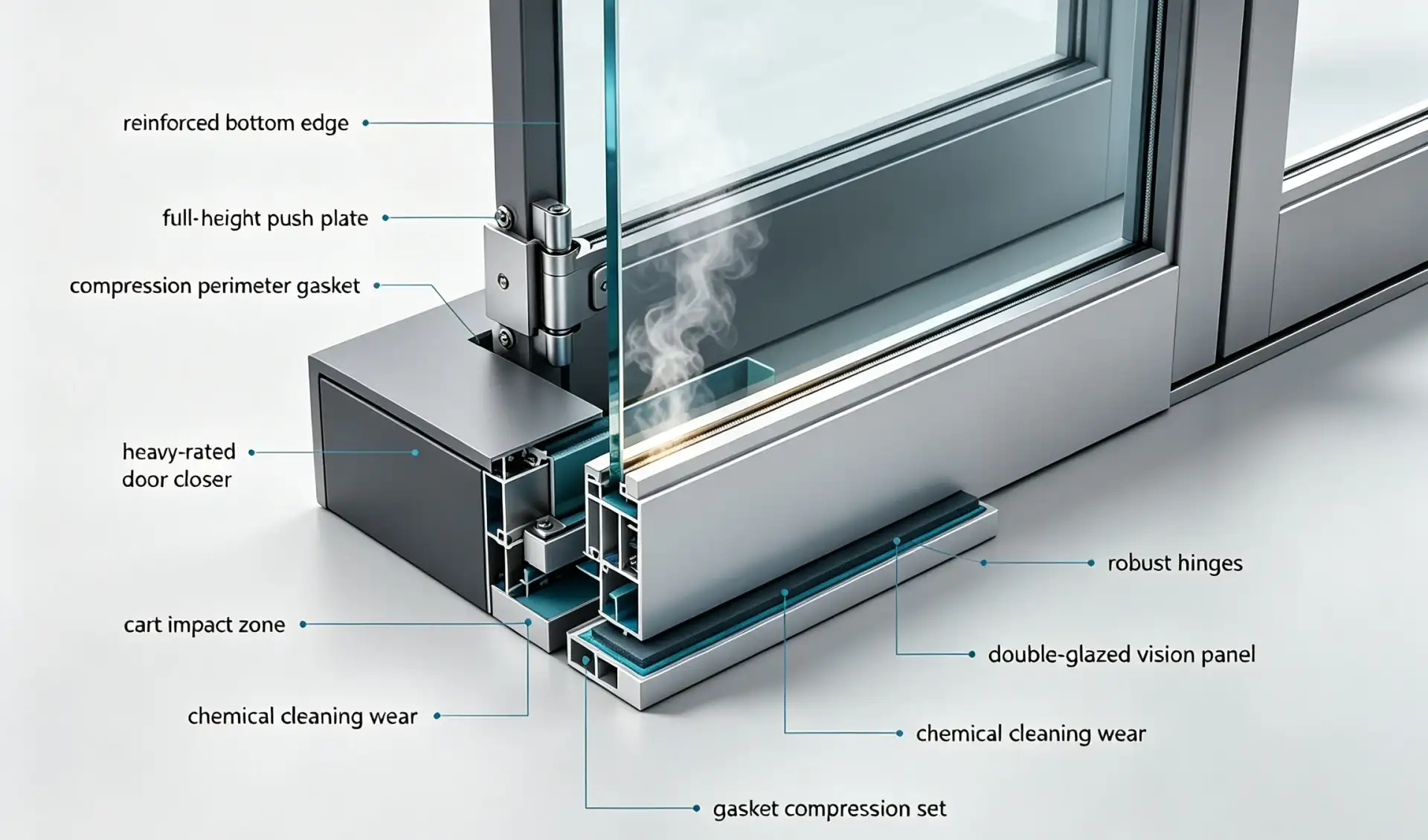
On a swing leaf, the bottom corner takes the punishment. Carts clip it. Bed frames catch it. Users push the door past its stop to make room, which is how closers lose their setting and hinges start to work loose. Reinforced bottom edges and panels that can take a knock are worth more here than a finer finish. If the traffic is constant enough that the swing arc is blocking the corridor, that is the moment to look at a sliding leaf. The airtight glass automatic sliding doors show how a clear span and a working seal can be detailed together, so nobody has to touch the leaf to get a bed through. Sliding is not inherently better. It is better when the route says so.
The pressure problem arrives as a drift, not a leak
Nobody walks into an ICU and sees the door leaking. What they see is a diffuser reading that will not settle, or a room that passes its check in the morning and misses it by the afternoon. The first suspicion usually falls on the HVAC. Sometimes it is the HVAC. Often the door has been open too often to recover, or the seal stopped making contact months ago.
Most ICU rooms sit at positive pressure against the corridor, so air moves outward when the door opens and contaminants from outside are less likely to come in. Every opening spends some of that differential. The system builds it back, which takes time. Open the door again before it has recovered and the room never reaches target, which in a busy unit can be most of the shift.
What helps is unglamorous. A closer that returns the leaf to the frame on its own gives the room a chance to recover. A gasket that still has its rebound closes that window immediately. A strip that looks intact but has taken a permanent set will leave the room drifting whatever the air handling is doing.
Then there is the habit every facility manager knows: propping the door open because someone needs both hands. A wedge under an ICU door is hard to defend when an infection control reviewer asks about it. If hands-free operation is genuinely needed, specify an operator that shuts the door as reliably as it opens it.
The same pressure logic runs through hospital isolation rooms, where airflow and containment are the point of the assembly. The guide to hospital isolation doors goes into the sealing and interlock details those rooms depend on, and most of it transfers straight to an ICU doorway.
You hear a bad door before you see it
Nurses notice a change in the sound first. The leaf clicks instead of settling. It bangs because the latch missed and the closer had to force it home. The noise is not a separate problem from the seal; it is usually the first sign that the hardware has moved out of adjustment.
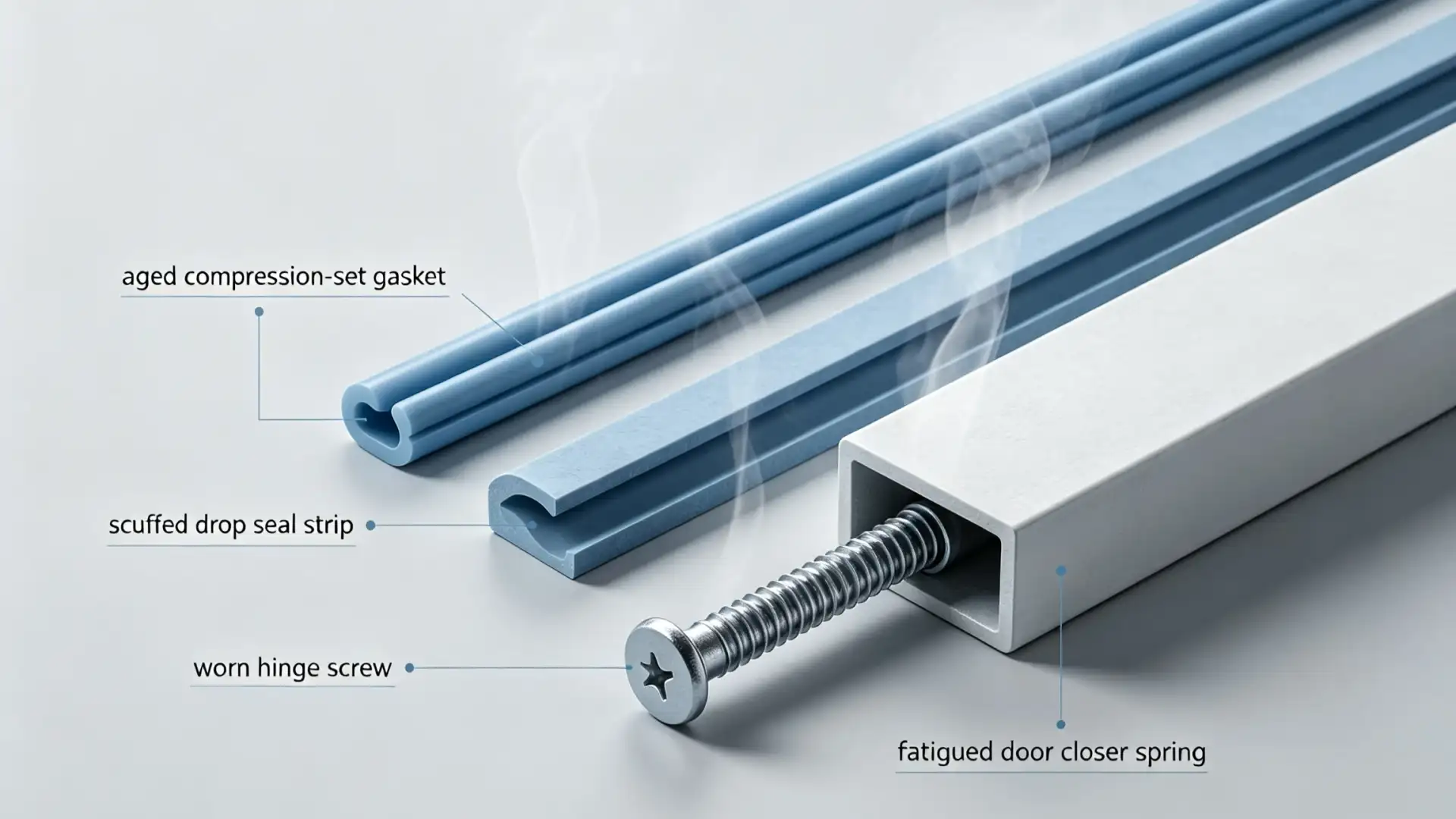
A closer loses tension slowly. A hinge screw backs out a turn at a time. The leaf starts sitting slightly differently in the frame, and the gasket stops compressing evenly along one edge. A hardened seal no longer absorbs the contact. By the time anyone sees the gap, the noise has been there for weeks.
The moving parts give out before the panel does. Hinges carry a leaf that gets pushed past its stop. Closers fight users who hold the door open with a bed. Locks are wiped and swiped dozens of times a shift. A drop seal on a sliding leaf drops and lifts on every pass. The door still opens throughout, which is why nobody writes anything down, until the latch needs a second push or the room starts drifting and the cause is not obvious.
A noise is worth treating as an inspection prompt. Check the closer speed, the striker, and the hinge screws before shopping for a different door. Those adjustments cost very little and usually restore the seal at the same time. On the busiest doorways, a weekly pass over the latch, the closer return, the gasket, and the bottom edge tells you more than an annual inspection ever will. Keep a note of what was adjusted and when. After a couple of cycles you will know the real service interval for that particular door, which is a far better number than a calendar date applied to every door in the building.
Three years of wiping leaves its mark
The parts people touch most get cleaned most. On an ICU door that means the handle, the push plate, the lower third of the leaf, and the frame edge beside the latch. Wipes and sprays applied several times a day do not remove anything instantly. They wear the surface down over years.
A powder-coated finish will pit at the edges if the wrong agent sits on it often enough. Once the coating goes on a handle, residue collects under the lip and becomes difficult to shift. A gasket exposed to chlorine or peroxide daily can harden and stop compressing. None of this appears in year one. It tends to appear across several doors at once in year two or three, which is when it gets mistaken for a batch problem.
The fix is mostly decided at specification. Choose a surface that tolerates the disinfectant that unit uses on its own schedule, not the one in a generic cleaning protocol. Keep the hardware simple: flush or recessed pulls, no decorative grooves, nothing with a ledge that needs working around. A surface that wipes in one pass stays clean. One that has to be negotiated does not.
Observation windows deserve a similar look. A clear panel lets staff check a patient without going in, which helps both infection control and safety. A fogged unit does neither. Where there is a temperature difference across the door, a double-glazed unit with a sealed spacer holds up better. Ask how the glass is sealed into the leaf, and not only what the glass is.
There is one more contact point worth mentioning because it gets overlooked. A knee or an elbow often opens these doors when someone's hands are occupied, and the push plate ends up taking that load. If the plate is small or mounted too low, users push on the panel instead, and the finish around that spot wears through long before the rest of the leaf. A full-height push plate on the side that gets used is a small addition. Watch a doorway for an afternoon and you will see exactly where people put their hands and shoulders. Specify for that, rather than for how the door looks in a photograph.
Access control meets someone with both hands full
An ICU is restricted, so some way of controlling entry is expected. Card readers, keypads, and touch locks keep the room managed and leave a record of who went in. In a regulated facility that record matters, and an entry missing from the log is a documentation issue even when the door itself works perfectly.
Critical care does not wait for someone to find a card. Staff are often carrying equipment in both hands. A reader that needs three swipes slows a response, and a lock that releases late holds the leaf against the closer. Both are small faults until the moment they are not.
The workable approach separates normal access from getting out. Electronic access can manage routine entry. A panic device or a hardware release keeps the door openable from the inside whatever the electronics are doing. Test the release as well as the reader, because a system that logs every entry but needs a finger on a button to leave has its priorities wrong.
Where the ICU opens onto an airlock or a sterile corridor, an interlock can stop two doors being open at once and protect the pressure cascade. It also introduces another way for the system to fail, so the logic needs a documented override for clinical need. That is the trade-off to weigh, not a reason to avoid interlocks altogether.
Let the route decide swing or sliding
If the doorway mostly carries people and the occasional trolley, a swing door with a closer sized for the leaf is simpler, cheaper, and easy to service. Staff already know how to use it.
Once beds and large equipment are passing through several times an hour, the swing arc becomes a cost. It takes floor space, it gets hit, and it holds up movement while someone swings it clear. A sliding leaf gives an uninterrupted opening. It asks more of the floor guide and the bottom seal, so those need specifying with the same attention as the leaf itself. When the choice is genuinely close, walk the route with the widest item and time how long the doorway blocks the corridor. The answer is usually obvious on the second pass.
What is worth putting in the specification
By this point the list is fairly short. A closer that returns and latches the leaf without help. Panels and bottom edges that can take a cart without denting. A surface and gasket that tolerate the cleaning agents used in that unit. Clear width measured against the widest thing that will pass through. A vision panel that stays clear and is sealed flush. Access control that produces a record without getting in the way of a fast exit.
These are ordinary features. What makes them work is sizing them against an honest picture of how the doorway gets used. The common failure is choosing a door that looks right on the drawing and then asking it to do a job nobody accounted for.
FAQs
How often should an ICU door be inspected?
The busiest doorways want a quick weekly check of the latch, closer return, gasket contact, and any impact damage at the bottom edge. A full inspection fits the quarterly round.
Can one door serve infection control and emergency egress?
Yes. A listed assembly with a reliable closer, suitable seals, and a rated panic device does both, provided the hardware is specified together so the rating holds.
Is a sliding ICU door as airtight as a swing door?
It can be. The seal depends on the bottom system and how the leaf sits in the frame, not on how the door moves. Sliding suits high traffic but needs careful adjustment.
Why does the pressure drop when the door is closed?
Recovery takes time after each opening. Open again before the differential returns and the room never reaches target. A closer that shuts promptly and a seal that makes immediate contact both help.
Should ICU doors have windows?
Usually. A clear panel lets staff observe a patient without entering. Specify a sealed, double-glazed unit that wipes clean.
A door is judged at the end of the shift
An ICU door has to seal, survive contact, and clean up easily, often on the same day. The measure is how it behaves after twelve hours of beds, trolleys, and wiping, not how it looked when it was installed. Send your traffic pattern, pressure requirements, cleaning agents, and opening sizes to E-ZONG and we will put together a specification for the duty that doorway will see.
-
 Cleanroom Glass Windows Are The Key to Maintaining a Clean Environment
-
 Top Aluminium Profile Manufacturers in China: Leading the Global Market
-
 The Evolution of Air Tight Sliding Doors
-
 AHU Aluminium Profile: A Comprehensive Guide
-
 The Importance of Choosing the Right Cleanroom Door in Vietnam
-
 The Benefits of Hospital Automatic Doors: Enhancing Efficiency and Safety
-
 The Best Bathroom Door Manufacturers - Unlocking Endless Possibilities!
-
 Unlock the Possibilities with AJ Manufacturing Doors
-
 Make a Statement with Manufactured Home Interior Doors!
-
 what is aluminum profile? Aluminum Profiles for Your Home is the best option
-
 ICU Doors Take More Daily Abuse Than Any Hospital Door
-
 Clean Room Door Accessories: Which Parts Wear Out First
-
 Lab Door Installation: Three Seals That Decide Pass or Fail
-
 Standard Door Width vs Custom: When Standard Falls Short
-
 Biotechnology Cleanroom Design: Zoning That Protects Process
-
 Airtight Door Room Map: Avoid Leaks Before the Audit
-
 Clean Room Airlock Not Holding Pressure? 6 Causes and Fixes
-
 Hospital Door Standards: NFPA, IBC, EN, and GB Compared
-
 Cleanroom Doors: Buyer's 15 Specs to Confirm Before PO
-
 Operating Room Door Spec: 7 Requirements Hospitals Must Meet




-

Home
-

Tel
-

Email
-

Contact


Guangzhou Yizhong Aluminum Industry Co., Ltd.
We are always providing our customers with reliable products and considerate services.
We are always providing our customers with reliable products and considerate services.
Speak Your Mind