
Clean Room Airlock Design: When Can the Second Door Open
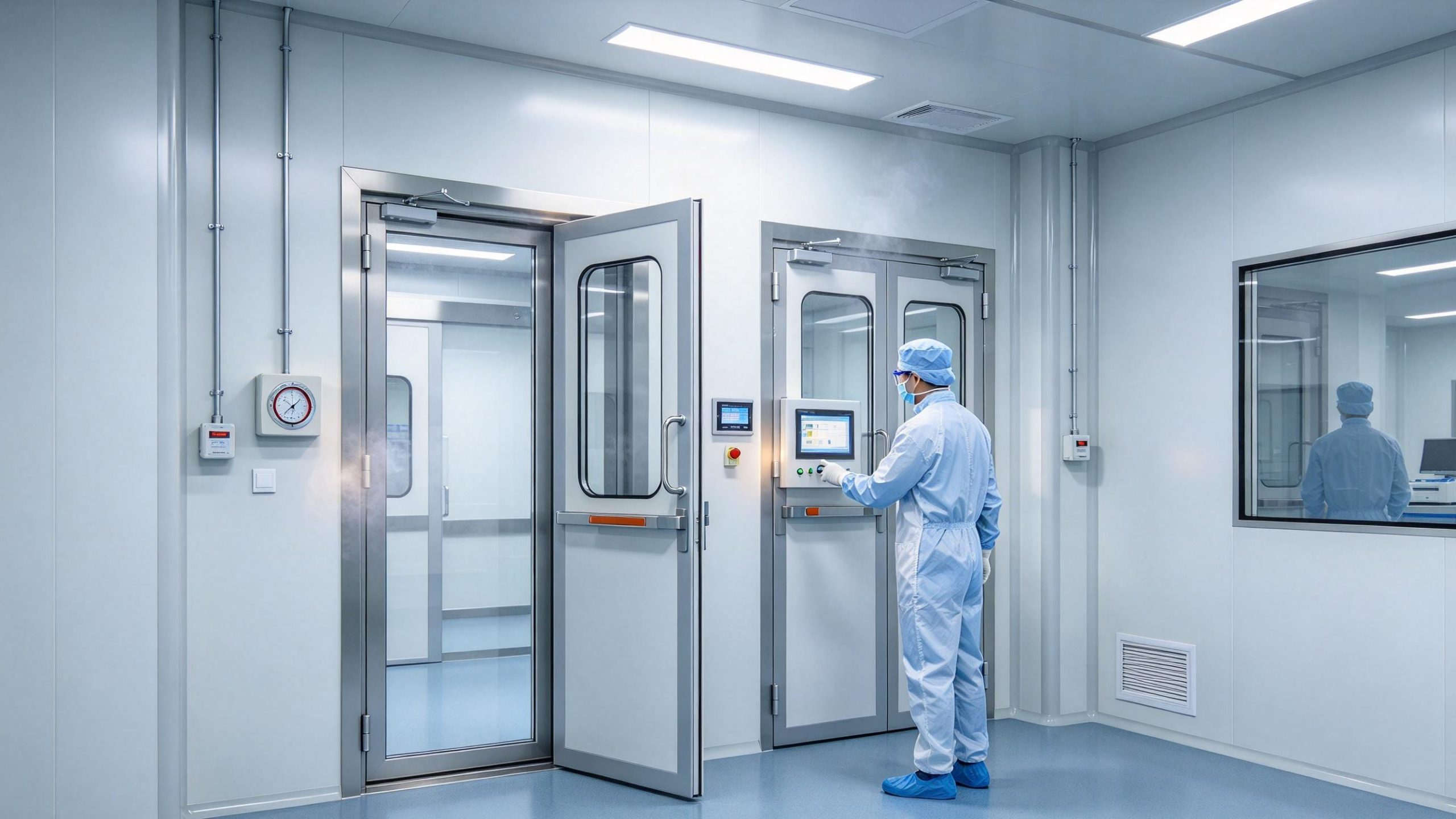
An operator steps into an airlock and the first door closes behind them. The second door is right there, with a green indicator and a card reader that will happily accept the card. On paper the interlock has done its job: only one door was ever open at a time. The operator badges, the second door unlocks, and the room on the other side takes a particle count spike that shows up on the next environmental monitoring report.
The interlock did what it was told. It checked whether the first door was closed. It never asked whether the air in the airlock had been replaced. That gap is the difference between an airlock that is locked and one that works. The second door should open only after two separate conditions are met: enough air changes have occurred to clear the space, and the pressure differential has recovered to its set point. In clean room airlock design, that gap is the part most often left to the control contractor to guess.
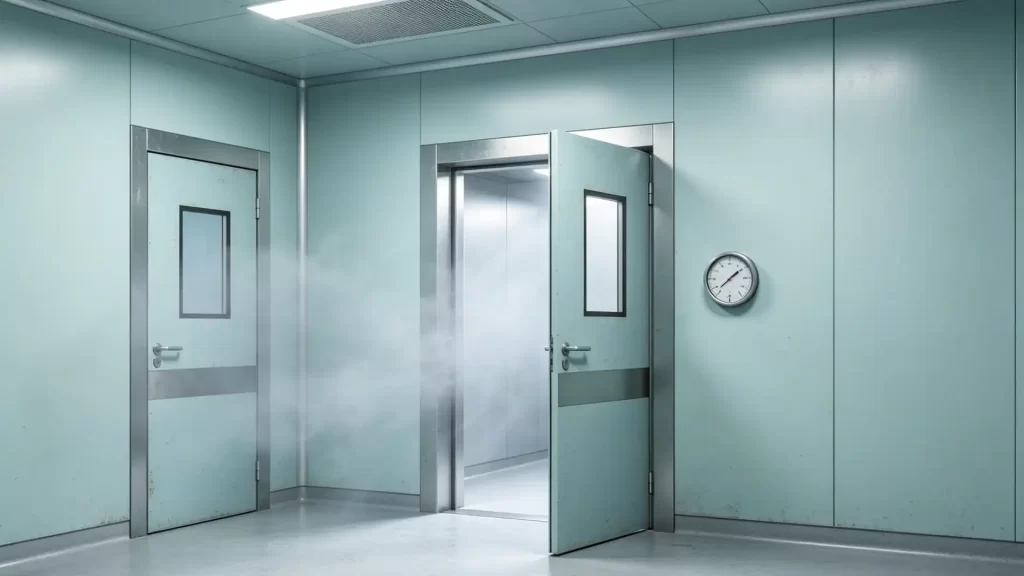
Closed is not the same as clean
An interlock answers one question: is the other door shut? A door position switch can confirm that in a fraction of a second. Once it reports closed, the controller releases the second door, and the operator can pass straight through.
The problem is that closing a door does not clean the airlock. When the first door opened, air from the less-clean side moved in. People brought particles in on their garments. A cart brought them in on its wheels and its load. Closing the door traps all of that in a small room. The space now needs to be flushed before its air resembles the clean side again.
This is what purge time is for. It is the dwell period between the first door closing and the second door becoming available. During that period the airlock runs its air changes, particles are diluted and carried away, and the pressure difference between the airlock and the clean room re-establishes itself. Skip the dwell and the operator carries a load of uncontrolled air straight into the classified space.
The airlock design overview covers the two governing controls of sequencing and cascade. Purge time is the clock that sits between them, and it is what turns a correct sequence into a clean transfer.
What sets the length of the wait
In clean room airlock design, two things decide how long the dwell should be, and they are often confused with each other.
The first is air changes. A room at a given ACH replaces its volume at a calculable rate. To reduce the concentration of whatever came in, you need a defined number of those replacements rather than a single pass. A common design target is to let several air changes pass before release, because dilution is exponential and the last part of the cleanup takes longer than the first. The exact number belongs in the validation plan, not in a rule of thumb.
The second is pressure recovery. Opening a door disturbs the differential. The HVAC system brings it back, but it does not do so instantly. If the second door opens while the airlock is still below its set point, the pressure cascade collapses at that threshold and air moves the wrong way. The FDA compliant doors guide describes the intended logic directly: the next door is permitted only after the mandated self-purging time based on ACH has completed and the pressure differential has recovered to its safety threshold.
Those two conditions run in parallel, and the longer one wins. A controller that releases on a fixed timer without checking pressure is only doing half the job. A controller that checks pressure but ignores air changes can release a room that is at the right differential and still full of particles.
Size matters here. A large airlock holds more air and takes longer to flush. A small one recovers its pressure quickly but leaves less room for a gowned operator to stand without touching the walls. The air change rate and the room volume together set the clock, which is why the number cannot be copied from one project to another.
How the controller should decide
A workable release logic waits for both signals before it unlocks the far door.
- Door closed: the first door reports closed and latched, not merely near the frame. A door that is almost shut still leaks and still blocks the pressure recovery you are waiting for.
- Air changes complete: either a timer derived from the design ACH and the required number of replacements, or a direct calculation from monitored airflow. The timer approach is simpler to validate; the airflow approach responds better to a system that is running below design.
- Pressure at set point: the differential between airlock and clean room, and between airlock and the corridor side, both within their bands. A single sensor is rarely enough, because the airlock sits between two different pressures.
Only then release: the far door unlocks, with a status indication that tells the operator the transfer is ready. If any condition fails, the door stays locked and the system flags why. This is more than an interlock with a delay on it. The pass doors guide makes the useful distinction: access control asks whether you are authorized, while an interlock says this door will not open right now because of what the other door is doing. Purge logic adds a third voice. It says the door will not open yet because the room is not ready, regardless of authorization and regardless of what the other door is doing now.
Emergency release still has to override all of it. A person trapped in an airlock with a fire alarm active must be able to get out. The fail-safe behavior has to be designed and tested rather than left to the installer.
Where clean room airlock design gets this wrong
The most common error is treating the interlock as the whole design. The doors are specified, the controller is wired for one-open-at-a-time, and nobody writes down what happens in the seconds after the first door closes.
A fixed timer with no pressure input is the next most common. It works when the HVAC is perfectly balanced and fails quietly as filters load or dampers drift. The room still cycles through its timer and releases the door, but the differential never quite recovers.
Indication is another weak point. If the operator cannot see why the door is locked, they will treat the delay as a fault and find a way around it. A red light with no explanation invites someone to hold a door or disable a sensor. A short message showing that the room is purging, or that pressure is still recovering, turns the wait into a visible part of the process instead of an obstacle.
Sizing the airlock too small causes a different problem. The room reaches its air change target on paper but the operator and the cart occupy most of its volume, which changes the effective air movement and contaminates the space they are standing in. A buffer that works in an empty-room calculation can fail when used as intended.
Monitoring is the last gap. If the purge sequence fails, somebody needs to know before the next particle count spikes. Housing alerting on a failed or shortened purge belongs in the same alarm set as a pressure excursion.
People and materials need different waits
A personnel airlock and a material airlock do not carry the same load into the space, so they should not share the same dwell without a reason.
An operator walking through brings particles mostly from garments and skin, and the load is relatively consistent from one pass to the next. A dwell sized for that predictable burden works most of the time. Add a gowning step inside the airlock and the picture changes, because the act of gowning sheds particles into the room at the moment you are trying to clean it. The purge has to run after the gowning movement stops, not from when the first door closed.
A material airlock is harder to generalize. A sealed cart of wrapped components brings very little contamination. An unpacked pallet, a waste container, or a piece of equipment that has been on the warehouse floor brings a great deal more. If the same dwell is applied to every load, the light transfers waste time and the heavy transfers are under-cleaned. Where the loads vary widely, the practical answer is a minimum dwell based on air changes plus a defined hold for any material that meets a dirtier criterion, with the operator able to request that hold rather than bypass it.
This distinction also affects the door specification. A material airlock that sees carts needs a wide, impact-tolerant leaf that still seals, while a personnel airlock can use a narrower airtight door. The wait and the door are two halves of the same transfer decision, and both belong in the same specification.
Proving the wait works
A dwell period written in a specification is a claim. Validation is where it becomes evidence, and the tests should look at the space rather than the controller.
Start by measuring the actual air changes in the finished airlock. Design values and installed values diverge once ductwork, filters, and dampers are in place. If the measured rate is below what the dwell was calculated from, the timer is already wrong on day one.
Next, challenge the room. Introduce a tracer or generate particles under a defined condition, close the first door, and sample the airlock at intervals through the dwell. The result tells you when the space reaches its target, which may be sooner or later than the design estimate. Do the same check on pressure, recording how long the differential takes to return and whether it overshoots or hunts around the set point.
Then check that the controller respects both. Force a condition where the timer has expired but pressure has not recovered, and confirm the far door stays locked. Force the reverse, with pressure recovered before the air changes are complete, and confirm it still stays locked. A system that passes only one of those two tests is not enforcing the design.
Document the sequence with the results attached. A validation pack that shows the dwell, the measured recovery, and the controller behavior gives an auditor something to inspect. One that only describes the interlock leaves the most important part of the airlock unverified.
Build the wait into the clean room airlock design
The dwell period is easiest to get right before the layout is fixed. Once the room is built and the air handler is selected, the air changes are what they are, and a purge time that turns out to be too short can only be fixed by changing the control logic or the HVAC.
Start with the classification and the validated cleaning target for the transfer. Work out how many air changes are needed to reach it and how long that takes at the design flow rate. Set the pressure bands for both sides of the airlock. Then give the controller the job of confirming all of them, and document the sequence so the validation team can test it.
Ask for the sequence to be demonstrated, not described. A supplier who can show the door staying locked while the timer runs and the pressure climbs is telling you the system will hold up. A supplier who describes an interlock and a timer as the same thing has not designed the wait.
The doors themselves still matter. A leaf that does not close fully will hold the pressure signal at the wrong value and keep the sequence waiting, or leak enough that it never recovers. Seal choice and frame integration have to support the same goal. The hospital room pressure and doors guide sets out the sealing-envelope reasoning that applies here as well, even though the room classification will be different.
FAQs
Can the second door open as soon as the first one closes?
Not if the airlock is doing its job. The space needs time to replace its air and re-establish pressure before it can hand anything through to the clean side.
Is an interlock timer the same as purge time?
No. A timer only counts elapsed time. Purge time assumes a defined number of air changes at a known rate, and it should be confirmed by pressure recovery as well.
Does a smaller airlock purge faster?
It reaches a given number of air changes sooner, but it also holds less usable space and can be compromised by the person and load inside it. Size it for the traffic first, then calculate the wait.
What should happen if pressure never recovers?
The far door stays locked and the system raises an alarm. The cause is usually a door that has not sealed, an HVAC issue, or a differential set too tight for the equipment.
Can emergency release override the purge sequence?
It must. Life safety takes priority, so the fail-safe path needs to be designed and tested alongside the normal transfer logic.
Design the pause between the doors
An airlock is defined less by its two doors than by what happens between them. The second door opens when the air has been changed and the pressure has come back, not a moment sooner. Send your airlock layout, room class, air change rate, and pressure bands to E-ZONG for a door and control package that treats that pause as a designed part of the barrier.
-
 Cleanroom Glass Windows Are The Key to Maintaining a Clean Environment
-
 Top Aluminium Profile Manufacturers in China: Leading the Global Market
-
 The Evolution of Air Tight Sliding Doors
-
 AHU Aluminium Profile: A Comprehensive Guide
-
 The Importance of Choosing the Right Cleanroom Door in Vietnam
-
 The Benefits of Hospital Automatic Doors: Enhancing Efficiency and Safety
-
 The Best Bathroom Door Manufacturers - Unlocking Endless Possibilities!
-
 Unlock the Possibilities with AJ Manufacturing Doors
-
 Make a Statement with Manufactured Home Interior Doors!
-
 what is aluminum profile? Aluminum Profiles for Your Home is the best option
-
 Clean Room Airlock Design: When Can the Second Door Open
-
 Hospital Double Doors: Why the Center Seal Leaks First
-
 ICU Doors Take More Daily Abuse Than Any Hospital Door
-
 Clean Room Door Accessories: Which Parts Wear Out First
-
 Lab Door Installation: Three Seals That Decide Pass or Fail
-
 Standard Door Width vs Custom: When Standard Falls Short
-
 Biotechnology Cleanroom Design: Zoning That Protects Process
-
 Airtight Door Room Map: Avoid Leaks Before the Audit
-
 Clean Room Airlock Not Holding Pressure? 6 Causes and Fixes
-
 Hospital Door Standards: NFPA, IBC, EN, and GB Compared




-

Home
-

Tel
-

Email
-

Contact


Guangzhou Yizhong Aluminum Industry Co., Ltd.
We are always providing our customers with reliable products and considerate services.
We are always providing our customers with reliable products and considerate services.
Speak Your Mind