
Hospital Double Doors: Why the Center Seal Leaks First
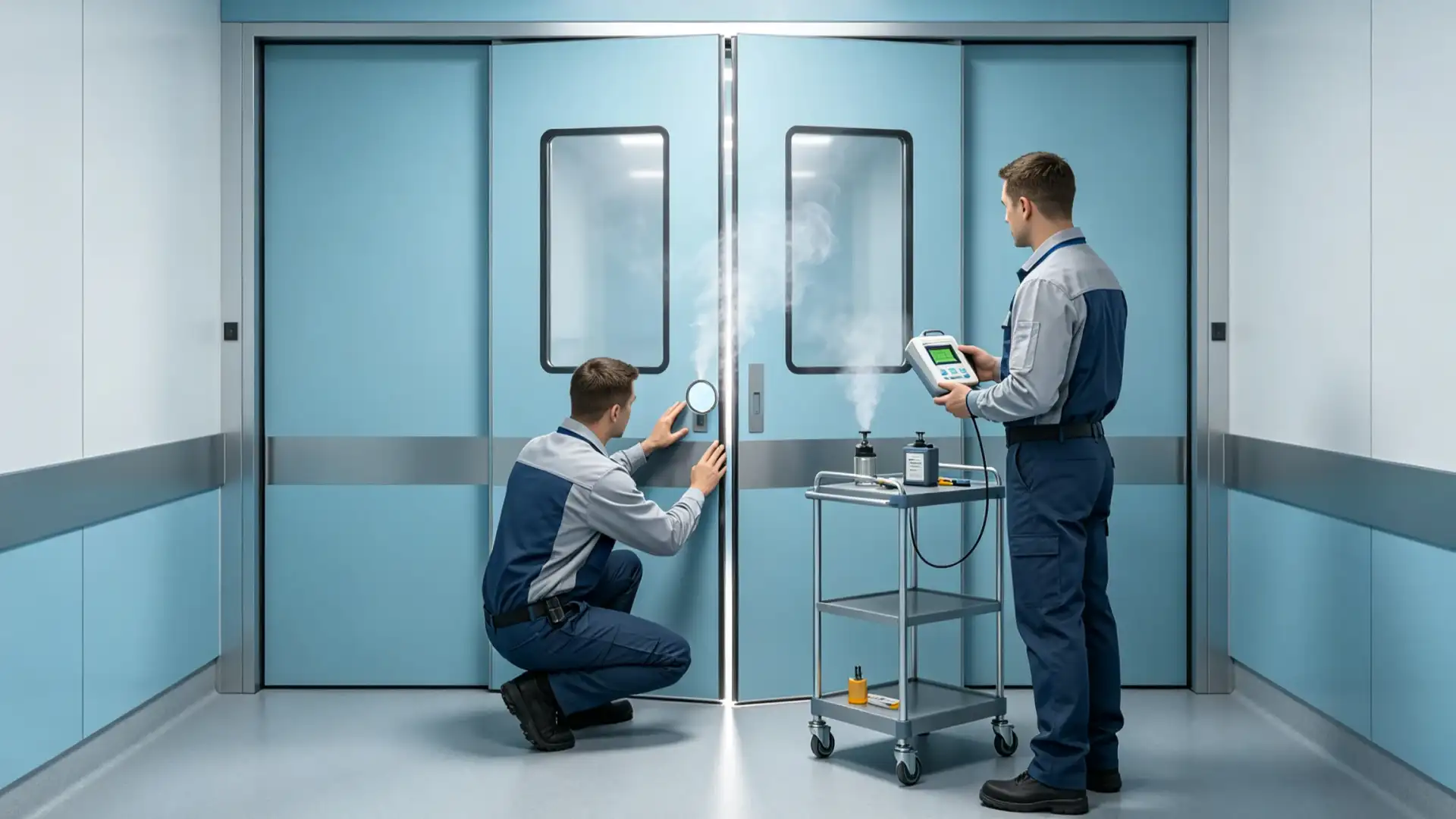
A pressure room was built with a double door at the entrance. The frame sealed, the drop seal at the floor worked, and the gasket around the perimeter was new. The room still could not hold its differential. A smoke test put the leak at the one place nobody had inspected: the vertical gap where the two leaves met in the middle. The seal there looked continuous from a distance. Up close, the leaves did not arrive at the same plane when they closed.
That is the ordinary failure of hospital double doors. People judge the perimeter because that is what they can see, and the center seam quietly does its own thing. In a single leaf there is no center seam. In a pair of leaves there are two extra edges, a meeting point, and a hardware sequence that all have to work together every time.
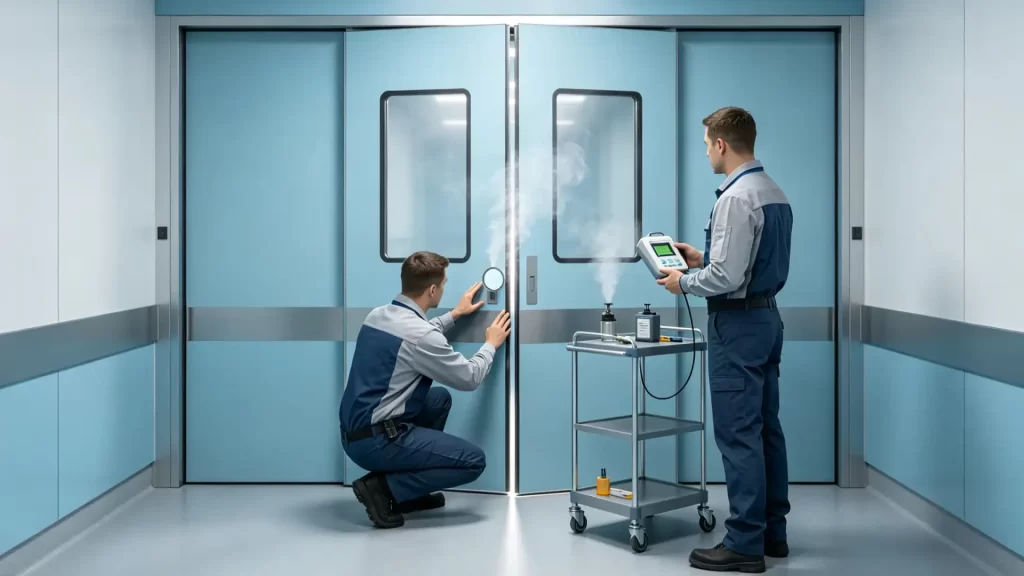
What a double door adds to the sealing problem
A single leaf presents one continuous perimeter to seal. A double leaf splits that perimeter into two leaves and introduces a third problem in the middle: the meeting stile, where the two leaves come together. The hospital doors overview sets out the three jobs a hospital door has to do, which are holding pressure, meeting the code, and moving traffic. A double door has to do all three with a seam running down the middle of the opening.
That seam is a moving joint. The leaves swing on separate hinges, they are closed by separate forces, and they meet at a point that changes slightly with temperature, humidity, and wear. A perimeter gasket only has to resist one leaf moving away from the frame. The center seal has to hold two leaves against each other, and either one moving out of plane opens a path. This is why the center seal is the first place to look when a double door fails a pressure check. The perimeter is usually fine. The middle is where two independent moving parts have to agree.
The ways the middle opens up
A center seam fails in a handful of predictable ways, and most of them start small.
- The leaves close at different times. If the inactive leaf is still moving when the active leaf arrives, the two edges glance past each other instead of compressing the seal. The door looks shut. The gasket never gets a clean bite.
- One leaf sags. Hinges loosen under the weight of a leaf that gets pushed past its stop, and the meeting edge drops a few millimeters. The top of the seal touches and the bottom opens, or the other way around. From the corridor it still reads as a closed door.
- The astragal or meeting stile is set wrong. On many pairs, one leaf carries a strip that the other leaf closes against. Set it too tight and the door will not latch without a shove. Set it too loose and the strip never compresses. Both errors look like a latch problem until someone checks the smoke.
- The seal itself ages. Rubber that has taken a compression set keeps its shape but loses the rebound that made it a seal. A strip that has been wiped with the wrong disinfectant can harden at the edge. The center sees the same cleaning as the handles and the same cycles as the hinges, so it ages on both fronts at once.
- The floor tells on the seam. A dip under one leaf twists the whole frame slightly, and the two meeting edges no longer line up vertically. What looks like a gasket problem is a level problem.
- Cleaning gets into the joint as well. The center seam sits at hand height, which is where staff push with a shoulder or a trolley handle, and it gets wiped along with the leaves. Residue builds up in the rebate where the two edges meet. That residue holds moisture, and moisture attacks a rubber strip faster than air does. A seam that is hard to wipe is a seam that will need replacing sooner, whatever grade of gasket went in.
- Vision panels add their own consideration on a pair of leaves. A window set too close to the meeting stile puts weight and a seal joint in the same region, and the edge of the glazing becomes another line that has to stay clean and intact. Keep the panel away from the center where the layout allows, and make sure the frame around it is flush. The same reasoning applies to observation windows on any sealed leaf, and the details are covered in the patient room air-tight swing door page, where the window is treated as part of the seal rather than a decoration.
Close in the right order
Double doors are not two independent doors hanging next to each other. They are a pair with a sequence, and the sequence is what makes the center seal work.
The inactive leaf closes first. It is the one that normally stays shut, held by a flush bolt at the top and bottom. The active leaf closes second, carrying the latch and, in many assemblies, the astragal that presses against the inactive leaf. If both leaves swing freely and close at random, the sequencing is gone and the center joint never behaves the same way twice.
That is what a coordinator is for. It holds the active leaf back while the inactive leaf closes and its flush bolts engage, then releases the active leaf to come against it. A sequential closer does a similar job within a single mechanism. Without one of them, the pair depends on whoever last used the door to close it in the correct order, which is not a specification you can defend.
Sequence is also a code item. Automatic flush bolts on paired leaves show up in the same section of NFPA 101 and the IBC that governs latching and clear width. The steel double doors fire rating guide covers what the hardware and sealing have to satisfy under GB/T 47162-2026, including the documents a specifier should ask for. A center seal that only works when staff close the leaves in the right order is a weakness in both the pressure plan and the fire rating.
The width you gain is smaller than it looks
Double doors are often chosen to get a wider opening. That is a legitimate reason, but the arithmetic is not what most people expect.
Two leaves do not give double the clear width of one. The meeting stile takes space in the middle. The lock stile and the hinge side take space at the edges. On an equal pair, each leaf is only part of the nominal opening, and the usable width is less again once the gaskets compress. On a nominal double opening, the clear passage can be well short of the number a buyer first reads. This matters most where the load is a bed or a cart with an operator alongside. Measure the widest item that will pass through, including the people guiding it, and work backward from the clear width you need. If the pair only just clears it on paper, it will not clear it once the seals are fitted and the leaves have settled.
Equal or unequal leaves is the decision that follows. An equal pair suits a passage that needs the full width most of the time. An unequal pair, with one narrow leaf for daily use and one wider leaf opened for equipment, suits a room where people pass constantly and large loads rarely. It keeps the center seam closed most of the day instead of swinging both leaves for every minor movement.
Where double doors are worth the trouble
Hospital double doors ask more of the specification than a single leaf. They have more hardware, a seam that needs managing, and a sequence that has to be maintained. That cost is worth paying in particular places.
An ICU or a room where ventilators and several staff need to pass together is one. The overview of selection by department notes that a double leaf fits this kind of traffic, provided the leaf still holds a seal and opens quickly for access. Isolation rooms with an anteroom are another, because the wider opening moves gowned staff and equipment without long pauses in the cascade. Operating rooms and imaging suites that move large equipment use a pair for the same reason.
For a low-traffic staff corridor or a small treatment room, a single airtight leaf is simpler. It seals on one perimeter, it has no sequence to maintain, and it costs less to keep working. Choosing a double door because it looks more substantial is how facilities end up with a seam they have to inspect every month.
Keeping the seam sealed
The center joint deserves its own place on the inspection schedule, separate from the perimeter and the floor seal.
Close the door slowly and watch the two meeting edges. They should arrive together, and the strip on the inactive leaf should compress evenly from top to bottom. A gap that opens at one end points to hinge adjustment or a frame that is out of level. A gap that runs the full height points to the astragal setting or a leaf that is no longer latched.
Check the flush bolts next. A top or bottom bolt that has stopped throwing fully leaves the inactive leaf free to drift, and the sequence falls apart from that point. On a high-use pair, a weekly check of the bolts, the coordinator, and the hinges takes a few minutes and catches a sagging leaf before the seal gives way.
When a center seal is replaced, fit the strip the assembly was designed for. A gasket chosen because it fits the channel may not tolerate the disinfectant used in that room, and one that swells after a few weeks will stop the leaves closing in sequence at all. The seal grade should follow the room class and the pressure the doorway holds in service, not the closest size in stock.
It helps to record what was found at the seam each time, along with what was fixed. Note whether the gap was at the top or the bottom, which leaf was out of plane, and whether the flush bolts were throwing fully. Over a few months that record tells you whether you have a hinge problem that keeps returning, a cleaner using the wrong agent, or a frame that moved when the floor settled. Those three causes look identical on the day they fail and need different fixes. A double door that keeps losing its center seal usually has one of them running in the background, and the pattern only becomes visible when somebody writes it down.
The same habit helps at acceptance. A center joint checked and photographed on the day of installation gives the commissioning team a baseline. When the room drifts six months later, you can compare the seam against that record instead of arguing about whether it was ever right.
FAQs
Why does the center of a double door leak before the edges?
The edges seal a leaf against a fixed frame. The center seals two moving leaves against each other, so any difference in their timing, alignment, or hinge condition opens the joint.
Do both leaves need a drop seal?
The floor is still part of the perimeter, and each leaf that reaches the floor needs to seal there. The center seam is an additional joint, not a replacement for the bottom seal.
What does a coordinator do?
It holds the active leaf back while the inactive leaf closes, then releases the active leaf to latch against it. That order is what lets the meeting stile compress consistently.
Are unequal double leaves worth considering?
Yes, where daily traffic is light and occasional loads are large. A small leaf handles routine passage while the wider one stays closed, which keeps the center seam undisturbed.
Can a double door meet the same airtightness grade as a single leaf?
It can, provided the meeting stile, the sequence, and the seals are specified as one assembly and verified together. Testing the leaves separately does not tell you how the joint performs.
Conclusion
When a double door fails a pressure check, the perimeter is the easy place to look and the middle is the place to find the fault. Two leaves have to arrive in the right order, in the same plane, with a seal between them that still rebounds. Send your opening width, room class, pressure requirement, and traffic pattern to E-ZONG for a double door assembly specified around the joint that will decide whether it holds.
-
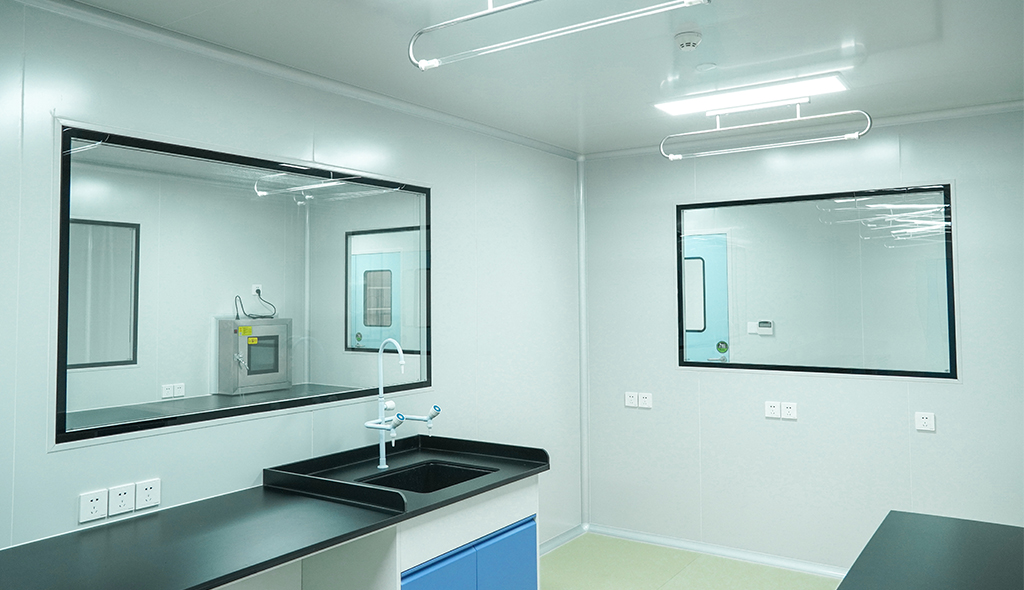 Cleanroom Glass Windows Are The Key to Maintaining a Clean Environment
-
 Top Aluminium Profile Manufacturers in China: Leading the Global Market
-
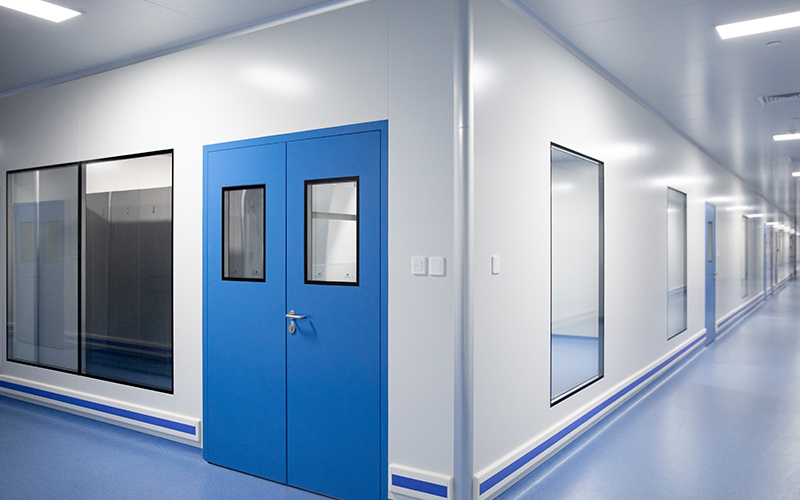 The Evolution of Air Tight Sliding Doors
-
 AHU Aluminium Profile: A Comprehensive Guide
-
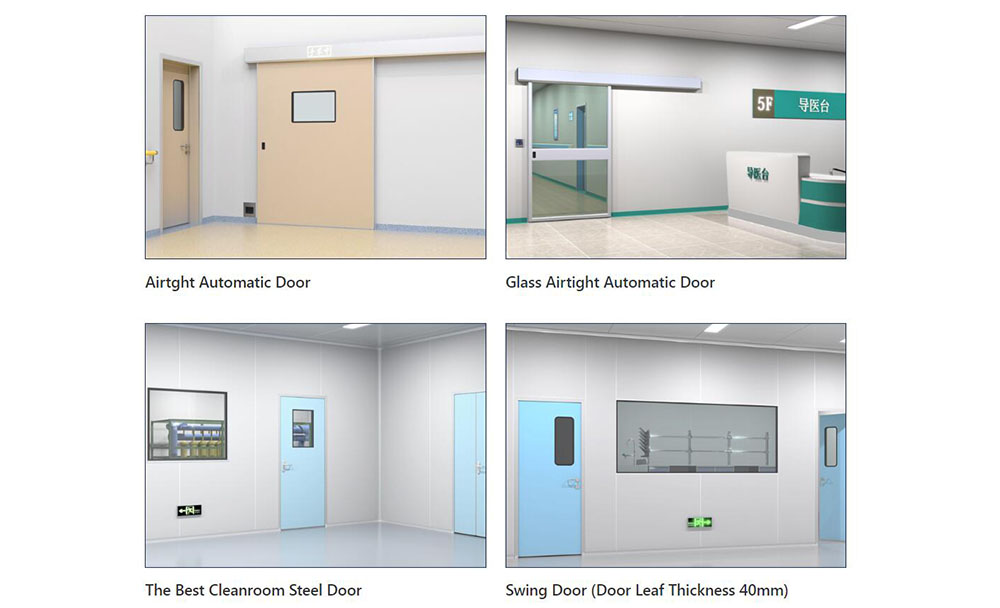 The Importance of Choosing the Right Cleanroom Door in Vietnam
-
 The Benefits of Hospital Automatic Doors: Enhancing Efficiency and Safety
-
 The Best Bathroom Door Manufacturers - Unlocking Endless Possibilities!
-
 Unlock the Possibilities with AJ Manufacturing Doors
-
 Make a Statement with Manufactured Home Interior Doors!
-
 what is aluminum profile? Aluminum Profiles for Your Home is the best option
-
 Clean Room Airlock Design: When Can the Second Door Open
-
 Hospital Double Doors: Why the Center Seal Leaks First
-
 ICU Doors Take More Daily Abuse Than Any Hospital Door
-
 Clean Room Door Accessories: Which Parts Wear Out First
-
 Lab Door Installation: Three Seals That Decide Pass or Fail
-
 Standard Door Width vs Custom: When Standard Falls Short
-
 Biotechnology Cleanroom Design: Zoning That Protects Process
-
 Airtight Door Room Map: Avoid Leaks Before the Audit
-
 Clean Room Airlock Not Holding Pressure? 6 Causes and Fixes
-
 Hospital Door Standards: NFPA, IBC, EN, and GB Compared





-

Home
-

Tel
-

Email
-

Contact


Guangzhou Yizhong Aluminum Industry Co., Ltd.
We are always providing our customers with reliable products and considerate services.
We are always providing our customers with reliable products and considerate services.
Speak Your Mind