
Door Seal Selection for Cleanroom and Medical Doors
1. Why Door Seals Serve as the Invisible Defense Line for Cleanroom and Medical Compliance
In modern cleanrooms and medical facilities, a door seal is far more than a simple physical filler; it is the core component maintaining a dynamic airtight boundary and preventing the spread of particulates and microorganisms. Whether managing suspended particles in cell therapy workshops or controlling pathogen negative pressure in isolation wards, the selection precision of a cleanroom door seal or hospital door seal directly dictates environmental pressure differential stability and cross-contamination risks. In engineering practice, seal failure often triggers a cascade of operational issues:
- Airflow short-circuiting leads to localized cleanliness failures, forcing the HVAC system into frequent cycling and increasing energy consumption by over 20%;
- Non-compliance during GMP/ISO audits results in rectification orders, work stoppages, and batch recalls;
- Surging maintenance costs and frequent seal replacements disrupt production continuity.
Airtight requirements in controlled environments rise exponentially with cleanliness classifications. The ISO 14644-1 and EU GMP grading systems establish strict leak thresholds for different zones. In medical settings, an airtight door and a hermetic door must address entirely different airflow management logics:
- Hybrid operating rooms require a micro-positive pressure of +5 to +10 Pa to block external contamination;
- Negative pressure isolation wards must prevent airflow backdraft within a dynamic fluctuation range of -5 to -30 Pa;
- A lab door in BSL-2/3/4 environments must balance chemical aerosol containment with biosafety redundancy.
As the final barrier for airlock systems and building envelopes, the performance of the door seal directly reflects the compliance baseline of the entire controlled space.
2. How to Select Scientifically? A 4-Step Decision Framework
Scientific selection prioritizes operational matching over mere parameter stacking. The following four-step framework is recommended:
- Match Cleanliness Class and Dynamic Pressure Differential
- GMP Class A/B zones require a leak rate below 0.5 m³/h·m, while Class C/D zones may allow up to 1.5 m³/h·m;
- Define the target pressure differential range and allowable fluctuation, reserving a 20% sealing redundancy to accommodate transient pressure impacts from HVAC cycling or frequent personnel traffic.
- Evaluate Door Type and Mechanical Stress
- High-frequency door swings (some clean corridors exceed 500 openings/closures daily) accelerate material creep;
- For automatic sliding door systems, simultaneously verify track parallelism, door leaf weight distribution, and motor drive torque;
- For interlocked airlocks using a double swing door, carefully calculate the compression interference of both seal lips to prevent door jamming or amplified leakage.
- Establish a Chemical and Biological Tolerance Matrix
- Medical and pharmaceutical environments routinely use peracetic acid, chlorine-based agents, 70% isopropyl alcohol, and quaternary ammonium compounds;
- Materials must pass a 7-day simulated wipe test, ensuring Shore A hardness change remains ≤5, with no swelling, cracking, or low-molecular leaching.
- Couple with Aluminum Frame Tolerances
- The structural rigidity of a door with frame is the foundation of long-term airtightness;
- Profile extrusion tolerances, groove depth, and door seal pre-compression must undergo 3D coupled calculations;
- Frame-to-leaf matching tolerances are typically controlled within ±1.5 mm, with on-site fine-tuning achieved via compensation shims or adjustable trim strips.
3. Performance Comparison of Mainstream Door Seal Materials and Structural Selection Guide
The base material property matrix is the foundational basis for door seal engineering selection. Current mainstream materials exhibit significant differences in temperature resistance, chemical compatibility, compression set, and biocompatibility:
- Silicone (VMQ): Offers excellent wide-temperature adaptability (-60 to 230°C) and extremely low compression set (<15%). Platinum-cured formulations meet USP Class VI medical-grade certification, making them the standard for GMP core areas and operating rooms.
- EPDM: Provides outstanding ozone, weathering, and polar solvent resistance at a moderate cost. Widely used in standard medical corridors, laboratories, and peripheral clean corridors.
- Fluorocarbon Rubber (FKM): Exhibits exceptional resistance to strong acids, alkalis, and halogenated hydrocarbons, with a compression set <10%. Ideal for high-level biosafety laboratories or specialized chemical cleanrooms, though at a higher cost.
- Thermoplastic Elastomer (TPE): Recyclable and highly efficient to mold, but limited in long-term fatigue resistance and high-temperature tolerance. Primarily used in temporary cleanroom modules or low-frequency applications.
For structural forms, adapt to operational conditions as follows:
- Foam-type door gasket provides superior initial contact pressure distribution, effectively compensating for installation tolerances;
- Mechanical compression types (D-profile/double-lip) are suited for sealed door systems with stable tolerances;
- Magnetic preload structures perfectly match the frictionless closure requirements of a clean room sliding door;
- For heavy-duty applications, stainless steel/fiberglass-reinforced composite profiles significantly enhance tear resistance.
Typical scenario mapping:
- pharmaceutical clean room door (GMP A/B): Magnetic + double-lip platinum silicone, leak rate <0.5 m³/h·m;
- operating room door (hybrid catheterization lab): Radiation-shielding barium/tungsten-filled silicone, flame-retardant UL 94 V-0, tolerant to high-frequency cycling;
- medical airtight door (ICU/isolation): Inflatable primary seal + EPDM mechanical backup, ensuring dynamic stability at -5 Pa.
Selection taboos must be strictly avoided:
- Never use formulations containing phthalate plasticizers (migration risks);
- Low-molecular-weight siloxane (LCOS) volatiles must be controlled to the ppm level to prevent contamination of highly sensitive processes;
- Avoid using standard silicone in strong alkaline or ketone solvent environments.
4. Synergistic Design of Door Seals, Aluminum Frames, and Door Systems
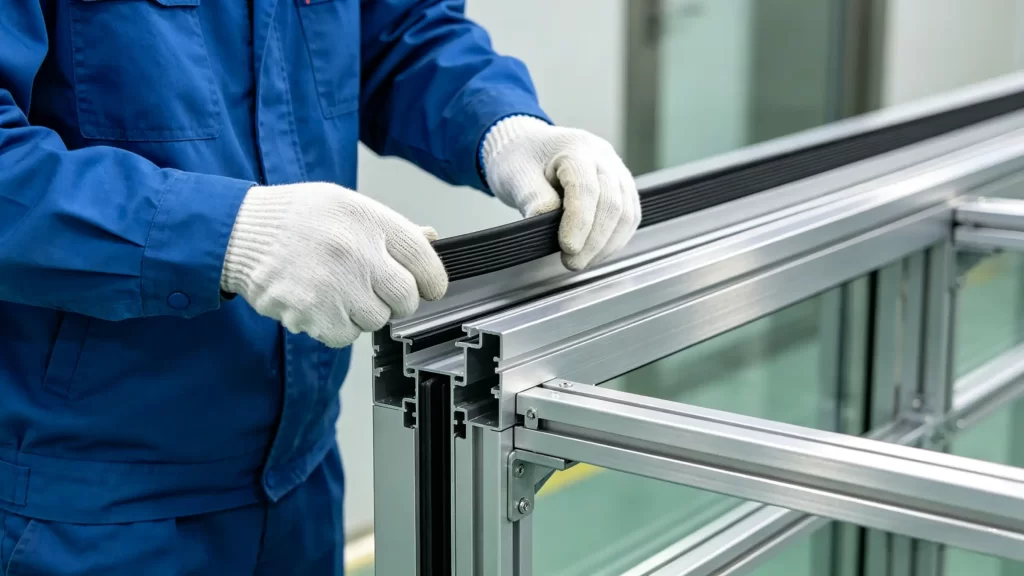
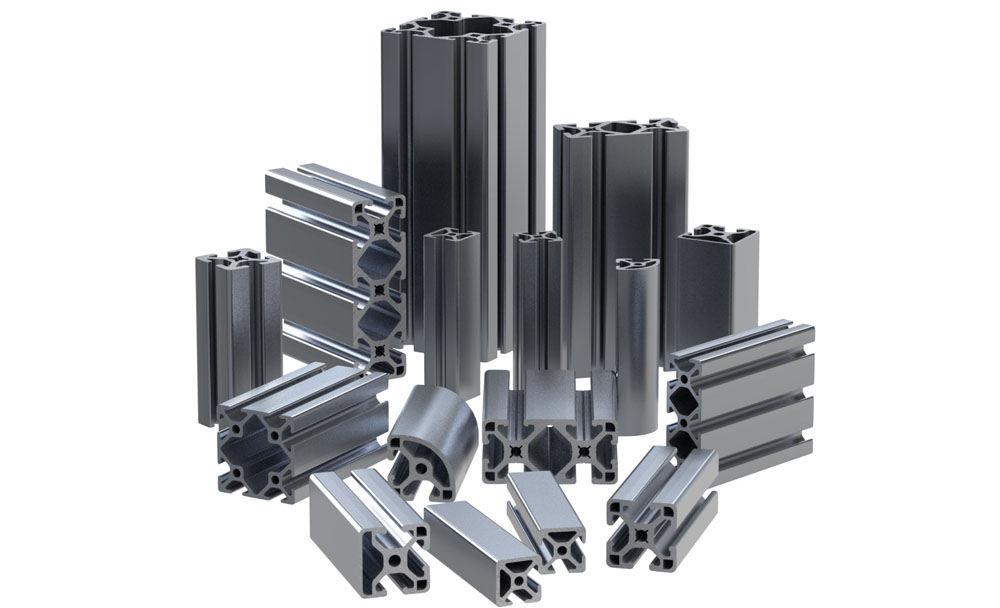
The ultimate realization of door seal performance heavily depends on the synergistic manufacturing capability of the aluminum frame and door system. As a manufacturer integrating cleanroom aluminum profiles, AHU frame profiles, air outlet profiles, and various door bodies, system-level matching is key to controlling lifecycle costs:
- Groove Mechanical Interlock Design: The aluminum profile groove must form a precise mechanical interlock with the seal cross-section. By optimizing the groove angle and fillet radius, the seal receives uniform radial support upon insertion, preventing localized stress concentration and premature fatigue.
- 90° Corner Seamless Process: Corner treatment is a weak link in airtight engineering. During cleanroom door installation and sliding door installation, thermal vulcanization, pre-molded corner pieces, or specialized lap-adhesive processes are recommended to eliminate micro-leakage channels caused by on-site cutting and splicing.
- Automatic Door Dynamic Torque Matching: The drive modules for hospital sliding door and medical sliding doors must be dynamically matched with the seal's rebound resistance. The motor torque curve must cover the resistance peak from the seal's free state to full compression, while anti-pinch sensor zones must avoid the initial contact trajectory of the seal lip.
- Airflow Organization Integrated Coordination: The door system must be designed with pressure-differential interlocking alongside components like cleanroom ceiling diffuser and return air grille. An integrated manufacturing model, featuring unified tolerance benchmarks and assembly processes, can reduce system air leakage by over 30% and significantly minimize quality losses from on-site cross-construction.
5. Procurement Pitfall Guide: Engineering Acceptance and Supplier Qualification Verification
Common operational errors often stem from lax qualification reviews during procurement:
- Over-pursuing theoretical absolute zero leakage, causing door operators to run overloaded long-term;
- Ignoring seasonal thermal expansion and contraction, leading to cyclical pressure drift;
- Mismatch between disinfectant pH and material swelling coefficients, directly shortening seal service life.
A strict supplier verification checklist must be established during procurement:
- Material Certification: Require complete COAs. Third-party ISO 10993 biocompatibility reports, UL 94 V-0 or EN 45545-2 flame retardancy certifications (synchronized standards for fire rated door) must be fully traceable;
- Performance Testing: Compression set must comply with ASTM D395 Method B (<15% under 70°C × 22h), and cycle fatigue life must pass ≥500,000 simulated opening/closing tests;
- Process Capability: Verify extrusion line precision, vulcanization curve control records, and batch consistency management systems;
- Supporting Capability: Suppliers offering full-category cleanroom door accessories significantly reduce compatibility risks associated with multi-vendor coordination.
The acceptance phase should follow this procedure:
- Strictly adhere to cleanroom door specifications, employing pressure decay or sulfur hexafluoride (SF₆) tracer gas methods for quantitative door seal testing;
- Issue measured test reports based on the EN 12207 air permeability grading standard;
- For hospital automatic door systems, incorporate the automatic door maintenance cycle into the delivery contract;
- Establish a quarterly monitoring archive correlating pressure differential, leak rate, and deformation attenuation to transition from reactive replacement to predictive maintenance.
6. Typical Application Cases and Data Validation
- GMP Class B Cell Therapy Workshop Retrofit
- Pain Point: Original healthcare sliding doors used standard EPDM seals, which reached a 32% compression set after 3 months, causing zonal pressure fluctuations exceeding ±8 Pa;
- Solution: Switched to platinum-cured silicone with a magnetic preload structure, optimizing compression to 28%;
- Result: 12-month tracking showed stable leak rates within 0.3 m³/h·m, HVAC inverter energy consumption dropped by 14%, and environmental particle compliance rose to 99.98%.
- BSL-3 Negative Pressure Laboratory Upgrade
- Configuration: The cleanroom double door airlock adopted an inflatable primary seal combined with an EPDM mechanical backup;
- Validation: Withstood 6 months of daily wiping with 1% peracetic acid without swelling or cracking;
- Result: Achieved second-level response recovery within a ±5 Pa pressure fluctuation range, meeting the high-level biosafety redundancy requirements of a laboratory airtight door.
- ICU Double-Door Interlocked Airlock Optimization
- Design: Utilized a double-lip compression design paired with a conductive silicone grounding strip, precisely controlling surface resistance to 10⁷ Ω;
- Effect: Effectively eliminated secondary particle resuspension caused by static adhesion, reducing the comprehensive lifecycle cost by approximately 22% compared to the initial high-cost single-procurement approach.
7. Conclusion
Door seal selection is fundamentally a systems integration of fluid dynamics, materials science, and precision manufacturing. In the evolution of medical airtight door and hospital hermetic doors, industry consensus has clearly shifted toward three core principles:
- Operational matching takes precedence over parameter stacking;
- System synergy outweighs single-point performance;
- Total lifecycle cost trumps initial purchase price.
Facing tightening global regulatory limits on extractables and leachables (E&L), alongside hard targets for building airtightness under dual-carbon goals, door seal technology is rapidly transitioning toward low-volatility formulations, extended-lifespan designs, and digital monitoring. Selecting a supplier with integrated R&D and manufacturing capabilities—spanning aluminum profile extrusion, door body fabrication, custom seals, and air outlet accessories—fundamentally eliminates system compatibility risks and shortens delivery cycles.
-
 Cleanroom Glass Windows Are The Key to Maintaining a Clean Environment
 -
 Top Aluminium Profile Manufacturers in China: Leading the Global Market
 -
 The Evolution of Air Tight Sliding Doors
 -
 AHU Aluminium Profile: A Comprehensive Guide
 -
 The Importance of Choosing the Right Cleanroom Door in Vietnam
 -
 The Benefits of Hospital Automatic Doors: Enhancing Efficiency and Safety
 -
.jpg) The Best Bathroom Door Manufacturers - Unlocking Endless Possibilities!
The Best Bathroom Door Manufacturers - Unlocking Endless Possibilities! -
 Unlock the Possibilities with AJ Manufacturing Doors
 -
 Make a Statement with Manufactured Home Interior Doors!
 -
 what is aluminum profile? Aluminum Profiles for Your Home is the best option
-
 Hospital Emergency Exit Doors: 90 Minute Fire Rating Meets Infection Control
 -
 ICU and Isolation Door Requirements Hospitals Often Overlook
 -
 Laboratory Door Requirements for BSL-2 and BSL-3 Containment
 -
 Retrofitting Hospital Sliding Doors: Upgrade Wards Without a Rebuild
 -
 Why Airtight Hospital Sliding Doors Are Critical for Infection Control
 -
 Automatic cleanroom door systems: sensor, actuator and access control integration
 -
 Cleanroom Door Materials: Stainless Steel vs HPL vs FRP vs Aluminum Comparison
 -
 X-Ray Room Door Buying Guide: Lead Thickness & Compliance
 -
 Operating Room Doors: Hermetic & Infection-Control Guide
 -
 Hospital ICU Door Selection: Sealing, Sterility & Workflow


-

Home
-

Tel
-

Email
-

Contact


Guangzhou Yizhong Aluminum Industry Co., Ltd.
We are always providing our customers with reliable products and considerate services.
We are always providing our customers with reliable products and considerate services.
Speak Your Mind