
5 Hermetic Door Mistakes That Break the Seal
A hermetic door earns its name only when it holds the pressure cascade shut. In a pharmaceutical suite, an operating room, or a biosafety lab, that seal is the difference between a clean zone and a contaminated one. The failure rarely starts with a dramatic blowout. It starts with a small spec gap, a worn threshold strip, or a frame that was never sealed to the wall the way the drawing promised.
Five mistakes quietly break the seal on a hermetic door. All five show up in real projects, every one is avoidable, and most are cheaper to fix on the schedule than in the field. The examples below draw on how cleanroom door manufacturers such as E-ZONG handle sealing, listing, and validation on working builds.
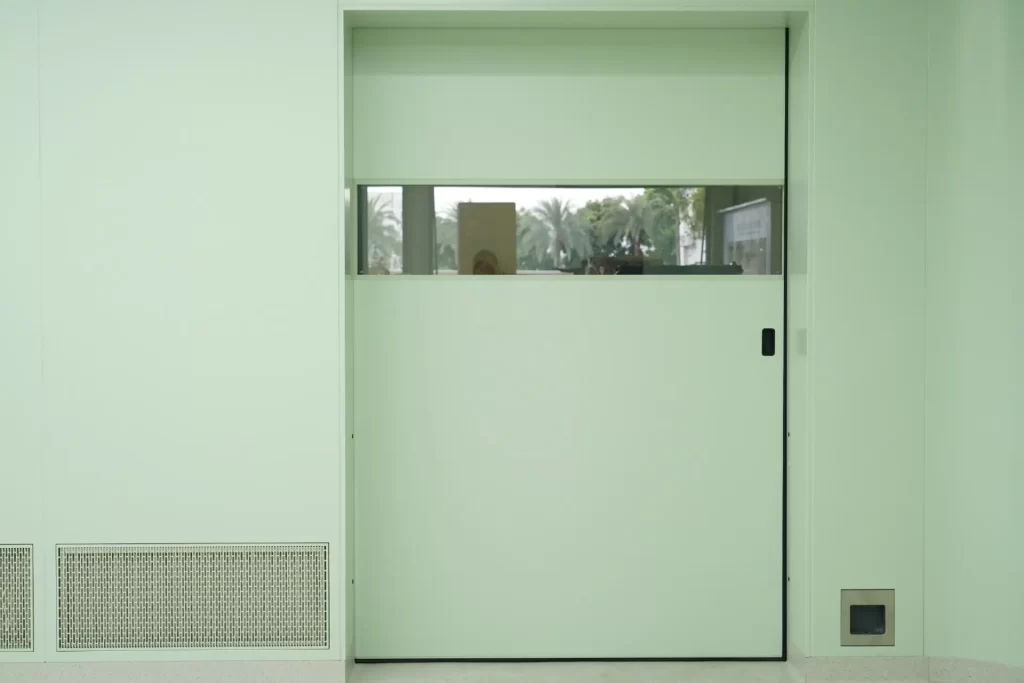
How a hermetic seal actually holds
Before the mistakes make sense, it helps to know what the door is supposed to do when it closes. A hermetic door forms a continuous barrier on four edges: the two sides, the top, and the threshold at the floor. The sides and top use a perimeter compression gasket, usually EPDM or silicone, that deforms against the frame as the leaf latches. The floor uses a drop down seal that presses into place only when the door reaches the closed position.
That combination is what lets a cleanroom door hold a pressure differential. Typical critical environments run 25 to 50 Pascals across the leaf. An operating room sits positive at a minimum of about 2.5 Pascals relative to the corridor. The number is small, but the consequence of losing it is not: air convection carries particles, odors, and in healthcare settings, pathogens, straight across the opening.
When any one edge stops sealing, the whole assembly leaks. The five mistakes below are the usual reasons that happens.
Mistake 1: Treating airtight sealing and fire rating as one spec
The most common error in early specification is assuming a door that seals air also stops fire, or vice versa. It does not. A compression gasket holds pressure. An intumescent seal and a fire rated core stop flame and smoke. They are different materials rated to different tests, and a boundary that needs both has to carry both listings on the same assembly.
We see this most often where a corridor doubles as a smoke compartment or where a pharmaceutical space sits next to a higher risk zone. Someone writes "airtight fire door" on the schedule, the supplier delivers a pressure rated leaf, and the fire authority or the validation team finds no intumescent listing. The door passes the leakage test and fails the compartment test, or worse, passes neither because the two requirements were never engineered together.
The fix is to specify the two ratings as separate, verified line items. If the wall is rated for 60 minutes, the door needs a 60 minute core and listed intumescent seals, plus its own perimeter compression gasket for pressure. Specifiers also use air permeability class, EN 12207 Class 3 or 4, as the pressure holding benchmark, kept separate from the fire test. E-ZONG's hermetic door range keeps these as distinct, documented options so a single leaf can meet both without one specification quietly cancelling the other.
Mistake 2: Underspecifying the threshold seal
The floor edge is where hermetic doors fail first, because it is where the most movement happens. A fixed sweep seal drags on the floor every single cycle. In a busy cleanroom that can mean hundreds of operations a day, and a fixed strip can wear a gap in a few months. Once the bottom edge leaks, the pressure cascade bleeds out at the threshold no matter how good the rest of the gasket is.
The correct detail is an automatic drop down seal. As the leaf reaches the closed position, the seal drops roughly 5 to 10 millimeters and presses against the floor. When the door opens, it lifts clear, so there is no drag and no wear. EPDM and silicone versions both work; silicone holds up better under frequent sterilization.
This is one place where a slightly higher spec pays back fast. A drop down seal that lifts on opening lasts several times longer than a fixed strip and keeps the floor gap at fractions of a millimeter. Pair it with a perimeter compression gasket and the leaf seals on all four edges every close, not just on the day it was installed.
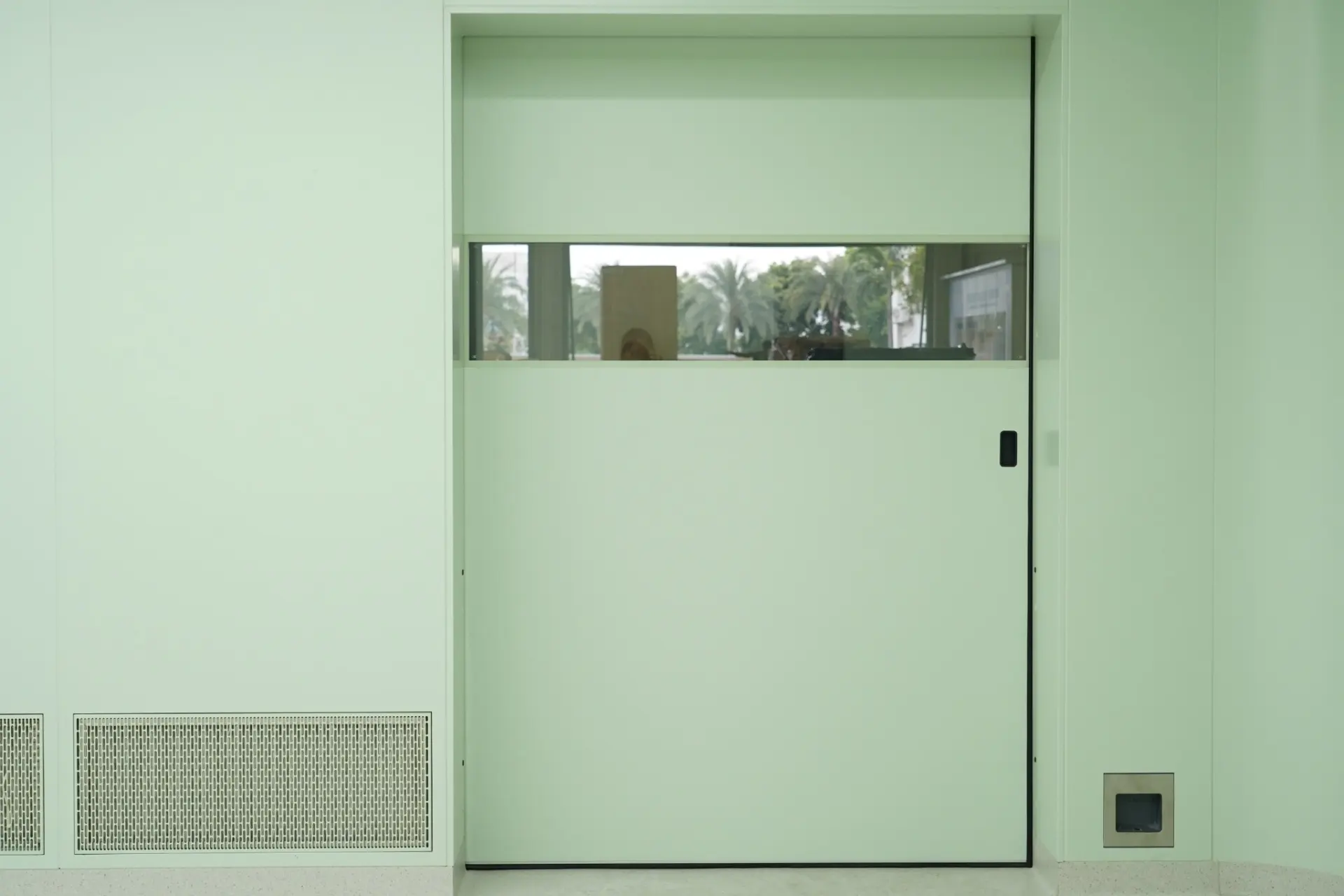
For swing leaves the same logic applies, and patient room doors use it as standard: a wall mounted, air tight swing leaf with a compression seal that does its work at rest, plus a threshold seal that engages only when shut. E-ZONG offers the drop down threshold as a listed option on both swing and sliding leaves so the floor edge seals without the drag that wears fixed strips.
Mistake 3: Ignoring the frame to wall gap and installation tolerance
A perfect door mounted on a sloppy opening still leaks. The frame has to meet the wall as one sealed plane, and that depends on the civil opening being true before the door arrives. When the opening is out of square, installers shim the frame and fill the void behind it with expanding foam, then hide the joint under trim. Foam shrinks. The trim looks fine. Air moves through the gap every hour the room is supposed to be pressurized.
The same problem appears as door sag. A stainless or color steel leaf is heavy, and if the hinges are too few or too weak, the leaf drops over time. The top and latch side gaps open, the gasket loses compression, and the room can no longer hold its differential. Three adjustable hinges spaced no more than about 600 millimeters apart, set with adjustment reserve, prevent most of this.
The practical rule is to verify the opening tolerance before the door ships and to seal the frame to the panel with continuous, documented sealant rather than foam alone. A flush frame that matches the surrounding wall panel leaves no ledge for dust and no hidden path for air. This is the install discipline that keeps a hermetic door hermetic after the warranty ends.
Real projects show the payoff. The Brunei isolation center used sealed, flush door assemblies across an active containment build, and the pressure boundary held because the frame to wall detail was treated as part of the door, not an afterthought the builder handled separately. E-ZONG builds the frame and leaf as one matched set so the installer seals a known interface rather than a guessed one.
Mistake 4: Accepting seal claims without third party pressure decay proof
Many buyers request an airtightness number and accept the supplier's own marketing sheet as proof. That is a mistake with a long tail. A claim like "low leakage" with no test pressure, no duration, and no independent lab behind it tells an auditor nothing, and it tells the buyer even less about what the door will do in year three.
The standard that matters is pressure decay testing. ASTM E779 and EN 1026 define how to measure air leakage through a sealed assembly at a set differential pressure. For containment spaces the accepted benchmark is a pressure decay of no more than about 1 Pascal per minute at 75 Pascals, measured over a hold period. A supplier should hand over a third party report with raw data, not a summary line.
Skipping this step moves the risk to commissioning. If the door fails validation then, correction means partial disassembly, re welding, and re testing, often at a cost of several thousand dollars per leaf plus weeks of delay. For pharmaceutical and biosafety work the same gap becomes an audit finding under GMP Annex 1 or FDA 21 CFR 211, where the inspector asks for the test report, not the brochure.
The fix is to require the pressure decay report with the tender and to reject any supplier who cannot produce one within a few business days. E-ZONG supports this with validation documentation and drawings matched to the listing, so the number on the spec sheet is the number the test lab measured.
Mistake 5: Wrong material for the sterilization chemistry
The seal lives in the leaf, but the leaf lives in the cleaning routine. A door specified in 304 stainless for a space that gets vaporized hydrogen peroxide, peracetic acid, or chloride based disinfectants will corrode at the gasket seat and the weld seams. Once the seat pits, the gasket can no longer compress evenly, and the leak returns regardless of how good the original seal was.
For aggressive chemistry, 316L is the safer call. The small step up in material cost is trivial next to the eight to twelve years of service life it protects in high humidity or high disinfectant environments. The same thinking applies to the surface finish: a smooth, non porous, easy clean panel resists both corrosion and bacterial harbor points.
This mistake overlaps with hinge and hardware choice. Crevice free, corrosion resistant hardware rated to the environment keeps the leaf aligned, and three dimensional adjustable hinges let a facility compensate for any early settlement before it becomes a gap. Specifying the material and the hardware to the actual cleaning chemistry, not to a generic "stainless" label, is what keeps the seal intact through the sterilization cycle count the room was built for. E-ZONG quotes 304 or 316L per the disinfection plan and documents the weld finish so the gasket seat stays true.
A quick pre purchase checklist
Before the order goes out, confirm these five points and most seal failures never start:
- Airtight and fire ratings are listed separately, not assumed to be one spec.
- The threshold uses an automatic drop down seal, not a fixed sweep strip.
- The opening tolerance is verified and the frame is sealed to the wall with continuous sealant.
- A third party pressure decay report (ASTM E779 or EN 1026) is part of the acceptance package.
- Leaf and hardware material match the actual disinfection chemistry, with 316L where needed.
A pharmaceutical workshop door system that meets all five holds its cascade, clears its audit, and avoids the field rebuild that the missing item would otherwise demand.
FAQs
What is the difference between a hermetic door and an airtight door?
In practice the terms describe the same function: a door built to hold a pressure differential with a continuous perimeter and threshold seal. "Hermetic" is the stronger word and is often used for medical and containment spaces. Both need full perimeter compression plus a threshold seal, and neither should be confused with a fire rated door.
How much pressure should a hermetic door hold?
Critical clean and containment spaces typically run 25 to 50 Pascals across the leaf. An operating room holds a minimum positive pressure of about 2.5 Pascals relative to the corridor. The right target comes from the room's pressure cascade design, not from a generic number.
How do I verify a hermetic door actually seals?
Require a third party pressure decay test to ASTM E779 or EN 1026, with the test pressure, duration, and raw data in the report. A marketing claim without that documentation is not validation evidence and will not satisfy a GMP or FDA audit.
Can a hermetic door also be fire rated?
Yes, when the assembly carries both listings: a fire rated core and intumescent seals for compartmentation, plus a separate compression gasket for pressure. Specify both as verified line items so neither cancels the other.
Conclusion
A hermetic door breaks its seal through small, predictable mistakes rather than bad luck. Mixing up airtight and fire specs, settling for a fixed threshold strip, leaving the frame to wall gap to foam, accepting unverified leakage claims, and under specifying material for the cleaning chemistry are the five that show up most. Each is cheaper to fix on the schedule than in the field.
E-ZONG builds hermetic doors as listed assemblies with perimeter compression and drop down threshold seals, custom sizing for the opening, and the validation documentation projects need to pass audit. If you are specifying doors for a cleanroom, hospital, or laboratory build, share the room type, required pressure differential, leaf size, and disinfection chemistry, and the team will return a sealed, documented recommendation rather than a catalog guess.
-
 Cleanroom Glass Windows Are The Key to Maintaining a Clean Environment
 -
 Top Aluminium Profile Manufacturers in China: Leading the Global Market
 -
 The Evolution of Air Tight Sliding Doors
 -
 AHU Aluminium Profile: A Comprehensive Guide
 -
 The Importance of Choosing the Right Cleanroom Door in Vietnam
 -
 The Benefits of Hospital Automatic Doors: Enhancing Efficiency and Safety
 -
.jpg) The Best Bathroom Door Manufacturers - Unlocking Endless Possibilities!
The Best Bathroom Door Manufacturers - Unlocking Endless Possibilities! -
 Unlock the Possibilities with AJ Manufacturing Doors
 -
 Make a Statement with Manufactured Home Interior Doors!
 -
 what is aluminum profile? Aluminum Profiles for Your Home is the best option
-
 5 Hermetic Door Mistakes That Break the Seal
 -
 Hospital Room Door Size by Room Type: Width and Clearance
 -
 Retrofit Manual Doors with Electronic Glass Operators
 -
 Hospital Emergency Exit Doors: 90 Minute Fire Rating Meets Infection Control
 -
 ICU and Isolation Door Requirements Hospitals Often Overlook
 -
 Laboratory Door Requirements for BSL-2 and BSL-3 Containment
 -
 Retrofitting Hospital Sliding Doors: Upgrade Wards Without a Rebuild
 -
 Why Airtight Hospital Sliding Doors Are Critical for Infection Control
 -
 Automatic cleanroom door systems: sensor, actuator and access control integration
 -
 Cleanroom Door Materials: Stainless Steel vs HPL vs FRP vs Aluminum Comparison




-

Home
-

Tel
-

Email
-

Contact


Guangzhou Yizhong Aluminum Industry Co., Ltd.
We are always providing our customers with reliable products and considerate services.
We are always providing our customers with reliable products and considerate services.
Speak Your Mind