Retrofit Manual Doors with Electronic Glass Operators
Most cleanroom and hospital doors were installed long before hands free access became a compliance expectation. Tearing them out to buy new automatic leaves is expensive, slow, and disruptive to a validated environment. Adding an electronic operator to the door you already have is usually cheaper and faster, and it keeps the frame, glazing, and wall integration that already passed inspection. The payoff is a hands free doorway without rebuilding the wall around it.
When retrofitting beats a full replacement
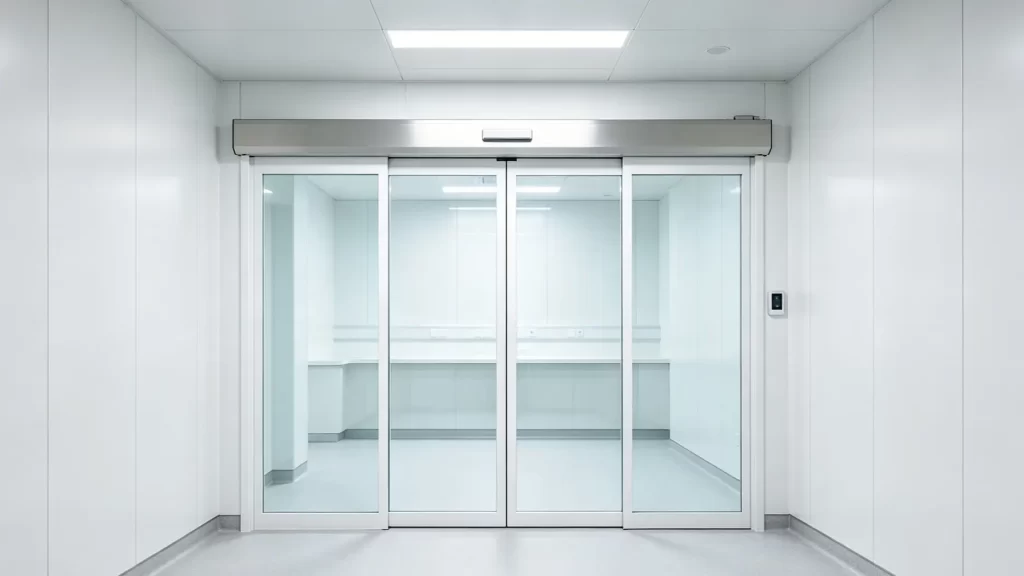
A retrofit mounts a motor, controller, and activation sensors onto the existing door and frame. The leaf, glazing, and wall connection stay put. That single decision avoids three problems that derail cleanroom projects.
Replacement means cutting the opening, rebuilding the header, and re validating the wall assembly, which can take weeks and stop a production line or a ward. A operator only upgrade often finishes in a day or two with the doorway out of service for hours, not weeks. For a pharmaceutical suite running continuous batches, that difference protects output and revenue, and it is why many facilities now ask about electronic glass doors before they ask about new construction.
Replacement also wastes a frame that is still structurally sound. Many sandwich panel walls and blockwork reveals are fine; only the opening action is manual. Spending the budget on a drive instead of a whole new door frees money for better sensors or a second automated leaf elsewhere.
The catch is honesty about limits. If the frame is degraded, the fire label is missing, or the leaf cannot carry the operator load, a retrofit will not save you. The checks below separate the good candidates from the ones that need a new door.
What an electronic glass door operator does
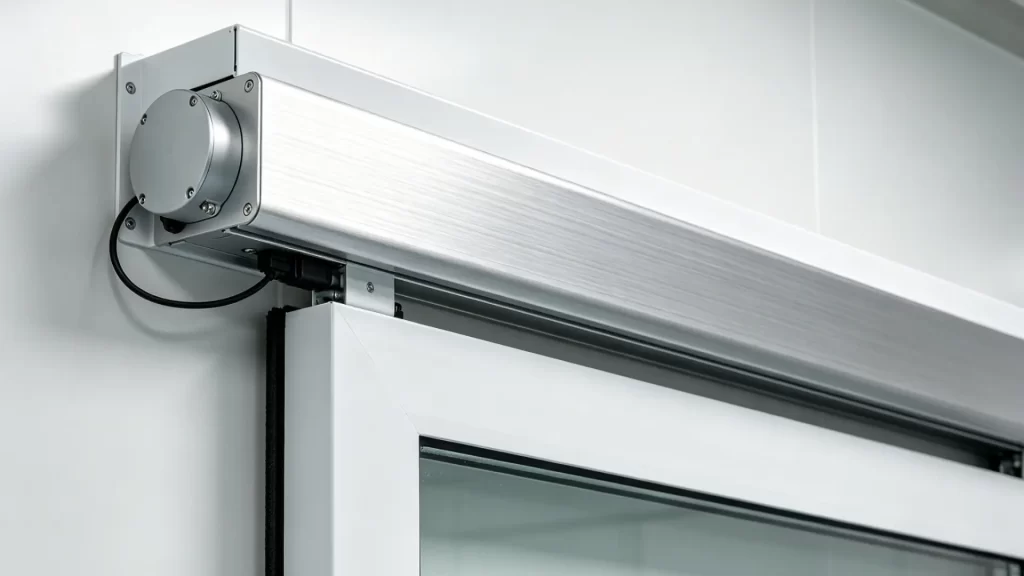
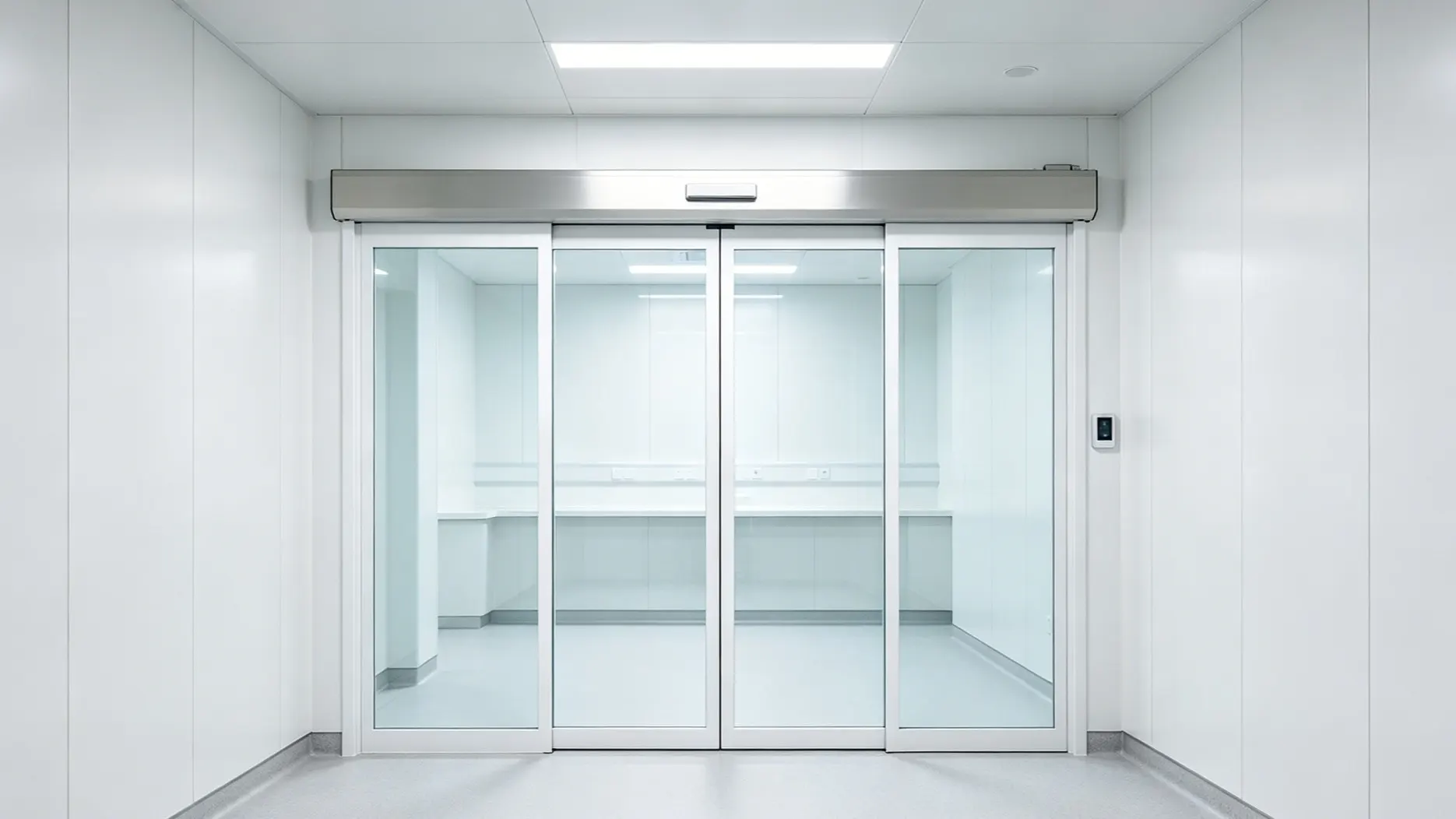
An electronic operator is a powered unit that opens and closes the leaf on its own. The core parts are a motor, a microcontroller, an arm or track, and activation sensors. Electronic glass doors pair a tempered panel with a powered operator, and most retrofits either keep an existing vision panel or add one so staff can see traffic on the other side.
Three operating modes matter for healthcare and cleanroom use. Full automatic opens the door with no touch when a sensor sees a person. Power assisted turns the operator into a powered closer that helps a manual push. Push and go triggers full automatic motion after a light push, which suits areas where some users still want to open by hand.
Battery backup is not optional in these environments. On power loss the door must still let people out, so a listed operator carries a backup that drives at least a few cycles or holds a fail safe position. Pair that with an emergency manual release and the doorway stays safe even when the building loses power.
Feasibility check before you commit
- Quoting a retrofit without seeing the door invites rework. Walk this list on site before the purchase order.
- Frame structural integrity comes first. The operator transmits every opening and closing torque into the frame and the wall behind it. A frame anchored only to panel skins will flex, drag the leaf, and read as a chronic door fault. Confirm it ties to a structural substrate.
- Leaf weight and width set the operator size. Typical units handle leaves from about 100 kg up to 250 kg and widths from roughly 700 mm to 1500 mm, though heavy industrial leaves need a stronger drive. Weigh the actual leaf, do not trust the original spec, because added glazing changes mass. Most electronic glass doors grew from a manual leaf that already carried a panel, so the original mass figure is rarely the whole story.
- Clear opening width after the operator is fitted must still meet accessibility and cart traffic needs. A transom box or arm can eat a few centimeters, so measure the finished clear span, not the leaf size.
- Fire rating and door leaf condition decide whether automation is even allowed. A fire rated leaf keeps its label only with listed hardware; a missing or damaged label means replacement, not retrofit. Note the adopted code and the authority having jurisdiction before promising a date.
- Electrical supply and activation layout are easy to miss. The operator needs a nearby circuit, and sensors need a clear field across the threshold. On sandwich panel walls, agree who cuts the opening and reinforces the header before panels are ordered, not after.
Choosing the operator type
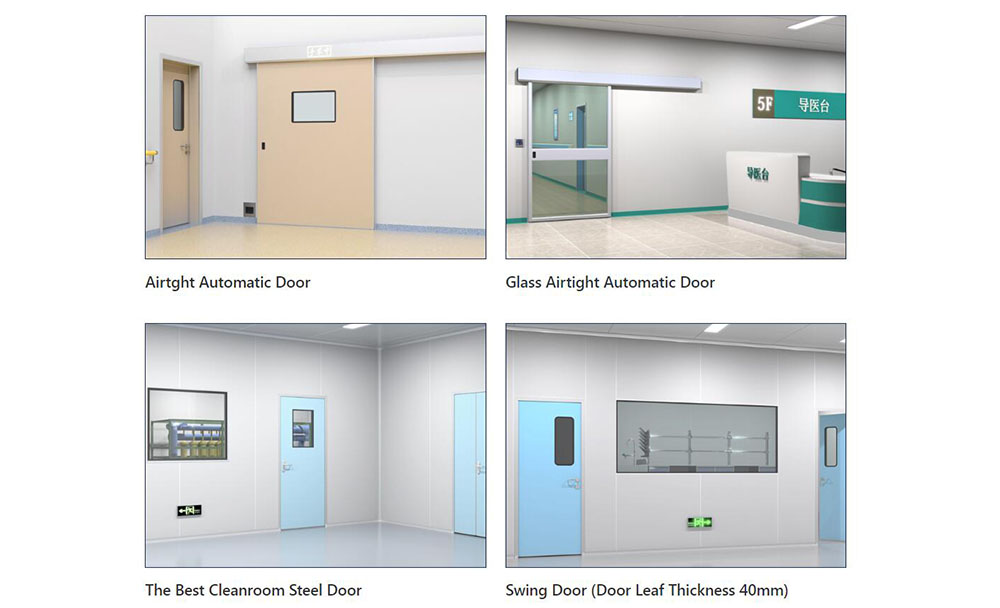
Two mount styles dominate. A transom or in head operator sits above the door in a box, which suits glass leaves or openings where the leaf cannot carry the drive. An on door operator mounts to the leaf itself and works when there is no room above. E-ZONG offers both transom and on door operators sized for cleanroom leaves, so specifiers can match the drive to the opening instead of reshaping the opening to fit a unit.
Swing and sliding motions overlap in function but not behavior, and the choice shapes the whole retrofit. A swing leaf sweeps the aisle and needs swing clearance, but it holds pressure well at rest because gaskets compress uniformly. A sliding leaf stays in the wall plane and suits continuous traffic where floor space is tight, though its track and seal geometry leaks more unless specialized. If the existing door is a swing, keep it a swing; converting motion type means a new leaf.
Single and double leaves need different control. A pair of doors uses a master slave setup where one operator leads and the other follows, synchronized so both latch. Getting this wrong leaves one leaf racking and failing the latch test.
Glass and visibility in a retrofitted door
Visibility is why glass shows up in these retrofits. Staff want to see carts, patients, or traffic before the door opens, and a vision panel supports observation without breaking the seal. The glass itself should be tempered or toughened, rated for impact, and sized to the leaf.
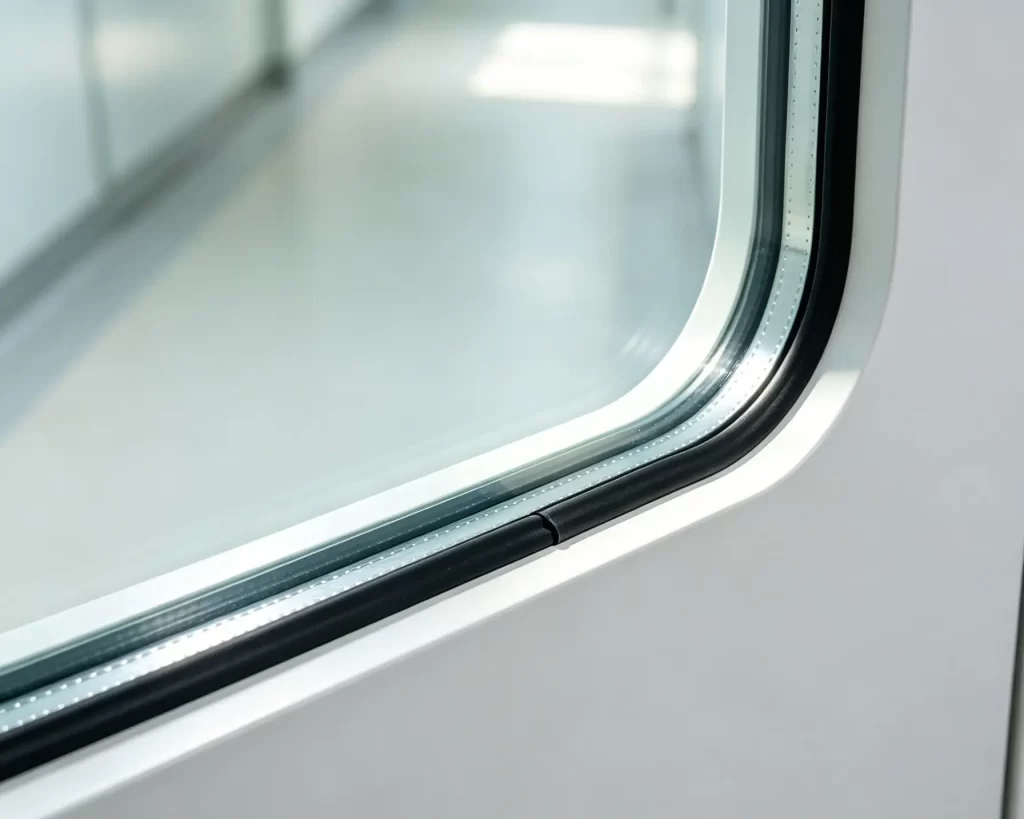
Double layer glazing with an anti fog and anti bacteria treatment is common in clean and clinical settings, because it stays clear under temperature swings and resists microbial film. Antimicrobial glass coatings now appear in most new healthcare installations, so adding them on a retrofit brings the doorway up to the same infection control bar those teams expect on new builds. E-ZONG supplies tempered, double layer vision panels with anti fog and anti bacteria treatment for exactly this reason.
The tension is size. On electronic glass doors a larger vision panel means less continuous gasket around the leaf, which can hurt airtightness if the frame does not clamp the glass and the leaf together. Keep the panel within the frame geometry that compresses the perimeter seal, and ask the supplier how the glazing interacts with the drop seal at the threshold.
Keeping the cleanroom seal intact
Automation moves the door more often than a hand ever did, so the seals must re engage perfectly at every close. This is the part of a retrofit that fails audits if it is treated as an afterthought.
Specify perimeter gasketing plus an automatic drop seal at the threshold, and confirm the frame clamps the leaf against continuous gaskets so compression stays even across years of cycling. E-ZONG encircled frames are built to clamp the leaf against continuous gaskets, which is why measured leakage stays low across the cycle life. Then ask for measured leakage at a stated pressure differential rather than accepting the word airtight on a datasheet. A cleanroom doorway lives or dies by that number.
Pressure cascade is the real test. A manual door might sit closed for minutes; an automatic one opens dozens of times an hour. If the operator or seal lets the leaf rack even slightly, the cascade across a wing can flatten and pull air from a contaminated space toward a protected one. Tie the doorway into the HVAC pressure plan and verify the differential after commissioning, not just on paper. For swing leaves this is the same sealing logic used in air tight patient room doors, where rest compression does most of the work.
Safety and compliance you cannot skip
Powered pedestrian doors carry their own safety standards, and citing the wrong one is a procurement miss. Electronic glass doors are powered pedestrian doors, so these standards apply the moment an operator is fitted. In Europe EN 16005 governs force and sensor behavior for automatic doors; in the United States ANSI/BHMA A156.10 covers power operated pedestrian doors and A156.19 the low energy type, while UL 325 applies to the operator drive. Ask which standard the quoted forces and sensor data were measured against.
Obstruction reversal and a low energy mode protect people. The operator must reverse or stop on contact, and a low energy setting lets it run slowly without full safety sensors where the risk is low. Both belong in healthcare and school settings where vulnerable users pass through.
Emergency release and fire interface are non negotiable. The door needs a manual release anyone can use, and on power loss it must fail to a safe position, never locked. If the leaf is fire rated, define how the operator talks to the fire alarm and what the leaf does on alarm.
Integrating with access control and building systems
Activation choices range from radar and infrared presence sensing to touchless wall switches and card readers. For clean and clinical zones, touchless activation supports infection control by removing a handle from the path. Place each sensor field so it ends where people actually approach, not where the drawings guess they will.
Higher spec facilities expect the operator to join the building management system. BACnet or MODBUS links let the door report status, react to fire alarms, and sequence with airlocks. Electromagnetic interlocks that stop two contaminated zone doors opening at once are a standard cleanroom control, and the operator should respect them. For a ward upgrade, modular hospital door solutions show how the same operators tie into wider access and alarm networks.
Commissioning and maintenance after the upgrade
Treat handover as a test, not a formality. The acceptance check should record opening force, closing speed, hold open time, obstruction reversal, and measured leakage at the stated differential. If any number is off, fix it before the doorway enters service.
Maintenance keeps the retrofit compliant. Powered operators run to about one million cycles in duty rated units, and the controller counts them, so schedule service before the count gets close. Inspect the safety sensors, battery health, and seal compression on a plan, and keep the records for the next audit. A pharmaceutical workshop door system that logs cycle counts avoids the surprise failure that shuts a line.
Retrofit mistakes that fail audits
The errors repeat across sites. Anchoring the operator to panel skins instead of structure, so the frame flexes. Quoting a fire rated leaf without a listed label, then discovering the rating is gone. Calling a door airtight with no measured leakage at differential. Skipping battery backup so the door locks on power loss. Citing a safety standard the supplier never tested to. Placing the sensor field where carts, not people, trigger it. Each of these turns a smart upgrade into a failed inspection and a possible life safety or contamination gap.
How E-ZONG supports retrofit projects
E-ZONG builds cleanroom and hospital doors with the frame geometry that makes retrofits straightforward, including encircled frames for sandwich panel walls and leaves ready for tempered glass vision panels. Project teams get shop drawings, load guidance, and sensor layout support so the operator fits the existing opening and the infection control plan. For new builds that skip retrofit entirely, the same engineering shows up in airtight glass automatic entrance systems designed for clean zones from the start.
If you are planning to motorize a manual door in a ward, pharmacy, or lab, share the leaf weight, opening size, wall type, and pressure requirements. E-ZONG can review the existing door and suggest a listed operator and glass package that meets the code while keeping the cleanroom seal intact.
FAQs
Can any manual door be motorized?
No. About two thirds of manual healthcare doors can take an operator, but only when the frame is sound, the leaf weight is within the drive range, and the fire label is intact. A site check decides the rest.
Does adding an operator break the fire rating?
Not if the hardware is listed with the assembly. A missing or damaged fire label cannot be fixed by automation, and the operator must fail to a safe position on alarm. Confirm the interface with the fire alarm before ordering.
How long does a retrofit take?
A straightforward operator swap on a sound frame often finishes in one to two days with the doorway out of service for hours. Full replacement with wall rebuild runs weeks, which is why retrofit wins on downtime.
Will the door still hold cleanroom pressure?
Yes, when perimeter gaskets and an automatic drop seal are specified and measured leakage is verified at the stated differential. Automation opens the door more often, so the seal must re engage perfectly every cycle.
What power does an electronic operator need?
Most run on a standard building circuit, commonly 230 V AC or 110 V AC depending on region, with a 24 V DC low energy option on some units. Battery backup covers egress during outages.
Conclusion
Retrofitting manual doors into electronic glass doors is usually the faster, cheaper path to hands free, code ready access, as long as the frame is sound and the seal is treated as a first class requirement. The work lives in the details: check the frame can carry the load, pick the mount and motion that fit the opening, demand a measured leakage number instead of the word airtight, and commission against the right safety standard. Get those right and the doorway runs on its own, holds the pressure cascade the HVAC was built around, and clears the next audit. Get them wrong and you have simply automated a door that still fails the same two tests.
-
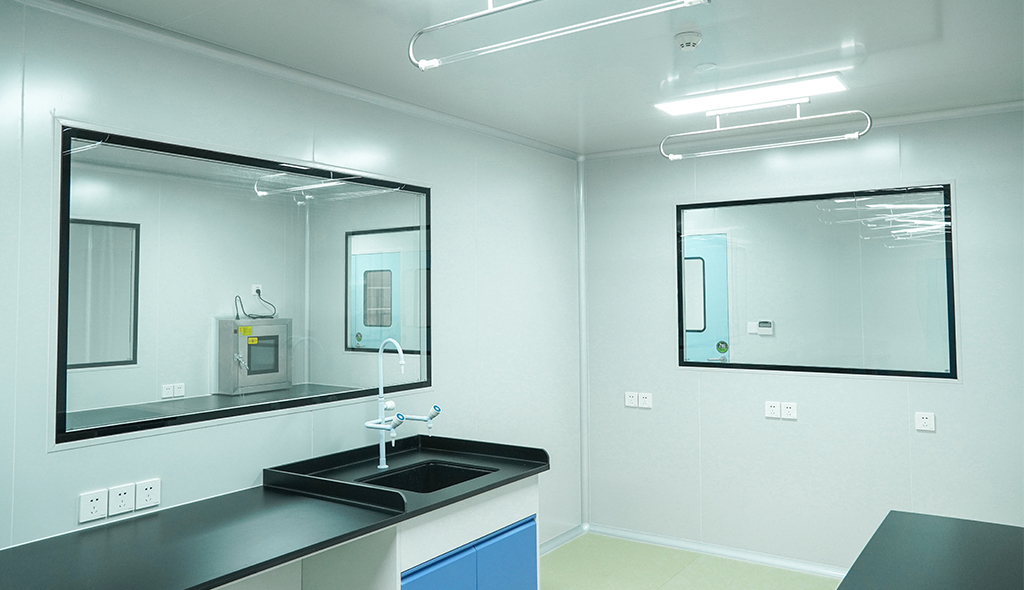 Cleanroom Glass Windows Are The Key to Maintaining a Clean Environment
 -
 Top Aluminium Profile Manufacturers in China: Leading the Global Market
 -
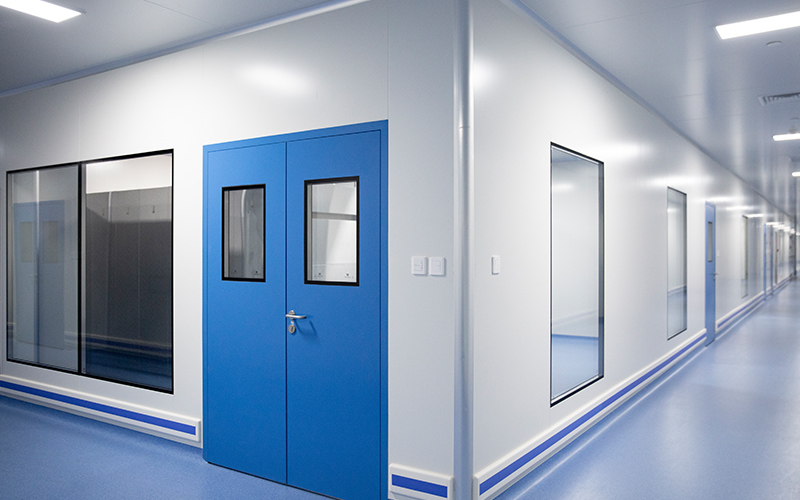 The Evolution of Air Tight Sliding Doors
 -
 AHU Aluminium Profile: A Comprehensive Guide
 -
 The Importance of Choosing the Right Cleanroom Door in Vietnam
 -
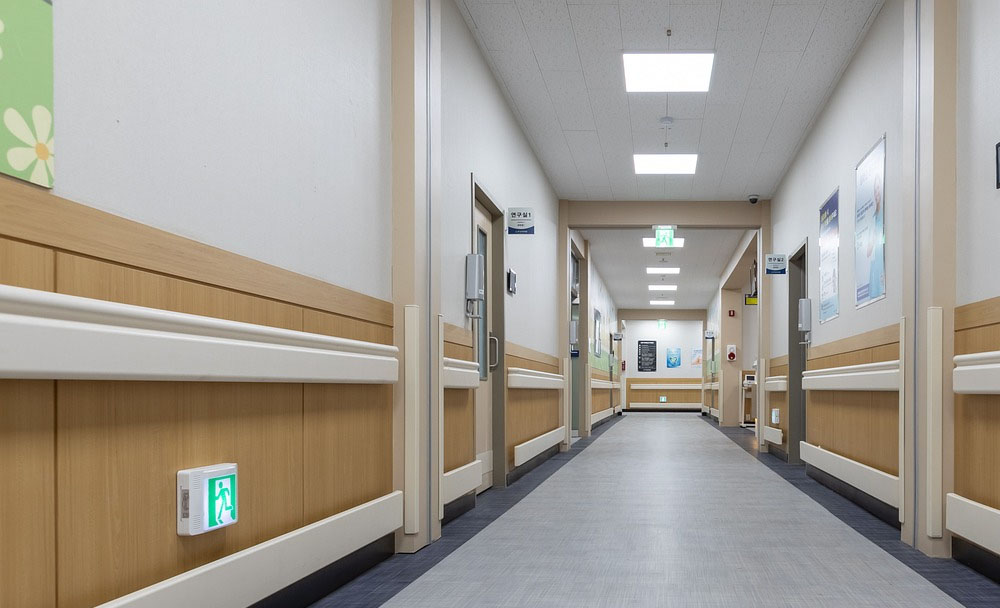 The Benefits of Hospital Automatic Doors: Enhancing Efficiency and Safety
 -
.jpg) The Best Bathroom Door Manufacturers - Unlocking Endless Possibilities!
The Best Bathroom Door Manufacturers - Unlocking Endless Possibilities! -
 Unlock the Possibilities with AJ Manufacturing Doors
 -
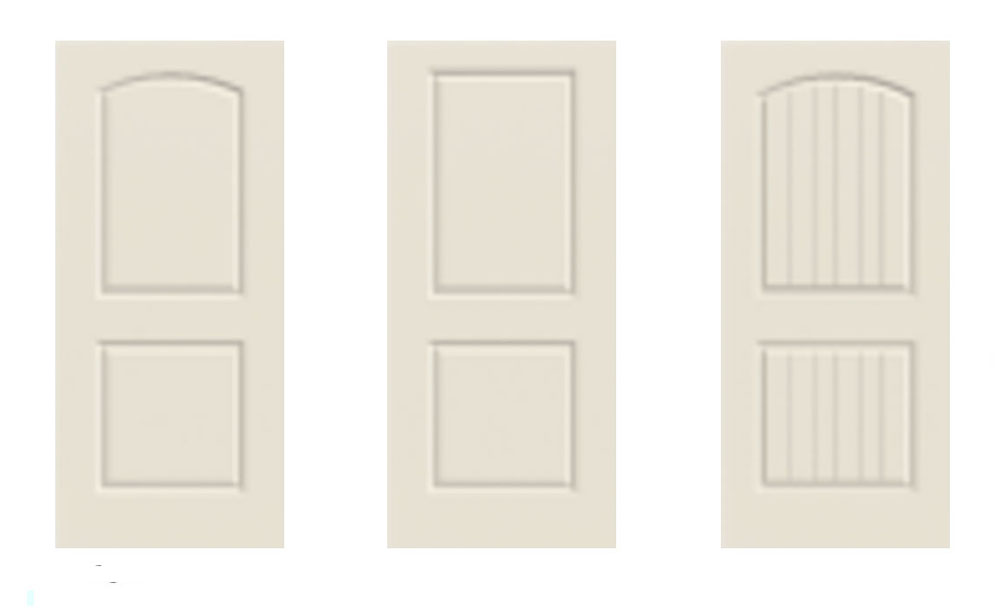 Make a Statement with Manufactured Home Interior Doors!
 -
 what is aluminum profile? Aluminum Profiles for Your Home is the best option
-
 Hospital Room Door Size by Room Type: Width and Clearance
 -
 Retrofit Manual Doors with Electronic Glass Operators
 -
 Hospital Emergency Exit Doors: 90 Minute Fire Rating Meets Infection Control
 -
 ICU and Isolation Door Requirements Hospitals Often Overlook
 -
 Laboratory Door Requirements for BSL-2 and BSL-3 Containment
 -
 Retrofitting Hospital Sliding Doors: Upgrade Wards Without a Rebuild
 -
 Why Airtight Hospital Sliding Doors Are Critical for Infection Control
 -
 Automatic cleanroom door systems: sensor, actuator and access control integration
 -
 Cleanroom Door Materials: Stainless Steel vs HPL vs FRP vs Aluminum Comparison
 -
 X-Ray Room Door Buying Guide: Lead Thickness & Compliance




-

Home
-

Tel
-

Email
-

Contact


Guangzhou Yizhong Aluminum Industry Co., Ltd.
We are always providing our customers with reliable products and considerate services.
We are always providing our customers with reliable products and considerate services.
Speak Your Mind