
How to Choose the Right HVAC Air Diffuser for Cleanrooms
Choosing the right cleanroom air diffuser is crucial for controlling environmental conditions, maintaining cleanliness levels, and ensuring efficient operation. This guide walks you through the entire selection process—from needs assessment to technical considerations—providing a clear, structured reference for industries such as pharmaceuticals, semiconductors, food processing, and healthcare. The content is concise, easy to navigate, and SEO-ready.
1. Define the Cleanroom Classification and Ventilation Requirements

1.1 Cleanroom Classification
According to ISO 14644-1, cleanrooms are classified by particle concentration.
- ISO Class 5 (Class 100) requires extremely low particle counts and is commonly used in semiconductor manufacturing.
- ISO Class 7 (Class 10,000) is more common in pharmaceuticals or food production.
Each classification sets specific requirements for diffuser filtration efficiency and airflow uniformity. Selection must be based on these standards.
1.2 Application-Specific Considerations
Different industries impose unique demands on cleanroom air diffusers:
- Pharmaceutical: Corrosion-resistant, easy-to-clean stainless steel diffusers, often paired with GMP-compliant cleanroom doors.
- Semiconductor: Ultra-stable airflow to prevent particle contamination.
- Food Processing: Compliance with hygiene standards—ceiling-mounted diffusers are recommended.
- Healthcare: Negative-pressure diffusers integrated with hermetic medical doors to prevent cross-contamination.
1.3 Airflow Pattern Selection
Airflow design influences diffuser performance:
- Laminar flow: Delivers vertical, uniform airflow—ideal for high-cleanliness environments.
- Turbulent flow: Mixes and dilutes air—common with linear slot diffusers for large spaces.
- Mixed flow: Combines both methods—often integrated with air grille systems.
1.4 Functional Requirements
Diffusers serve three main purposes:
- Supply: Introduce clean air into the space.
- Return: Enable air recirculation.
- Exhaust: Remove contaminated air.
The choice of ceiling diffusers—their type, quantity, and placement—must align with the overall ventilation system design.
2. Types of Cleanroom HVAC Air Diffusers: Laminar, Swirl, and HEPA Compared
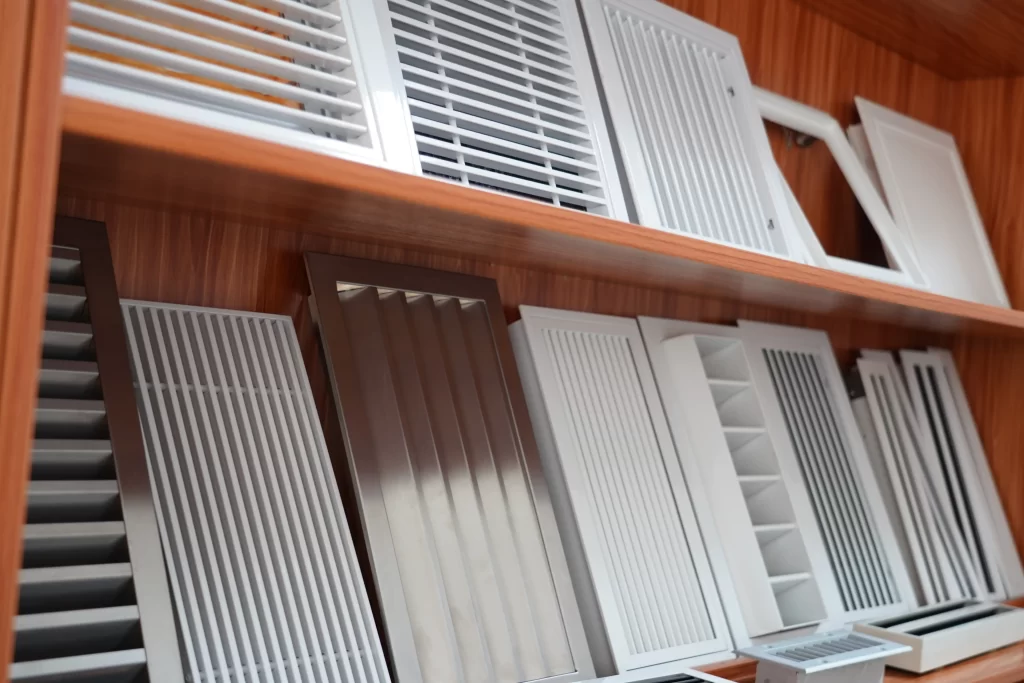
Below is a comparison of the most common types of cleanroom air diffusers, covering their advantages, disadvantages, and application scenarios.
2.1 Laminar Flow Diffusers
Ideal for unidirectional cleanrooms, these deliver uniform airflow and form the backbone of many systems.
- Pros: Excellent particle control, suitable for ISO Class 5.
- Cons: Higher cost, requires anodized aluminum frames, larger footprint.
- Applications: Semiconductor and precision manufacturing.
2.2 Swirl Diffusers
Generate a rotating air pattern for efficient mixing—suited to non-unidirectional spaces.
- Pros: Broad coverage, compatible with systems from cleanroom profile suppliers.
- Cons: May create localized turbulence.
- Applications: Food processing, general cleanrooms.
2.3 HEPA Filter Diffusers
Integrate high-efficiency filters capable of removing 99.97% of 0.3 μm particles.
- Pros: Exceptional cleanliness levels, meets strict particulate control.
- Cons: Higher maintenance, regular filter replacement required.
- Applications: Pharmaceuticals, healthcare facilities.
2.4 Perforated Plate Diffusers
Best for low-volume or localized supply applications.
- Pros: Easy to install, cost-effective.
- Cons: Limited airflow coverage.
- Applications: Small laboratory cleanrooms.
Comparison Table
| Diffuser Type | Airflow Pattern | Pros | Cons | Typical Applications |
|---|---|---|---|---|
| Laminar Flow | Unidirectional | Uniform airflow, top-level control | High cost, large size | Semiconductor, precision |
| Swirl | Non-unidirectional | Wide coverage, good mixing | Possible turbulence | Food, general cleanrooms |
| HEPA Filter | Uni/Mixed flow | High filtration efficiency | Costly maintenance | Pharma, medical |
| Perforated Plate | Local supply | Low cost, simple installation | Limited coverage | Small labs |
3. Material and Manufacturing Quality
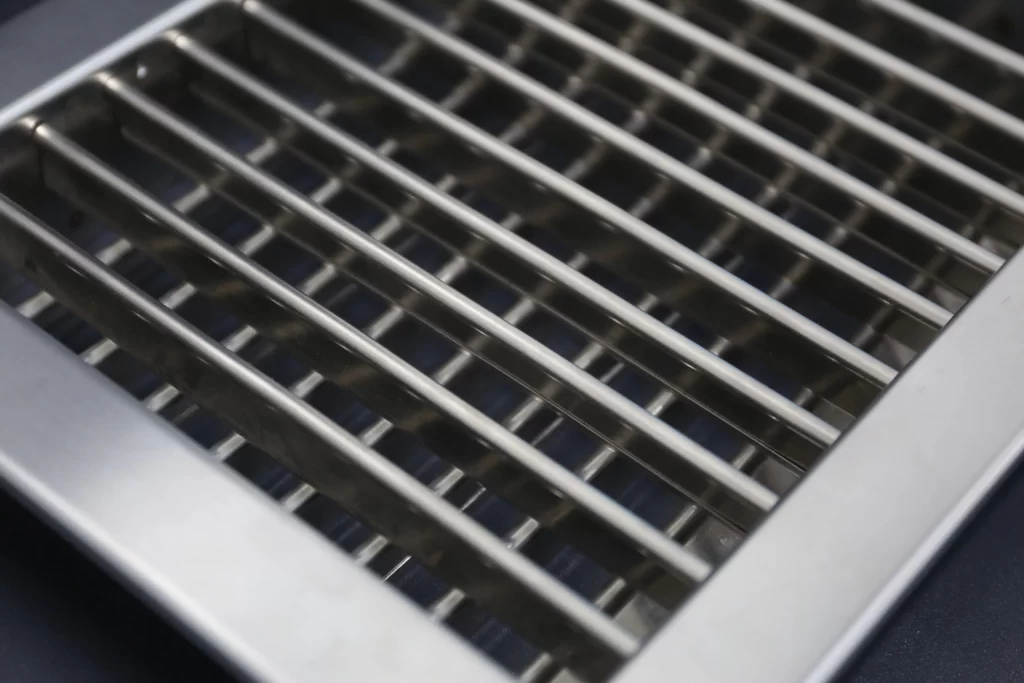
3.1 Material Selection
Material choice affects performance, compliance, and maintenance:
- Stainless Steel (304/316): Corrosion-resistant, easy to clean—ideal for GMP and food environments.
- Anodized Aluminum: Lightweight, economical—common for custom frames and cabinet unit profiles.
- Coated Steel: Must have robust coatings to prevent particle shedding.
3.2 Manufacturing Standards
Surfaces should be smooth and seamless to prevent particle buildup and bacterial growth. Seamless welding and polished finishes are standard for high-grade cleanroom profile supplier products.
3.3 Certification Compliance
Ensure the diffuser meets GMP or FDA standards, especially when paired with hermetic or automatic medical doors.
4. Key Performance Parameters
Performance metrics determine suitability:
- Airflow & Velocity: Must match air changes per hour (ACH)—e.g., ISO Class 5 requires 20–40 ACH.
- Pressure Drop: Keep below 50 Pa to reduce system energy use.
- Noise: Under 45 dB for comfort in sensitive environments like hospitals.
- Filtration Efficiency: HEPA or ULPA filters at ≥99.97%.
Performance Table
| Parameter | Recommended Value | Purpose |
|---|---|---|
| Airflow & ACH | 20–40 ACH | Uniform distribution |
| Pressure Drop | <50 Pa | Energy efficiency |
| Noise Level | <45 dB | Comfort |
| Filtration | ≥99.97% (HEPA/ULPA) | Particle control |
5. System Compatibility
5.1 Connection Type
Flanged or quick-connect joints must be airtight to prevent leakage.
5.2 Airflow Coordination
Match diffuser capacity with AHU output to avoid overloading or insufficient supply.
5.3 Pressure Balance
Maintain correct positive or negative pressure according to cleanroom type.
6. Environmental Control Considerations
6.1 Airflow Uniformity
Linear slot diffusers should avoid dead zones and turbulence.
6.2 Temperature & Humidity Control
E.g., pharmaceuticals often require 22 ± 2°C and 50 ± 10% RH.
6.3 Pressure Stability
Diffusers must maintain consistent supply to support pressure-controlled spaces.
6.4 Easy Cleaning
Quick-release designs reduce downtime and contamination risk.
7. Industry Standards & Certifications
- ISO 14644-1: Cleanroom classification.
- ASHRAE/IEST: HVAC design guidelines.
- NSF/UL: Product safety and quality assurance.
- cGMP: Regulatory compliance for pharma facilities.
8. Installation & Maintenance Ease
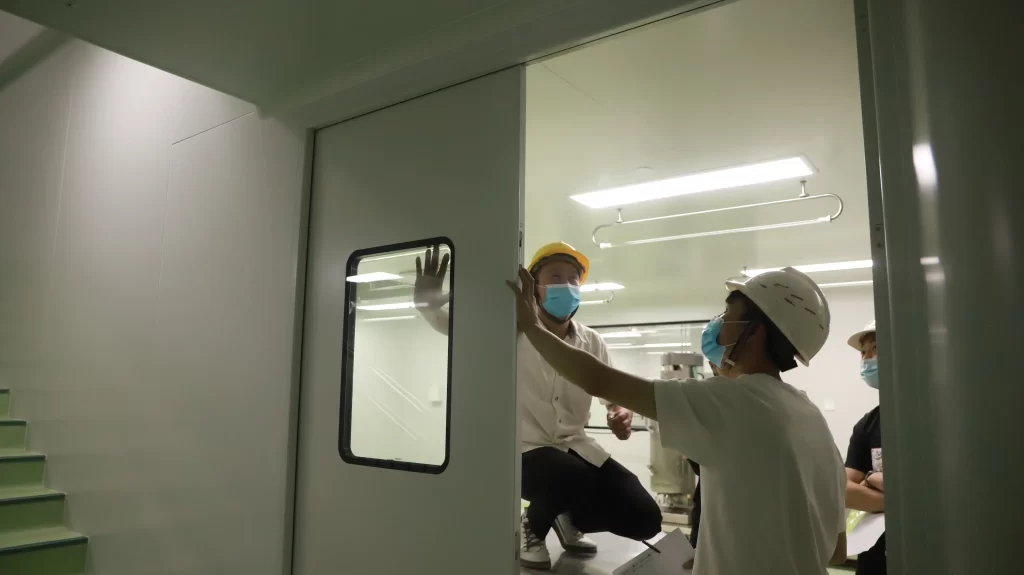
- Modular ceiling diffusers simplify installation.
- Replaceable-filter HEPA units reduce long-term costs (6–12 month cycle).
- Reliable spare parts supply is critical.
- Strong after-sales support from the manufacturer is essential.
9. Choosing a Manufacturer or Supplier
- Experience: Proven track record in cleanroom or HVAC diffuser projects.
- Product Comparison: Evaluate performance, pricing, and customization capabilities.
- Technical Documentation: Detailed reports and certifications for quality assurance.
- Customization: Flexibility for frames and profile designs.
10. Case Studies & Selection Tips
Case 1: Pharmaceutical Plant
A GMP facility achieved ISO Class 5 conditions with stainless steel HEPA diffusers, maintaining 30 ACH.
Case 2: Semiconductor Manufacturing
Laminar diffusers paired with ULPA filters kept particle sizes under 0.1 μm.
Common Mistakes
- Poor airflow design causing particle buildup.
- Incorrect material choice leading to contamination.
- Ignoring maintenance costs.
Selection Checklist
- Confirm ISO class and airflow type.
- Verify materials and certifications.
- Check performance specs and compatibility.
- Assess installation/maintenance requirements and manufacturer support.
11. FAQs
Q: How should I choose diffusers for non-standard cleanroom shapes?
Opt for suppliers offering custom aluminum frames and modular diffusers such as linear slot designs for curved or angled spaces. Conduct airflow modeling to prevent dead zones.
Q: What are the special requirements for high-humidity environments like food processing?
- Use 316L stainless steel for chloride resistance.
- Avoid porous materials to prevent microbial growth.
- Ensure diffuser surfaces have a slope ≥3° to prevent condensate pooling.
Q: How can I upgrade existing cleanroom diffusers without system conflicts?
- Test current AHU pressure–flow curves.
- Ensure new diffuser resistance ≤110% of the existing setup.
- Confirm fan static pressure can handle additional filter load.
- Use CFD simulations to validate airflow compatibility.
-
 Cleanroom Glass Windows Are The Key to Maintaining a Clean Environment
 -
 Top Aluminium Profile Manufacturers in China: Leading the Global Market
 -
 The Evolution of Air Tight Sliding Doors
 -
 AHU Aluminium Profile: A Comprehensive Guide
 -
 The Importance of Choosing the Right Cleanroom Door in Vietnam
 -
 The Benefits of Hospital Automatic Doors: Enhancing Efficiency and Safety
 -
.jpg) The Best Bathroom Door Manufacturers - Unlocking Endless Possibilities!
The Best Bathroom Door Manufacturers - Unlocking Endless Possibilities! -
 Unlock the Possibilities with AJ Manufacturing Doors
 -
 Make a Statement with Manufactured Home Interior Doors!
 -
 what is aluminum profile? Aluminum Profiles for Your Home is the best option
-
 How to Extend the Life of Your Exterior Steel Door
 -
 What Are the Best Materials for AC Vent Covers
 -
 Ceiling Vent Covers Labeled Fire-Rated? Here’s How to Verify
 -
 Upgrading Lab Doors: When to Replace vs. When to Retrofit?
 -
 Stainless Steel Door vs. Alternatives in Cleanrooms
 -
 Ceiling Vent Care Tips to Boost HVAC Efficiency Year Round
 -
 How Air Dampers Drive Efficiency in High Performance Buildings
 -
 Why Semiconductor Manufacturing Can’t Function Without Cleanrooms
 -
 How to Select the Right Floor Vent for Cleanrooms
 -
 How to Clean and Maintain AC Registers for Peak HVAC Performance





-

Home
-

Tel
-

Email
-

Contact


Guangzhou Yizhong Aluminum Industry Co., Ltd.
We are always providing our customers with reliable products and considerate services.
We are always providing our customers with reliable products and considerate services.
Speak Your Mind