
Cleanroom Doors: Mastering Leakage and Sealing Tech
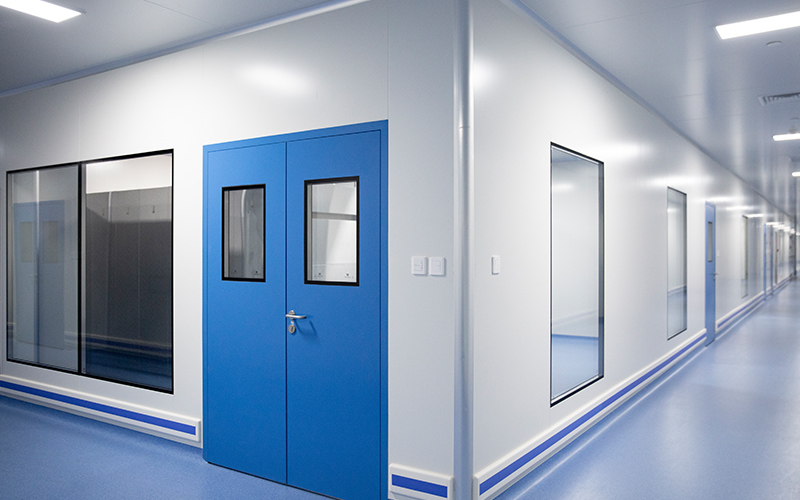
In today's demanding industrial and medical environments, the cleanroom door is a core barrier ensuring product quality, experimental precision, and patient safety. From semiconductor wafer fabrication to sterile pharmaceutical filling, from biosafety labs to hospital operating rooms, these doors maintain controlled environments by strictly managing airborne particles, microbes, and chemicals. Yet, within this intricate system, the cleanroom door is often the weakest link.
Hospital doors are more than just architectural partitions; they are lifelines for maintaining sterility and pressure differentials in critical areas like operating rooms, ICUs, and sterile wards. According to ISPE, over 30% of contamination incidents stem from door seal failures or improper operation. Even minor leaks can cause batch failures, data errors, or cross-contamination in high-stakes settings like hospital doors or pharmaceutical cleanrooms. With strict GMP, ISO 14644, and FDA cGMP standards, sealing performance—measured by leakage rates—is vital for compliance, pressure stability, and operational efficiency.
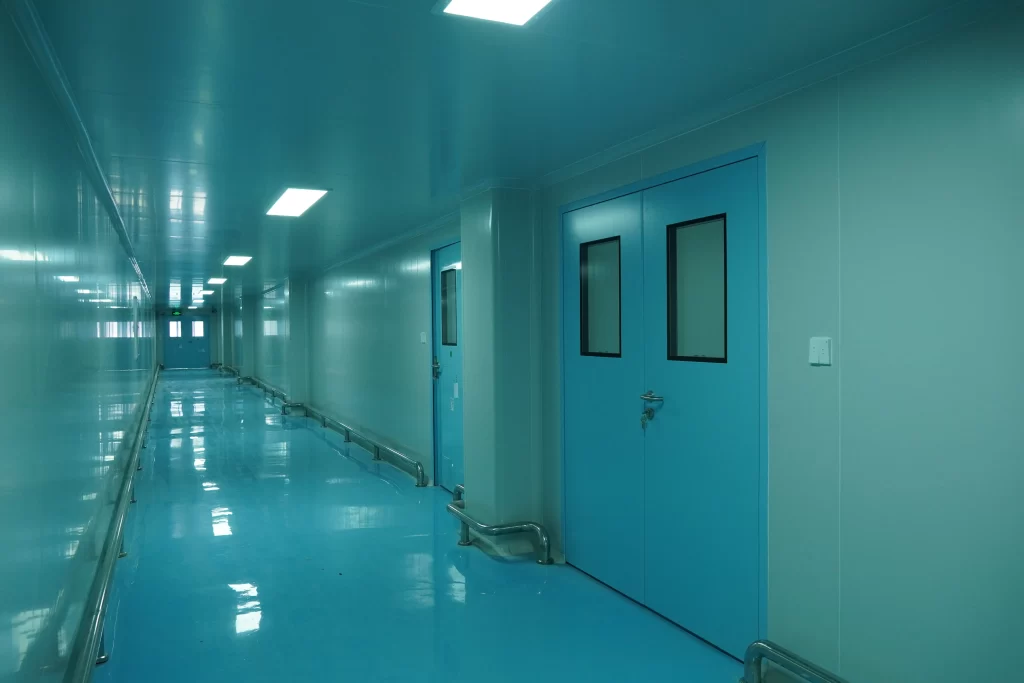
Why Cleanroom Door Sealing Matters: No Room for “Good Enough”
Maintaining Pressure Differentials
As the “movable interface” of a pressure boundary, a cleanroom door’s sealing performance is critical to maintaining stable pressure cascades. A single gap or aging seal can cause uncontrolled leakage, leading to pressure drops or reversals. Studies show that a single cleanroom door with a continuous 0.5 mm gap can leak up to 0.3 m³/h of air at a 15 Pa pressure differential—enough to disrupt localized airflow patterns.
Worse still, when multiple doors have minor leaks, the cumulative effect increases the load on HVAC systems, causing frequent fan cycling, higher energy costs, and potential pressure alarms that can halt production. In environments requiring precise cleanroom HVAC system control, proper sealing is foundational to operational efficiency.
Preventing Cross-Contamination
In pharmaceutical and biotech settings, cross-contamination is a top threat to product quality. A poorly sealed cleanroom door can become a pathway for particles, microbes, or active compounds. For instance, in high-potency active pharmaceutical ingredient (HPAPI) production, even trace amounts of drug dust escaping through door gaps can contaminate adjacent areas and pose health risks to personnel.
Per the Chinese Pharmacopoeia and EU GMP Annex 1, cleanroom particle concentrations must consistently meet ISO 14644-1 standards (e.g., ISO Class 5 limits particles ≥0.5 μm to 3,520 per m³). Any air leakage can introduce external contaminants, causing monitoring failures. This ties directly to the core mission of cleanroom environmental monitoring.
In sterile manufacturing, door leaks can also disrupt unidirectional airflow, exposing critical zones to contamination risks. FDA inspection reports frequently cite “inadequate cleanroom door sealing” as a cause of failed aseptic process simulations (Media Fills), an unacceptable risk for pharmaceutical cleanroom design and medical device cleanrooms.
Meeting Regulatory and Certification Standards
Cleanroom compliance isn’t just about daily operations—it requires periodic facility qualification and environmental monitoring to prove sustained control. GMP, ISO 14644-3 (Cleanroom Testing Methods), and IEC 614644-13 (Cleanroom Door Performance Testing) all set clear expectations for airtightness.
For example, EU GMP Annex 1 (2022) Section 8.30 states: “All containment structures, including cleanroom doors, windows, and penetrations, must have adequate sealing to maintain required pressure and cleanliness levels.” Similarly, FDA cGMP guidelines emphasize minimizing contamination and cross-contamination risks.
During certification, leakage testing is a standard part of facility commissioning, revalidation, and annual reviews. Failure to pass these tests can lead to costly remediation, production delays, or certification rejection. Selecting doors that meet certification requirements and establishing robust cleanroom validation services are critical to project success.
Understanding Cleanroom Door Leakage Rates: Definitions, Standards, and Testing
What Is a Leakage Rate?
The leakage rate is a key measure of sealing performance, defined as the volume of air leaking through door gaps per unit of time under a specific pressure differential, typically expressed in cubic meters per hour (m³/h) or cubic feet per minute (CFM).
More technical metrics include:
- Air Changes per Hour (ACH): The proportion of leaked air relative to the cleanroom’s volume.
- Equivalent Leakage Area (ELA): The effective area of a hypothetical circular hole (in mm²) representing the total leakage.
Leakage rates depend on factors like door construction, sealing materials, installation precision, and operational condition. Ideally, a closure achieves “airtight closure” with no detectable airflow under normal pressure conditions.
Industry Reference Standards
While there’s no universal mandatory standard for leakage rates, industry guidelines and company specifications offer benchmarks:
| CLEANROOM CLASS (ISO 14644-1) | MAX RECOMMENDED LEAKAGE RATE (@50 PA) | APPLICATION EXAMPLES |
|---|---|---|
| ISO Class 5 (Grade A) | ≤ 0.1 m³/h | Sterile filling, isolators |
| ISO Class 6–7 | ≤ 0.3 m³/h | Pharma intermediates, biotech |
| ISO Class 8 | ≤ 0.5 m³/h | General clean zones, packaging |
50 Pa is a standard test pressure, simulating the door’s performance under maximum differential conditions. High-risk areas, like Biosafety Level 3 labs, may require testing at higher pressures (e.g., 100 Pa) to ensure reliability in extreme scenarios.
These standards align with ISO 14644-1 cleanroom classifications. For instance, ISO 5 cleanrooms and ISO 7 cleanrooms have the strictest leakage requirements due to their tight particle control limits. Understanding ISO cleanroom classifications is key to grasping sealing expectations.
Common Testing Methods
1. Pressure Decay Test
This method suits highly sealed cleanrooms or confined spaces (e.g., pass-throughs, isolators). Steps include:
- Pressurize the cleanroom to a target (e.g., 50 Pa) using a blower.
- Shut off the blower and monitor the rate of pressure drop over time.
- Calculate the leakage rate based on the decay speed.
Pros: Simple, cost-effective. Cons: Sensitive to room volume and temperature fluctuations, less precise, best for overall leakage assessment.
2. Tracer Gas Testing
The most accurate and widely accepted method for leakage detection, used in GMP certifications and high-risk facilities. Common tracer gases include sulfur hexafluoride (SF₆), isobutylene, or helium.
Process:
- Release a known concentration of tracer gas inside the cleanroom.
- Use a high-sensitivity gas analyzer (detecting down to ppb levels) to sample air near door gaps or adjacent areas.
- Calculate gas leakage over time to estimate air leakage rate.
Per ISO 14644-3, tracer gas testing achieves ±10% accuracy, making it the “gold standard” for sealing validation. This method is typically offered by professional cleanroom testing services or certification providers.
3. Smoke Testing
Using a smoke generator to release non-toxic vapor (e.g., propylene glycol mist), this method visualizes airflow direction and leakage paths near cleanroom door gaps. It’s primarily for qualitative detection, not quantifying leakage rates, but is useful for quick inspections and installation checks.
Key Factors Affecting Sealing Performance
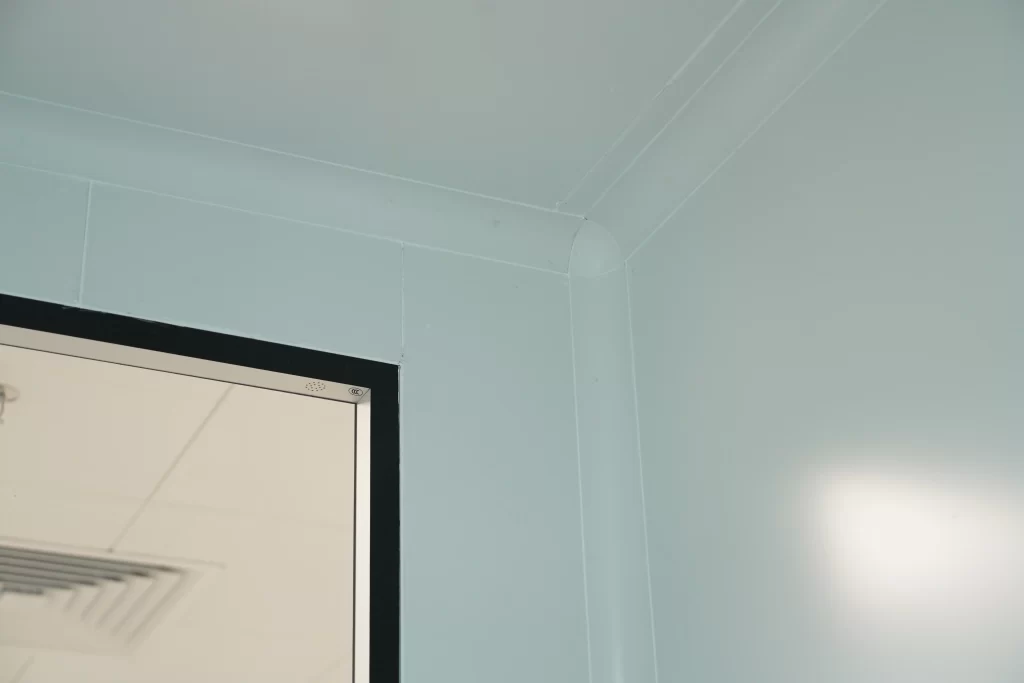
Door Construction Design
The structural design of a cleanroom door directly impacts its airtightness. Common types include:
- Fully Welded Stainless Steel Doors: Made from 304 or 316L stainless steel with seamless welding, these offer smooth, easy-to-clean surfaces ideal for high-cleanliness zones.
- Framed Doors: Assembled from aluminum or stainless steel frames with PC/acrylic panels, these are cost-effective but prone to micro-gaps at joints, requiring high-quality seals to compensate.
The door frame’s integration with the wall is equally critical. Flush-mounted installation, with the frame embedded 50–100 mm into the wall and sealed with cleanroom-grade silicone caulk, prevents “bypass” leakage. This ties into the design of cleanroom wall panels and wall systems.
Sealing Material Selection
Sealing gaskets are the heart of a cleanroom door’s airtight closure. Material properties vary significantly in compression recovery, temperature resistance, chemical compatibility, and particle shedding.
| MATERIAL TYPE | HARDNESS (SHORE A) | OPERATING TEMP RANGE | CHEMICAL RESISTANCE | CLEANROOM SUITABILI |
|---|---|---|---|---|
| Silicone | 40–60 | -60°C to +200°C | Excellent | High, low particle release |
| EPDM Rubber | 50–70 | -40°C to +130°C | Good | Moderate, requires testing |
| PVC Foam | 20–30 | -10°C to +60°C | Poor | Low, prone to aging |
Compression set (permanent deformation after compression) is a critical metric for gasket longevity. High-quality silicone gaskets should have a compression set below 20% after 22 hours at 70°C, ensuring reliable rebound over time.
Door Type and Opening Mechanism
The opening mechanism affects sealing consistency:
- Automatic Sliding Doors: Motor-driven horizontal sliding ensures consistent gasket compression via guide rails, ideal for high-traffic areas.
- Pneumatic Doors: Inflatable gaskets activate post-closure, applying dynamic pressure to the frame for the lowest leakage rates.
- Manual Hinged Doors: Rely on operator force, leading to inconsistent closure and potential “partial shut” issues, not recommended for ISO Class 5 or higher.
Cleanroom roller or high-speed doors, while fast, typically offer lower sealing performance and are better suited for logistics areas with less stringent cleanliness requirements.
Installation and Maintenance Quality
Even high-performance doors can fail due to installation errors. Common issues include:
- Uneven door frames or walls, causing uneven gasket pressure.
- Improperly installed or overstretched gaskets, reducing rebound.
- Unsealed gaps between the frame and wall.
Over time, gaskets degrade due to UV exposure, cleaning agents, or mechanical wear. A regular maintenance schedule—checking seals every 3 months and replacing them annually in high-risk areas—is essential. This aligns with broader cleanroom maintenance strategies.
Advanced Sealing Technologies
Double Sealing Systems
In high-risk cleanrooms, single seals are often insufficient. Double sealing systems use dual independent layers for redundancy:
- An outer dynamic seal compresses upon closure.
- An inner static seal connects the frame to the wall, preventing bypass leakage.
Used in isolators, RABS (Restricted Access Barrier Systems), and high-potency drug areas, these systems reduce leakage to one-fifth of standard doors.
Magnetic Gasket Doors
Magnetic strips embedded in the gasket adhere to a metal frame, eliminating mechanical friction. Benefits include:
- Frictionless closure, minimizing wear.
- Uniform sealing without localized stress.
- Easy-to-clean surfaces with no dead zones.
Magnetic seals provide 20–30 N/m of closing force, sufficient for 50 Pa differentials, and support frequent opening/closing cycles.
Inflatable Seals
Embedded rubber bladders in the frame inflate with compressed air (0.3–0.6 MPa) after closure, filling all gaps. Leakage rates can drop to 0.01 m³/h @ 50 Pa, approaching “zero leakage.” Ideal for nuclear medicine, high-potency compounds, and biosafety labs, though they require complex gas and control systems.
Integrated Access and Interlock Systems
Modern doors often incorporate electronic access controls, pressure sensors, and interlock logic to prevent simultaneous door openings, avoiding “air shower short-circuits” or pressure collapses. Some systems include real-time door status monitoring and alarms for smarter management.
How to Assess and Improve Your Cleanroom Door Sealing

Self-Inspection Checklist
Conduct quarterly checks on cleanroom door sealing performance:
- Are gaskets hardened, cracked, or peeling?
- Are there visible gaps or “play” when the door is closed?
- Do automatic doors close fully without unusual noises?
- Is the pressure differential stable, or does it fluctuate frequently?
Maintenance and Upgrade Recommendations
- Short-Term Fixes: Clean gaskets with neutral detergents, adjust hinges or tracks for tighter closure.
- Mid-Term Upgrades: Replace aging gaskets with silicone, add automatic door-bottom seals.
- Long-Term Investments: Swap manual doors for automatic sliders or adopt magnetic/inflatable sealing for superior performance.
For new cleanroom design and construction or renovation projects, prioritize high-performance doors as standard. When selecting cleanroom manufacturers or contractors, ensure they provide ISO-compliant cleanroom door solutions.
Case Study: Door Seal Failure Causes Batch Contamination
A Chinese biopharma company found persistent particle concentration exceedances during annual Grade C cleanroom monitoring. Investigation traced the issue to an aging hinged door between the gowning room and cleanroom. After 5 years, the gasket’s compression recovery dropped to 45%, with a leakage rate of 0.8 m³/h @ 15 Pa—far above acceptable limits.
The leakage destabilized pressure, allowing external particles to enter and causing a sterile batch to fail particle testing, resulting in over $100,000 in losses. The company upgraded to a stainless steel automatic sliding door with dual silicone seals and regular SF₆ testing, improving pressure stability by 90% and passing 12 consecutive months of environmental monitoring.
Conclusion: Sealing Isn’t Just “On or Off”—It’s About Excellence
In high-stakes cleanroom environments, sealing isn’t a binary issue—it’s a matter of continuous optimization. These doors are not just barriers but integral components of cleanroom system engineering.
From design and selection to installation and validation, from daily maintenance to periodic testing, every step impacts sealing performance. Investing in high-performance doors isn’t just about compliance—it’s a strategic move to ensure product quality, boost efficiency, and mitigate risks.
Incorporate sealing performance into your annual facility validation plan, using tracer gas testing and pressure monitoring to build a robust evaluation system. Whether for pharmaceutical cleanrooms, semiconductor cleanrooms, or medical device cleanrooms, exceptional door sealing is the cornerstone of reliable, sustainable operations.
-
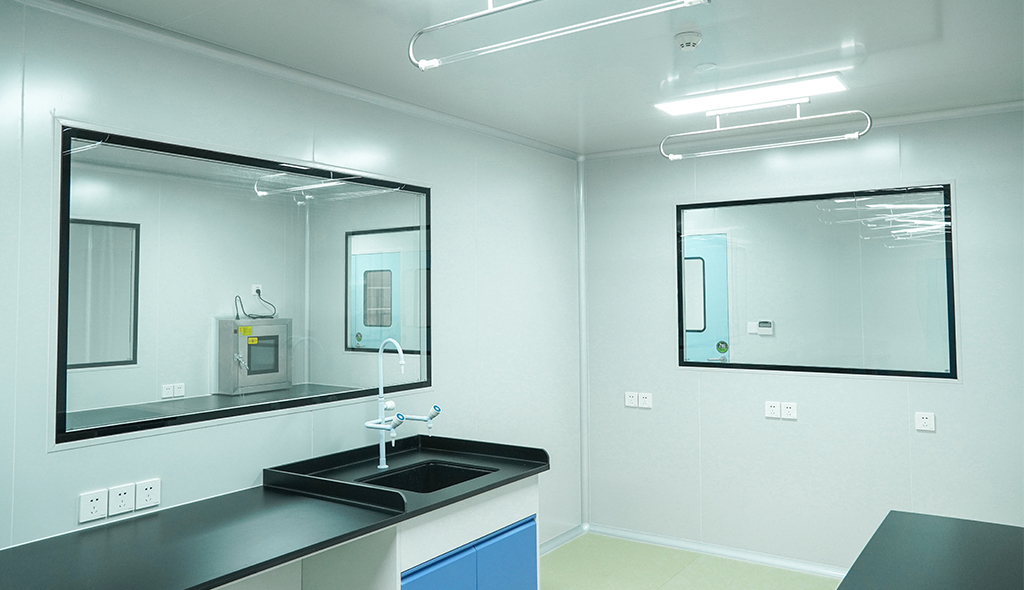 Cleanroom Glass Windows Are The Key to Maintaining a Clean Environment
 -
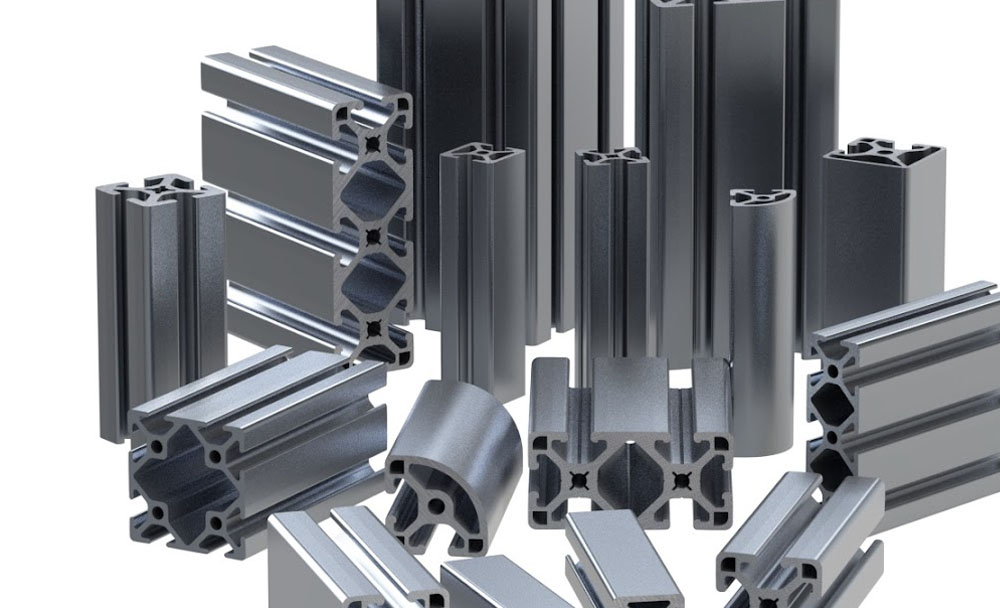 Top Aluminium Profile Manufacturers in China: Leading the Global Market
 -
 The Evolution of Air Tight Sliding Doors
 -
 AHU Aluminium Profile: A Comprehensive Guide
 -
 The Importance of Choosing the Right Cleanroom Door in Vietnam
 -
 The Benefits of Hospital Automatic Doors: Enhancing Efficiency and Safety
 -
.jpg) The Best Bathroom Door Manufacturers - Unlocking Endless Possibilities!
The Best Bathroom Door Manufacturers - Unlocking Endless Possibilities! -
 Unlock the Possibilities with AJ Manufacturing Doors
 -
 Make a Statement with Manufactured Home Interior Doors!
 -
 what is aluminum profile? Aluminum Profiles for Your Home is the best option
-
 What Is a Return Air Vent and Why Does It Matter in HVAC
 -
 Top Materials for Durable Pharma Clean Room Doors
 -
 Hospital Cleanroom Door Design Requirements
 -
 Swing Doors vs Standard Doors: Which Is Right for Your Facility
 -
 Cleanroom Door Materials Explained: Key Types and Applications
 -
 How Do Different Vent Grills Impact Medical Cleanrooms
 -
 Controlled Environment vs Air Clean Room Differences Explained
 -
 How to Extend the Life of Your Exterior Steel Door
 -
 What Are the Best Materials for AC Vent Covers
 -
 Ceiling Vent Covers Labeled Fire-Rated? Here’s How to Verify

-

Home
-

Tel
-

Email
-

Contact


Guangzhou Yizhong Aluminum Industry Co., Ltd.
We are always providing our customers with reliable products and considerate services.
We are always providing our customers with reliable products and considerate services.
Speak Your Mind